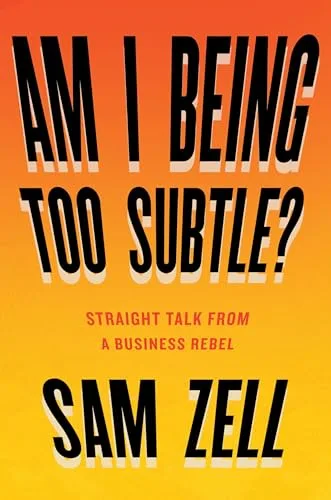
Am I Being Too Subtle?
Straight Talk From a Business Rebel
by Sam Zell
- Published
- 2017
- Pages
- 240 pages
- Publisher
- Portfolio
- Readers
- 3 members have read this
Sam Zell's blunt memoir of five decades buying what others were dumping: distressed property after the 1970s bust, rail cars, manufactured home communities, and the office empire he sold for $39 billion in 2007. It is a working lesson in downside analysis, replacement cost and contrarian timing, and it does not dodge the Tribune deal that went bankrupt.
Zell, who died in 2023, built Equity Group Investments in Chicago, helped create the modern REIT industry and earned the nickname Grave Dancer for buying troubled real estate after crashes. His record includes both the $39 billion sale of Equity Office Properties and the Tribune Company buyout that went bankrupt a year later.
The book is part memoir, part manual. Zell explains how he reads risk: he wants to know the worst case before the upside, prefers deals with little competition, leans on non-recourse debt, and judges an asset against what it would cost to build. He also writes about running his firm as a meritocracy, about the importance of a good name, and about not taking himself too seriously.
The value-investing blog Value and Opportunity read it as the record of a Graham-style deep value investor, and noted that he discusses his misses as well as his wins. The Wall Street Journal called him notoriously blunt. He owns up to a few personal failings, but the book is mostly a record of deals. The same blog also pointed out that several of his listed non-property holdings, such as Covanta and Anixter, lagged the market over the prior decade.
It is the best first-person account of how a real estate cycle investor thinks, and it is useful to anyone in real estate, distressed debt or private equity who has to decide when the crowd is wrong.
- Start with the downside. Zell estimated the worst plausible outcome first and only pursued deals he could survive in that case, rather than anchoring on the best case.
- Go where the competition isn't. Many of his best buys came in markets or industries others had abandoned, from overbuilt offices to rail cars, where he could set the price.
- Replacement cost is a margin of safety. Buying real assets well below what they would cost to build gave him room to be wrong about timing.
- Sell into the frenzy. The $39 billion Equity Office sale in early 2007 shows the other half of cycle investing: recognizing when buyers are paying peak prices and taking them.
- Leave something on the table. Zell argues that reputation and repeat counterparties are worth more than squeezing the last dollar from a negotiation, and that long relationships produced his deal flow.
After an introduction titled No B.S., the book runs roughly chronologically, then closes with the philosophies behind the deals.
- An impossible life. Zell opens with his parents' escape from Poland in 1939, one day before the German invasion, and their route through Lithuania, Russia and Japan to the United States, a story he credits with shaping his drive.
- Early hustle. He describes his first ventures, from reselling magazines as a boy to managing apartment buildings as a University of Michigan student and then buying apartment buildings of his own after graduating.
- Grave Dancer. He explains how he bought distressed real estate after the 1970s collapse and later a glut of overbuilt offices, and why he bought rail cars when that industry was crumbling before branching into energy and manufacturing.
- The big trades. He recounts building and selling Equity Office for $39 billion in 2007, and the $8 billion Tribune privatization that closed into the Great Recession and filed for bankruptcy a year later.
- How he works. The last chapters cover his firm's culture and the rules he lives by: readiness to pivot, simplicity, keeping an open mind, loyalty, reputation and not taking yourself too seriously.
The traits that make Sam Zell one of the world’s most successful entrepreneurs also make him one of the most surprising, enigmatic, and entertaining mavericks in American business. Self-made billionaire Sam Zell consistently sees what others don’t. From finding a market for overpriced Playboy magazines among his junior high classmates, to buying real estate on the cheap after a market crash, to investing in often unglamorous industries with long-term value, Zell acts boldly on supply and demand trends to grab the first-mover advantage. And he can find opportunity virtually anywhere—from an arcane piece of legislation to a desert meeting in Abu Dhabi. If everyone is going left, look right,” Zell often says. To him, conventional wisdom is nothing but a reference point. Year after year, deal after deal, he shuts out the noise of the crowd, gathers as much information as possible, then trusts his own instincts. He credits much of his independent thinking to his parents, who were Jewish refugees from World War II. Talk to any two people and you might get wild swings in their descriptions of Zell. A media firestorm ensued when the Tribune Company went into bankruptcy a year after he agreed to steward the enterprise. At the same time, his razor-sharp instincts are legendary on Wall Street, and he has sponsored over a dozen IPOs. He’s known as the Grave Dancer for his strategy of targeting troubled assets, yet he’s created thousands of jobs. Within his own organization, he has an inordinate number of employees at every level who are fiercely loyal and have worked for him for decades. Zell’s got a big personality; he is often contrarian, blunt, and irreverent, and always curious and hardworking. This is the guy who started wearing jeans to work in the 1960s, when offices were a sea of gray suits. He’s the guy who told The Wall Street Journal in 1985, If it ain’t fun, we don’t do it.” He rides motorcycles with his friends, the Zell’s Angels, around the world and he keeps ducks on the deck outside his office. As he writes: I simply don’t buy into many of the made-up rules of social convention. The bottom line is: If you’re really good at what you do, you have the freedom to be who you really are.” Am I Being Too Subtle?—a reference to Zell’s favorite way to underscore a point—takes readers on a ride across his business terrain, sharing with honesty and humor stories of the times he got it right, when he didn’t, and most important, what he learned in the process. This is an indispensable guide for the next generation of disrupters, entrepreneurs, and investors.
Reader reviews
No reviews yet. Join to write the first one.