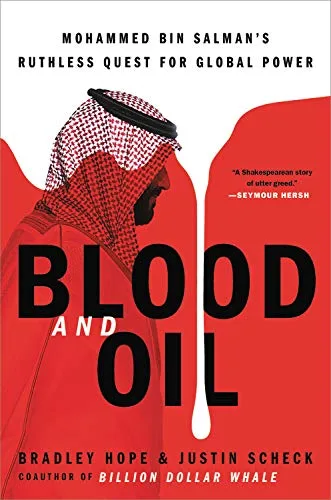
Blood and Oil
Mohammed bin Salman's Ruthless Quest for Global Power
by Bradley Hope and Justin Scheck
- Published
- 2020
- Pages
- 368 pages
- Publisher
- Hachette Books
- Readers
- 1 member has read this
Two Wall Street Journal reporters trace how Mohammed bin Salman went from a little-known prince to the ruler of Saudi Arabia's economy, its oil company and its sovereign wealth fund. The story of Vision 2030, the Aramco listing, the Ritz-Carlton detentions and the Khashoggi killing, and of the bankers, consultants and investors who courted him.
Bradley Hope, coauthor of Billion Dollar Whale about the 1MDB scandal, and Justin Scheck covered the kingdom for The Wall Street Journal and built this book on that reporting. Its subject is King Salman's son Mohammed, who went within a few years from a young prince with little standing to control of Saudi Aramco, the Public Investment Fund and Vision 2030, a plan to wean the kingdom off oil. Kirkus noted that it is less a personal biography than a study of the prince's economic project, and praised its research.
For finance readers, the book shows how state capital gets deployed and what it costs to take it. Western executives, banks and consultancies lined up to help, drawn by the money he promised to invest. The book covers the plan to list Aramco and the doubts about its valuation, and how the Ritz-Carlton detentions and the murder of Washington Post columnist Jamal Khashoggi forced bankers and Silicon Valley partners to decide whether to keep doing business with the kingdom.
It was longlisted for the Financial Times and McKinsey Business Book of the Year. Kirkus, Booklist and Library Journal gave it starred reviews, though Kirkus and Booklist both noted that his project was still unfinished. Read it before taking Gulf money, or to understand one of the largest pools of investable capital in the world.
- State capital has strings. The Public Investment Fund's investments in Western companies came with a ruler's priorities attached, and the Khashoggi killing turned those ties into a reputational problem for partners.
- Valuation follows power. The prince's push to list Aramco at the valuation he wanted shows how a political target can shape an IPO, and why outside investors were skeptical.
- Property rights are political. The Ritz-Carlton detentions, in which wealthy Saudis surrendered assets to secure release, show what investors face where the rule of law depends on one person.
- Consultants and bankers enable. Western firms helped build Vision 2030 and its deals, and the book shows how fees and access kept them close despite growing risks.
- Legitimacy can be bought, for a while. Investment funds, giant development projects and the Aramco listing won the prince standing with global elites and the Trump administration, until the Khashoggi killing showed how quickly that standing could turn.
The book follows Mohammed bin Salman's rise chronologically, from the royal court of the early 2010s to the aftermath of the Khashoggi killing.
- A prince in waiting. The authors describe the Al Saud family's succession system and Salman's years as governor of Riyadh, and how his ambitious son positioned himself close to his father.
- Taking power. After Salman becomes king in 2015, his son becomes defense minister, starts the war in Yemen, gains control of economic policy and later replaces his cousin Mohammed bin Nayef as crown prince.
- The reform pitch. With help from consultants, the crown prince unveils Vision 2030, promises an Aramco listing, lifts the ban on women driving and courts investors, bankers and tech executives in Riyadh and on tours of the US.
- Consolidation by force. In 2017 he detains hundreds of princes and businessmen at the Ritz-Carlton, silences critics and pursues dissidents abroad while a record sum is paid for a painting attributed to Leonardo da Vinci.
- Khashoggi and after. The killing of Jamal Khashoggi in Istanbul in October 2018 isolates him for a time, tests his Western partners and leaves open whether his transformation of the kingdom will succeed.
From award-winning Wall Street Journal reporters Justin Scheck and Bradley Hope (coauthor of Billion Dollar Whale), this revelatory look at the world's most powerful ruling family reveals how a rift within Saudi Arabian royalty produced Crown Prince Mohammed bin Salman, a charismatic leader with a ruthless streak. Thirty-five-year-old Mohammed bin Salman's sudden rise stunned the world. Political and business leaders such as former UK prime minister Tony Blair and WME chairman Ari Emanuel flew out to meet with the crown prince and came away convinced that his desire to reform the kingdom was sincere. He spoke passionately about bringing women into the workforce and toning down Saudi Arabia's restrictive Islamic law. He lifted the ban on women driving and explored investments in Silicon Valley. But MBS began to betray an erratic interior beneath the polish laid on by scores of consultants and public relations experts like McKinsey & Company. The allegations of his extreme brutality and excess began to slip out, including that he ordered the assassination of Washington Post journalist Jamal Khashoggi. While stamping out dissent by holding three hundred people, including prominent members of the Saudi royal family, in the Ritz-Carlton hotel and elsewhere for months, he continued to exhibit his extreme wealth, including buying a $70 million chateau in Europe and one of the world's most expensive yachts. It seemed that he did not understand nor care about how the outside world would react to his displays of autocratic muscle-what mattered was the flex. Blood and Oil is a gripping work of investigative journalism about one of the world's most decisive and dangerous new leaders. Hope and Scheck show how MBS's precipitous rise coincided with the fraying of the simple bargain that had been at the head of U.S.-Saudi relations for more than eighty years: oil in exchange for military protection. Caught in his net are well-known US bankers, Hollywood figures, and politicians, all eager to help the charming and crafty crown prince. The Middle East is already a volatile region. Add to the mix an ambitious prince with extraordinary powers, hunger for lucre, a tight relationship with the White House through President Trump's son in law Jared Kushner, and an apparent willingness to break anything -- and anyone -- that gets in the way of his vision, and the stakes of his rise are bracing. If his bid fails, Saudi Arabia has the potential to become an unstable failed state and a magnet for Islamic extremists. And if his bid to transform his country succeeds, even in part, it will have reverberations around the world.
Reader reviews
No reviews yet. Join to write the first one.