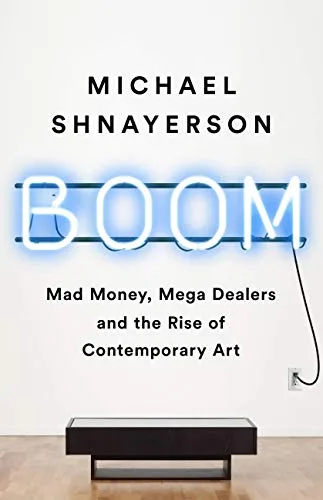
Boom
Mad Money, Mega Dealers, and the Rise of Contemporary Art
- Published
- 2019
- Pages
- 480 pages
- Publisher
- PublicAffairs
- Readers
- 1 member has read this
A Vanity Fair writer's history of how a few dealers turned contemporary art from a postwar backwater into a global, lightly regulated market for the very rich. Read it to see how pricing works when there is no exchange: dealers make the market, auctions set the marks, and the trading mostly happens in private.
Contemporary art has no exchange, no disclosure rules and few public prices, yet it now trades like an asset class for billionaires. Michael Shnayerson tells how that happened through the dealers who built the market. His argument is that sometime in the late 1990s the art world turned into an art market, and that dealers were the ones who made it happen.
Shnayerson spent three decades as a Vanity Fair contributing editor and has written biographies of Irwin Shaw and Andrew Cuomo. For this book he interviewed Larry Gagosian, David Zwirner, Iwan Wirth and Arne Glimcher, along with many other dealers, collectors and critics, and that access gives the book its texture.
Kirkus gave it a starred review and credited its grasp of the money side. Publishers Weekly called it an entertaining business history. Other reviewers note its limits. It reads more like a long magazine feature or a group biography than economic analysis, it is dense, and Shnayerson rarely passes judgment on the people he profiles. The Christian Science Monitor found some anecdotes throwaway but the business insights strong. Readers who want art criticism will not find it here.
Read it if you advise wealthy clients, lend against collectibles or are curious how prices form in an opaque, dealer-made market. Don Thompson's The $12 Million Stuffed Shark works well as a companion.
- Dealers make the market. With no exchange, value rests on what a dealer can persuade collectors and museums to believe. Gagosian himself describes it as an act of collective faith, and a dealer's support is the closest thing an artist's market has to a bid.
- Auctions are the visible marks. Since the 1973 Scull sale, auction results have been the public reference prices for an asset that mostly changes hands privately, so a few sales can reprice an artist's whole body of work.
- The secondary market is where the money is. Gagosian rose by reselling works already in collections rather than nurturing new artists. That model of finding inventory, matching buyers and taking a cut looks more like brokerage than patronage.
- Financialization came late and fast. Jeffrey Deitch pitched art advice to bank clients in the 1980s, but Shnayerson dates the real shift to the late 1990s. Bank lending against art and tax-free storage in free ports then turned art into an asset class, and the slack rules that make it attractive also make it useful for money laundering.
- Scale wins, and the pipeline suffers. The four mega galleries take artists that smaller dealers developed once those artists start to sell. Rents and art fair costs squeeze the mid-size galleries that find new talent, which concentrates the market further.
The book runs in rough chronological order, from a handful of struggling galleries in the 1940s to a global trade run by four firms.
- The New York school, 1940s and 1950s. Peggy Guggenheim shows Jackson Pollock at Art of This Century on West 57th Street and then hands her artists to Betty Parsons. Parsons and Sidney Janis carry the Abstract Expressionists as the avant-garde moves from Paris to New York.
- The Castelli model. From 1957 Leo Castelli backs Rauschenberg, Johns, Lichtenstein and Warhol. He pays artists stipends and builds a network of allied dealers across the country and abroad. The 1973 auction of taxi owner Robert Scull's collection shows that a resale price can far exceed what the artist was paid, and makes the auction result a public benchmark for value.
- SoHo and the 1980s. Paula Cooper, Mary Boone and others turn SoHo into the center of the trade. Gagosian, a former poster seller in Los Angeles, breaks in through the secondary market, reselling works from collectors, and then poaches artists from rivals.
- Recession and consolidation. The early 1990s slump pushes dealers toward estates and joint deals with auction houses. After Castelli's death in 1999, the auction houses move into private sales, banks lend against collections, and Chelsea and the art fairs take over.
- The mega dealers. Profiles of Gagosian, Zwirner, Hauser & Wirth and Pace show their global galleries, rivalries and succession questions. The book ends with free ports, money-laundering risk and mid-size galleries squeezed by the big four.
The meteoric rise of the largest unregulated financial market in the world-for contemporary art-is driven by a few passionate, guileful, and very hard-nosed dealers. They can make and break careers and fortunes. The contemporary art market is an international juggernaut, throwing off multimillion-dollar deals as wealthy buyers move from fair to fair, auction to auction, party to glittering party. But none of it would happen without the dealers-the tastemakers who back emerging artists and steer them to success, often to see them picked off by a rival. Dealers operate within a private world of handshake agreements, negotiating for the highest commissions. Michael Shnayerson, a longtime contributing editor to Vanity Fair, writes the first ever definitive history of their activities. He has spoken to all of today's so-called mega dealers-Larry Gagosian, David Zwirner, Arne and Marc Glimcher, and Iwan Wirth-along with dozens of other dealers-from Irving Blum to Gavin Brown-who worked with the greatest artists of their times: Jackson Pollock, Andy Warhol, Cy Twombly, and more. This kaleidoscopic history begins in the mid-1940s in genteel poverty with a scattering of galleries in midtown Manhattan, takes us through the ramshackle 1950s studios of Coenties Slip, the hipster locations in SoHo and Chelsea, London's Bond Street, and across the terraces of Art Basel until today. Now, dealers and auctioneers are seeking the first billion-dollar painting. It hasn't happened yet, but they are confident they can push the price there soon.
Reader reviews
No reviews yet. Join to write the first one.