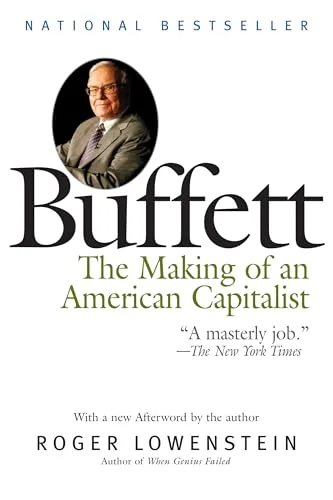
Buffett
The Making of an American Capitalist
- Published
- 1995
- Pages
- 512 pages
- Publisher
- Random House Trade Paperbacks
- Readers
- 2 members have read this
Former Wall Street Journal reporter Roger Lowenstein's biography follows Warren Buffett from his Omaha boyhood and his studies under Benjamin Graham to his partnerships, Berkshire Hathaway and the Salomon Brothers crisis. It is still the best single account of how Buffett's investing philosophy took shape and how it reflects the man, and it remains readable three decades on.
Roger Lowenstein reported for The Wall Street Journal for more than a decade before writing this, his first book, published in 1995. He went on to write When Genius Failed, about Long-Term Capital Management, and The End of Wall Street. Buffett did not cooperate with the project, but he did not stand in its way, and Lowenstein spent three years interviewing Buffett's family, friends, partners and colleagues and working through the public record.
The result is a full biography rather than an investing manual, though it explains the method clearly: how Buffett absorbed Graham's discipline of buying below intrinsic value, then moved beyond it toward great businesses held for the long term. Kirkus called it a blue-chip biography and noted that it does not skip Buffett's few big errors, including the investment in Salomon Brothers, or his unconventional private life. The New York Times Book Review called it masterly.
The obvious limit is its age. The story stops in the mid-1990s, before the dot-com years, the 2008 crisis and Buffett's giving pledge. Alice Schroeder's authorized biography The Snowball (2008) covers the later decades with Buffett's cooperation. Lowenstein's shorter book stays more focused on how Buffett actually made his money.
It suits any investor who wants to understand Buffett's thinking in the context of his life.
- Temperament beats intellect. Buffett's edge came from patience and independence of mind as much as from analysis. He was willing to do nothing for long stretches and to act alone when others were afraid.
- Graham was the start, not the end. Buffett began with Graham's cheap-stock methods and moved toward great businesses at fair prices, a change the book traces to Munger and to experience.
- Know when to step back. Closing the partnerships when bargains disappeared shows the discipline to stop rather than lower standards.
- Insurance float is a funding engine. Berkshire's insurance businesses supplied low-cost capital for decades of investment, the structural key to its growth.
- Reputation is an asset. The Salomon episode shows Buffett putting his own credibility on the line to rescue a firm, and the lengths he would go to protect his name.
The book follows Buffett's life in chronological order, with the investing ideas introduced as he develops them.
- Omaha origins. Buffett grows up the son of a stockbroker and Republican congressman, running small businesses and studying the stock market from childhood.
- Graham's student. At Columbia's business school he studies under Benjamin Graham, later works for Graham's firm, and absorbs the doctrine of buying securities for less than they are worth.
- The partnerships. Back in Omaha, Buffett runs investment partnerships for friends and family with outstanding results, takes control of the textile maker Berkshire Hathaway, and closes the partnerships at the end of the 1960s when he can no longer find bargains.
- Building Berkshire. Influenced by Charlie Munger, he shifts toward quality businesses held for the long term, building Berkshire through insurance and large stakes in companies such as the Washington Post, GEICO, Capital Cities/ABC and Coca-Cola.
- Salomon and fame. The Salomon Brothers investment draws him into a scandal and a stint running the firm, while his personal life, including his separation from his wife Susan, is examined alongside his growing celebrity as arguably the greatest investor of his era.
Since its hardcover publication in August of 1995, Buffett has appeared on the Wall Street Journal, New York Times, San Francisco Chronicle, Los Angeles Times, Seattle Times, Newsday and Business Week bestseller lists. The incredible landmark portrait of Warren Buffett's uniquely American life is now available in paperback, revised and updated by the author. Starting from scratch, simply by picking stocks and companies for investment, Warren Buffett amassed one of the epochal fortunes of the twentieth century--an astounding net worth of $10 billion, and counting. His awesome investment record has made him a cult figure popularly known for his seeming contradictions: a billionaire who has a modest lifestyle, a phenomenally successful investor who eschews the revolving-door trading of modern Wall Street, a brilliant dealmaker who cultivates a homespun aura. Journalist Roger Lowenstein draws on three years of unprecedented access to Buffett's family, friends, and colleagues to provide the first definitive, inside account of the life and career of this American original. Buffett explains Buffett's' investment strategy--a long-term philosophy grounded in buying stock in companies that are undervalued on the market and hanging on until their worth invariably surfaces--and shows how it is a reflection of his inner self.
Reader reviews
No reviews yet. Join to write the first one.