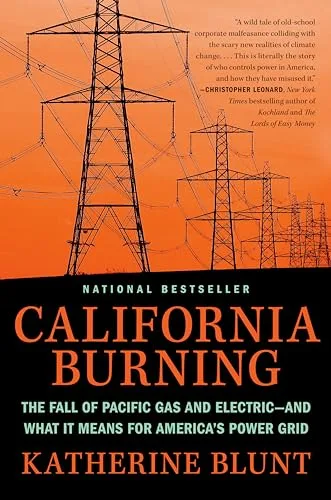
California Burning
The Fall of Pacific Gas and Electric--and What It Means for America's Power Grid
- Published
- 2022
- Pages
- 368 pages
- Publisher
- Portfolio
- Readers
- 2 members have read this
A Wall Street Journal energy reporter traces how Pacific Gas and Electric went from building California's power system to pleading guilty to 84 counts of involuntary manslaughter after its equipment started the 2018 Camp Fire. Utility investors and credit analysts get a detailed case study of deferred maintenance, regulatory failure and climate risk.
For most of a century PG&E was the model of a safe, regulated utility. Katherine Blunt shows how that reputation came apart, from California's 1990s deregulation and PG&E's first bankruptcy to the wildfires, capped by the Camp Fire, that drove a second filing in 2019. Her central argument is that spending on maintenance lost out to capital projects that earned regulated returns, while aging lines ran through land growing hotter and drier.
Blunt covered PG&E for the Journal and was part of the reporting team whose work on the company was a Pulitzer finalist. This is her first book. Publishers Weekly praised its diligent reporting and clear focus, and Kirkus called it intensely researched and deeply unsettling.
The book's strength is its long view, which links the company's 19th-century hydroelectric origins, the deregulation fight, the push for renewable power and the wildfire years into one story. Kirkus noted that the detailed accounts of political, legal and corporate maneuvering would overwhelm readers in less skilled hands, and that even Blunt cannot rule out that PG&E's problems are insoluble.
It belongs on the shelf of anyone who owns utility stocks or bonds, underwrites infrastructure, or wants to understand how physical climate risk becomes financial risk.
- Regulated returns shape spending. When a utility earns returns on new capital but not on maintenance, its incentives can tilt away from upkeep. Read rate cases and capex plans with that in mind.
- Markets designed badly get gamed. California's 1990s deregulation produced a market that traders exploited, and the price spikes broke the state's largest utility.
- Physical risk becomes balance-sheet risk. Wildfire liability of about $30 billion drove PG&E into bankruptcy. Climate exposure belongs in credit and equity models for utilities.
- Safe stocks can fail twice. PG&E went bankrupt in 2001 and again in 2019. A history of regulation and dividends does not guarantee safety.
- Watch the safety record. The San Bruno explosion and earlier fires were warnings. Repeated incidents and criminal cases are signs of a culture problem that earnings will not show.
The book runs roughly in chronological order, from the company's founding to its exit from bankruptcy.
- Building the system. In the late 19th century the company's founders dam rivers and string lines to power a growing state. PG&E forms in 1905 and grows into California's largest utility, a stodgy but reliable investment for its shareholders.
- Deregulation and the energy crisis. California's 1996 restructuring opens power markets to competition. Traders manipulate the new market, prices spike, rolling blackouts follow, and PG&E files for bankruptcy in 2001.
- Neglect. Blunt describes how the company favored capital investment over upkeep and how regulators failed to catch it, a pattern that played out in the deadly 2010 San Bruno gas pipeline explosion as well as on the electric grid.
- Fire. Drought and heat combine with aging equipment. A series of wildfires, culminating in the 2018 Camp Fire, brings huge lawsuits and the 2019 bankruptcy filing.
- Reckoning. PG&E pleads guilty to 84 counts of involuntary manslaughter, settles with fire victims, and emerges from bankruptcy in 2020. Blunt closes on what its fall means for other investor-owned utilities that must keep shareholders happy while hardening their grids.
A revelatory, urgent narrative with national implications, exploring the decline of California’s largest utility company that led to countless wildfires — including the one that destroyed the town of Paradise – and the human cost of infrastructure failure Pacific Gas and Electric was a legacy company built by innovators and visionaries, establishing California as a desirable home and economic powerhouse. In California Burning, Wall Street Journal reporter and Pulitzer finalist Katherine Blunt examines how that legacy fell apart—unraveling a long history of deadly failures in which Pacific Gas and Electric endangered millions of Northern Californians, through criminal neglect of its infrastructure. As PG&E prioritized profits and politics, power lines went unchecked—until a rusted hook purchased for 56 cents in 1921 split in two, sparking the deadliest wildfire in California history. Beginning with PG&E’s public reckoning after the Paradise fire, Blunt chronicles the evolution of PG&E’s shareholder base, from innovators who built some of California's first long-distance power lines to aggressive investors keen on reaping dividends. Following key players through pivotal decisions and legal battles, California Burning reveals the forces that shaped the plight of PG&E: deregulation and market-gaming led by Enron Corp., an unyielding push for renewable energy, and a swift increase in wildfire risk throughout the West, while regulators and lawmakers pushed their own agendas. California Burning is a deeply reported, character-driven narrative, the story of a disaster expanding into a much bigger exploration of accountability. It’s an American tragedy that serves as a cautionary tale for utilities across the nation—especially as climate change makes aging infrastructure more vulnerable, with potentially fatal consequences.
Reader reviews
No reviews yet. Join to write the first one.