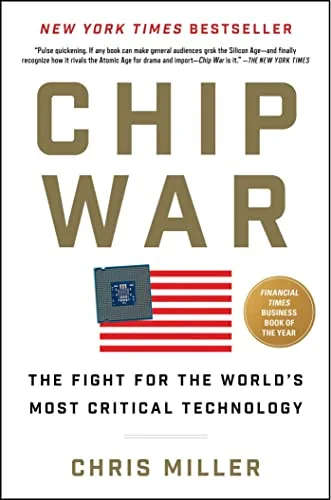
Chip War
The Fight for the World's Most Critical Technology
by Chris Miller
- Published
- 2022
- Pages
- 464 pages
- Publisher
- Scribner
- Readers
- 3 members have read this
The 2022 FT Business Book of the Year tells how the semiconductor went from a Cold War military project to the chokepoint of the global economy, concentrated in a handful of firms such as TSMC and ASML. For investors it explains why chips sit at the center of US-China rivalry, supply-chain risk and the valuations of the world's largest technology companies.
Chris Miller's argument is that computing power, like oil in the twentieth century, has become the resource on which military and economic power rests, and that its production is concentrated in very few places. The most advanced logic chips are made mainly in Taiwan, by TSMC; the extreme ultraviolet lithography machines needed to make them come from one Dutch company, ASML; and the design software and key tools are largely American.
Miller is an economic historian at Tufts University's Fletcher School and a fellow at the American Enterprise Institute, previously known for books on Soviet and Russian economic policy. He brings a historian's sense of contingency to the industry.
The book won the FT Business Book of the Year and the Council on Foreign Relations' Arthur Ross Book Award. In the FT, Demetri Sevastopulo praised it for making a complex industry understandable. Barry Eichengreen, in Foreign Affairs, admired the storytelling but noted that it went to press before the October 2022 US export controls on China and does not assess whether such controls work.
It is the clearest single account of the industry for anyone who invests in technology, follows geopolitical risk or wants to understand why Nvidia, TSMC and ASML matter so much to markets.
- Chips are the new oil. Computing power underpins weapons, phones, data centers and cars, so control of chip production now shapes both economic and military power.
- The supply chain has single points of failure. TSMC's leading-edge fabs, ASML's lithography machines and a few US design-software firms are chokepoints that no country can easily replace.
- Industrial policy has a long history here. Pentagon contracts, Japanese state support, Sematech and Chinese subsidies all shaped the industry, which matters for judging today's CHIPS Act spending.
- Business models decide winners. TSMC's pure-play foundry model and the rise of fabless designers reshaped the industry, while Intel's missed bets show how quickly leadership can slip.
- Taiwan is a market risk, not just a political one. A conflict or blockade would disrupt the production of most advanced logic chips, a tail risk that investors in technology stocks should price.
Miller tells the story chronologically, in short chapters built around engineers, executives and policymakers.
- Cold War origins. The transistor at Bell Labs, the integrated circuit at Texas Instruments and Fairchild, and the military and NASA contracts that gave Silicon Valley its first customers. Moore's Law sets the pace.
- An American-led industry goes global. US firms move assembly to Asia, while Japanese electronics firms such as Sony become world-class rivals and Taiwan, South Korea and others join the supply chain as part of America's Cold War alliances.
- Leadership lost and regained. In the 1980s Japanese memory makers overtake US rivals, Washington responds with trade pressure and Sematech, and Intel under Andy Grove abandons memory to focus on microprocessors. Micron and Samsung emerge.
- The foundry era. Morris Chang builds TSMC, fabless designers flourish, the industry consolidates, and lithography narrows to ASML's EUV machines. Intel misses the smartphone era.
- China's challenge. Beijing pours subsidies into firms such as SMIC, Tsinghua Unigroup and Huawei, aiming to end its dependence on foreign chips.
- The chip choke. Washington uses its control of design tools and equipment to cut Huawei off, the supply chain becomes a weapon, and Taiwan's concentration of production becomes a strategic risk for the world.
You may be surprised to learn that microchips are the new oil—the scarce resource on which the modern world depends. Today, military, economic, and geopolitical power are built on a foundation of computer chips. Virtually everything—from missiles to microwaves, smartphones to the stock market—runs on chips. Until recently, America designed and built the fastest chips and maintained its lead as the #1 superpower. Now, America's edge is slipping, undermined by competitors in Taiwan, Korea, Europe, and, above all, China. Today, as Chip War reveals, China, which spends more money each year importing chips than it spends importing oil, is pouring billions into a chip-building initiative to catch up to the US. At stake is America's military superiority and economic prosperity.
Economic historian Chris Miller explains how the semiconductor came to play a critical role in modern life and how the U.S. become dominant in chip design and manufacturing and applied this technology to military systems. America's victory in the Cold War and its global military dominance stems from its ability to harness computing power more effectively than any other power. But here, too, China is catching up, with its chip-building ambitions and military modernization going hand in hand. America has let key components of the chip-building process slip out of its grasp, contributing not only to a worldwide chip shortage but also a new Cold War with a superpower adversary that is desperate to bridge the gap.
Illuminating, timely, and fascinating, Chip War shows that, to make sense of the current state of politics, economics, and technology, we must first understand the vital role played by chips.
Reader reviews
No reviews yet. Join to write the first one.