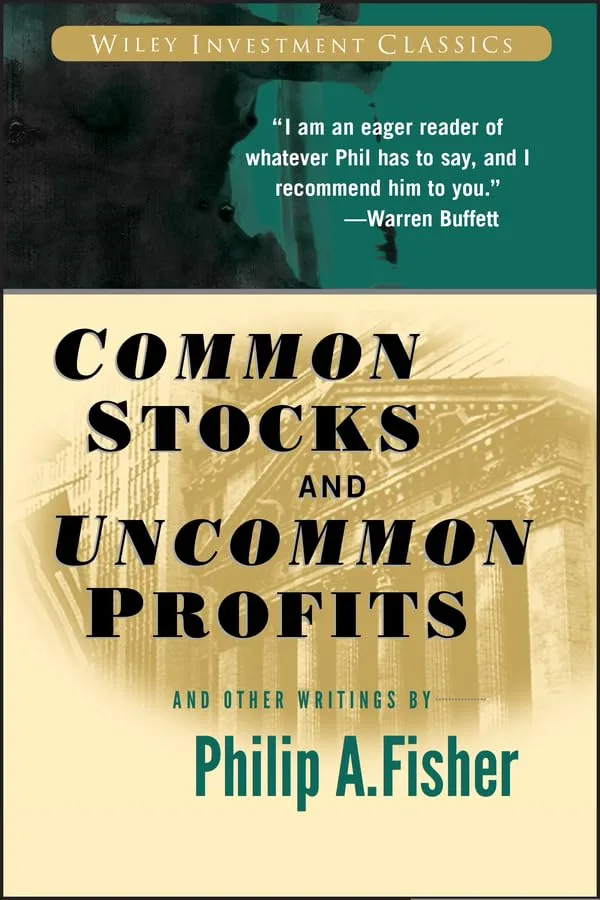
Common Stocks and Uncommon Profits and Other Writings
- Published
- 1958
- Pages
- 320 pages
- Publisher
- Wiley
- Readers
- 3 members have read this
Philip Fisher's 1958 classic laid out the growth investor's method: find a few outstanding companies through relentless 'scuttlebutt' research, judge them on fifteen points about products, margins and management, buy them sensibly and almost never sell. Warren Buffett credits it alongside Graham, and its checklist still reads like a modern analyst's playbook.
Philip Fisher founded his San Francisco firm Fisher & Co. in 1931 and ran it until 1999. He specialized in research-driven companies and is best known for buying Motorola in 1955 and holding it for the rest of his life. Common Stocks and Uncommon Profits, first published in 1958, set out the method behind that record. Where Benjamin Graham looked for statistical bargains, Fisher looked for exceptional businesses that could compound for decades and argued that paying a fair price for one was safer than buying a mediocre company cheaply.
The heart of the book is the fifteen points to look for in a common stock, from sales growth potential and research effectiveness to depth of management and management integrity. Fisher pairs it with scuttlebutt, his name for gathering information from competitors, suppliers, customers, former employees and scientists. Warren Buffett called it a very, very good book at the 2018 Berkshire meeting and said his investment managers Todd Combs and Ted Weschler still use the scuttlebutt method.
The Wiley Investment Classics edition adds Conservative Investors Sleep Well (1975) and Developing an Investment Philosophy (1980), plus a preface and introduction by his son, Ken Fisher. The 1950s examples are dated, and the prose is plain.
Anyone doing fundamental equity research, especially in growth or quality strategies, should read it.
- Do the scuttlebutt. Talking to competitors, suppliers, customers and former employees reveals more about a company's real position than its reports do.
- Use the fifteen points. Judge a business on growth potential, research productivity, sales strength, margins, people, management depth, cost controls and integrity before thinking about price.
- Buy great companies and hold them. If the original analysis was right and the company still meets the standard, the time to sell is almost never.
- Watch how management handles bad news. A company that talks freely when things go well and goes quiet when they go badly is a warning sign.
- Concentrate on what you know. Fisher warns against overdiversification into companies you understand poorly, arguing that a smaller number of carefully researched holdings is safer.
This edition collects three works, with an introduction by Ken Fisher.
- Common Stocks and Uncommon Profits (1958). Fisher draws lessons from market history, explains scuttlebutt research, sets out the fifteen points, and covers when to buy, when to sell and when not to, why dividends matter less than investors think, and two lists of five don'ts, such as overdiversifying and quibbling over eighths and quarters. It closes with how he finds growth stocks himself.
- Conservative Investors Sleep Well (1975). Fisher defines a conservative investment along four dimensions: low-cost production and strong marketing and research, the quality of the people, the investment characteristics of the business, and the price relative to the company's real prospects.
- Developing an Investment Philosophy (1980). A short memoir of how Fisher's approach took shape, from the 1929 crash and the Depression through investments such as Food Machinery Corporation and Texas Instruments, including his three-year rule for patience and a critique of the efficient market hypothesis using Raychem as an example.
- Appendix. A summary checklist of the functional factors, people factors and business characteristics Fisher used to evaluate promising firms.
Widely respected and admired, Philip Fisher is among the most influential investors of all time. His investment philosophies, introduced almost forty years ago, are not only studied and applied by today's financiers and investors, but are also regarded by many as gospel. This book is invaluable reading and has been since it was first published in 1958. The updated paperback retains the investment wisdom of the original edition and includes the perspectives of the author's son Ken Fisher, an investment guru in his own right in an expanded preface and introduction I sought out Phil Fisher after reading his Common Stocks and Uncommon Profits...A thorough understanding of the business, obtained by using Phil's techniques...enables one to make intelligent investment commitments. —Warren Buffet
Reader reviews
No reviews yet. Join to write the first one.