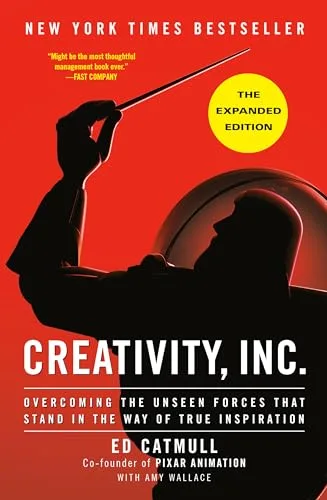
Creativity, Inc.
Overcoming the Unseen Forces That Stand in the Way of True Inspiration
by Ed Catmull and Amy Wallace
- Published
- 2014
- Pages
- 496 pages
- Publisher
- Random House
- Readers
- 2 members have read this
Pixar co-founder Ed Catmull, writing with journalist Amy Wallace, explains how the studio went from a money-losing hardware company backed by Steve Jobs to the maker of Toy Story and Finding Nemo, and what management habits kept its films good. A practical book on candor, failure and protecting new ideas inside a growing company.
Ed Catmull studied computer graphics under Ivan Sutherland at the University of Utah, ran the computer graphics division at Lucasfilm, and in 1986 co-founded Pixar with Alvy Ray Smith when Steve Jobs bought the division. He later became president of both Pixar and Walt Disney Animation Studios. Creativity, Inc., written with journalist Amy Wallace, is his account of how that company was built and his argument for how creative organizations should be managed.
The book's premise is that early versions of every film are bad, and that a manager's job is to build a culture where problems surface early and people feel safe saying so. Catmull describes the Braintrust, a group of directors and storytellers who give candid notes on films in progress, along with postmortems and other practices meant to counter the hidden forces that make successful companies complacent. He spends as much time on mistakes as on hits.
Kirkus called it a superb debut for managers in any field, the Financial Times shortlisted it for its business book of the year, and the New York Times reported it was becoming a bible in Hollywood. The book is written by the boss, so it is generous to Pixar and its leaders. The 2023 expanded edition adds a new introduction, two new chapters and four postscripts.
Finance readers who run teams, sit on boards or evaluate management will find it one of the clearest descriptions of how culture is actually built.
- People matter more than ideas. Catmull argues that a mediocre team will ruin a good idea while a good team will fix or replace a weak one, so hiring and team design come first.
- Candor needs a structure. Pixar's Braintrust works because notes are candid, given by peers and carry no authority to force changes, which keeps the decision with the director.
- Failure is a cost of doing something new. Managers should make it safe to take risks and expect early versions to be bad, rather than punish every misstep.
- Success hides problems. The forces that damage a company are often invisible to its leaders, which is why Catmull keeps looking for what he is not seeing.
- Feed the beast carefully. A growing organization's demand for output can crush new projects unless leaders deliberately protect them.
The original edition has four parts and an afterword, moving from Pixar's origin story to the principles drawn from it, then testing them at Disney. The 2023 expanded edition keeps that frame and adds new material.
- Getting started. Catmull recounts his early ambition to make the first computer-animated film, his years at the University of Utah and Lucasfilm, the 1986 founding of Pixar with Steve Jobs's money, the lean years before Toy Story and, in Establishing Pixar's Identity, how a troubled sequel taught the studio that quality depends on people more than ideas.
- Protecting the new. The core of the book: chapters on honesty and candor and the Braintrust, fear and failure, the hungry beast of output versus the ugly baby of a new idea, change and randomness, and the problems that stay hidden from managers.
- Building and sustaining. Two chapters on broadening one's view and on planning for the unmade future no one can predict.
- Testing what we know. After Disney buys Pixar, Catmull and Lasseter take over Walt Disney Animation Studios and try the same principles on a struggling studio, and Pixar runs Notes Day, a company-wide exercise in candor.
- The Steve we knew. An afterword reflects on working with Jobs. The expanded edition adds a new introduction, two new chapters and four chapter postscripts on the years since 2014.
Creativity, Inc. is a manual for anyone who strives for originality and the first-ever, all-access trip into the nerve center of Pixar Animation—into the meetings, postmortems, and “Braintrust” sessions where some of the most successful films in history are made. It is, at heart, a book about creativity—but it is also, as Pixar co-founder and president Ed Catmull writes, “an expression of the ideas that I believe make the best in us possible.”
For nearly twenty years, Pixar has dominated the world of animation, producing such beloved films as the Toy Story trilogy, Monsters, Inc., Finding Nemo, The Incredibles, Up, WALL-E, and Inside Out, which have gone on to set box-office records and garner thirty Academy Awards. The joyousness of the storytelling, the inventive plots, the emotional authenticity: In some ways, Pixar movies are an object lesson in what creativity really is. Here, in this book, Catmull reveals the ideals and techniques that have made Pixar so widely admired—and so profitable.
Reader reviews
No reviews yet. Join to write the first one.