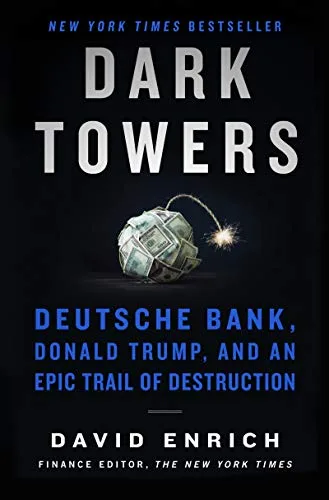
Dark Towers
Deutsche Bank, Donald Trump, and an Epic Trail of Destruction
by David Enrich
- Published
- 2020
- Pages
- 416 pages
- Publisher
- Custom House
- Readers
- 2 members have read this
New York Times business investigations editor David Enrich traces how Deutsche Bank's push to become a Wall Street power produced two decades of scandal, from Libor rigging and Russian mirror trades to more than $2 billion in loans to Donald Trump. It is a case study in what happens when a bank's growth outruns its controls.
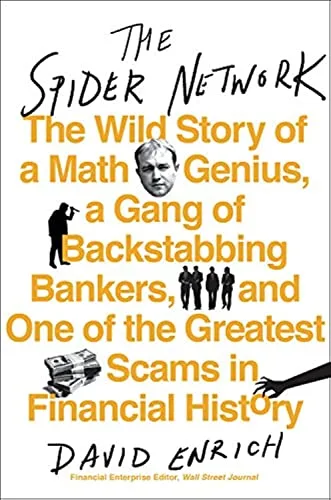
Enrich covered banking for the Wall Street Journal, including as its European banking editor in London, and wrote The Spider Network, about the Libor trader Tom Hayes. Here he tells how a staid German lender set out to become a global investment bank and grew rapidly with too little oversight, framing the story around the suicide of a retired senior risk executive, Bill Broeksmit, and his stepson's search for an explanation. His background shows in the clear treatment of the bank's derivatives business, compliance failures and fines.
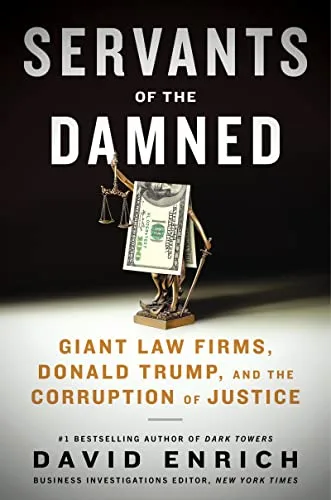
The Trump strand is the selling point. Deutsche was the one major bank still willing to lend to Trump after his business failures and lawsuits, and he owed it roughly $350 million at the 2016 election. Reviewers mostly admired the reporting. Roger Lowenstein in the New York Times Book Review called it thorough and fair, though he found the Broeksmit device overworked. Steven Pearlstein in the Washington Post and Gary Silverman in the FT faulted it for neglecting the bank's actual business strategy and finances in favor of personalities, and Kirkus noted that the Russia questions are left as a tangle of open leads.
It suits readers interested in bank risk culture, regulation and the Trump business story.
- Growth by acquisition imports culture. Hiring an entire Merrill Lynch team and buying Bankers Trust gave Deutsche a trading franchise quickly, along with a risk appetite its German management never fully controlled.
- Compliance is a business line, not a cost center. The Libor fines, the mirror-trade penalties and the money-laundering failures show how weak controls can eventually cost more than the profits they protected.
- Watch the lender of last resort. When one bank keeps lending to a client everyone else has dropped, it is either seeing something others miss or taking a risk others refuse, and Enrich's account suggests Deutsche's Trump loans were the latter.
- Divisions see risk differently. Moving a defaulted borrower from the investment bank to the wealth-management arm let Deutsche keep the relationship on different terms, a reminder that one bank's units can judge the same client very differently.
- Reputational risk compounds. Each scandal made the next more damaging, and by the end, the bank's problems with regulators, investors and politicians fed on each other.
The book alternates between the bank's institutional history and the Broeksmit family's search, moving roughly chronologically from the 1990s to the Trump presidency.
- Ambition. Deutsche Bank decides to compete with Wall Street, hires Edson Mitchell from Merrill Lynch along with Anshu Jain and Bill Broeksmit, and agrees to buy Bankers Trust in 1998. Mitchell's aggressive culture drives growth until his death in a plane crash in 2000.
- Excess. Under chief executive Josef Ackermann, with Jain running the investment bank, Deutsche piles on risk and leverage through the run-up to 2008, with Broeksmit holding senior risk roles before his retirement in 2013.
- The Trump relationship. Enrich follows the bank's lending to Trump after other lenders walked away, Trump's 2008 lawsuit against it after a default on his Chicago tower loan, and the move of his business to the private-banking unit under his banker Rosemary Vrablic.
- Scandal. The bank is fined for rigging Libor, paying about $2.5 billion in 2015, and is caught in the Russian mirror-trading scheme that moved roughly $10 billion out of Russia. Broeksmit's 2014 suicide comes amid this period.
- Reckoning. Val Broeksmit digs through his stepfather's files and email and becomes a source for journalists and investigators, while congressional committees and prosecutors seek the bank's Trump records and the bank struggles to recover.
David Enrich's explosive exposé of the most scandalous bank in the world, revealing its shadowy ties to Donald Trump, Putin's Russia, and Nazi Germany A jaw-dropping financial thriller” —Philadelphia Inquirer On a rainy Sunday in 2014, a senior executive at Deutsche Bank was found hanging in his London apartment. Bill Broeksmit had helped build the 150-year-old financial institution into a global colossus, and his sudden death was a mystery, made more so by the bank’s efforts to deter investigation. Broeksmit, it turned out, was a man who knew too much. In Dark Towers, award-winning journalist David Enrich reveals the truth about Deutsche Bank and its epic path of devastation. Tracing the bank’s history back to its propping up of a default-prone American developer in the 1880s, helping the Nazis build Auschwitz, and wooing Eastern Bloc authoritarians, he shows how in the 1990s, via a succession of hard-charging executives, Deutsche made a fateful decision to pursue Wall Street riches, often at the expense of ethics and the law. Soon, the bank was manipulating markets, violating international sanctions to aid terrorist regimes, scamming investors, defrauding regulators, and laundering money for Russian oligarchs. Ever desperate for an American foothold, Deutsche also started doing business with a self-promoting real estate magnate nearly every other bank in the world deemed too dangerous to touch: Donald Trump. Over the next twenty years, Deutsche executives loaned billions to Trump, the Kushner family, and an array of scandal-tarred clients, including convicted sex offender Jeffrey Epstein. Dark Towers is the never-before-told saga of how Deutsche Bank became the global face of financial recklessness and criminality—the corporate equivalent of a weapon of mass destruction. It is also the story of a man who was consumed by fear of what he’d seen at the bank—and his son’s obsessive search for the secrets he kept.
Reader reviews
No reviews yet. Join to write the first one.