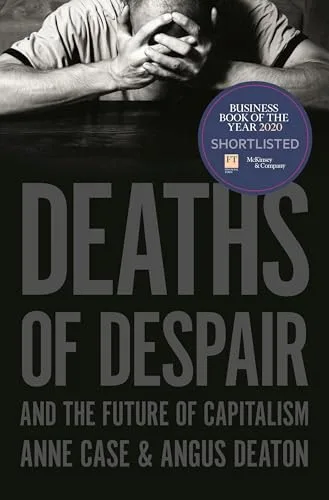
Deaths of Despair and the Future of Capitalism
by Anne Case and Angus Deaton
- Published
- 2020
- Pages
- 312 pages
- Publisher
- Princeton University Press
- Readers
- 2 members have read this
Two Princeton economists, one of them a Nobel laureate, show that suicide, drug overdose and alcoholic liver disease have pushed down American life expectancy, especially among white adults without a college degree. They lay the blame on a health-care system that drains wages and an economy that shifts power from workers to capital and corporations.
From the late 1990s, mortality among middle-aged white Americans stopped falling and started rising, which no other rich country saw. Anne Case and Angus Deaton put the change down to suicide, drug overdose and alcoholic liver disease, which they call deaths of despair, and turn that finding into an argument about American capitalism. The people dying are mostly those without a four-year degree, whose lives, the authors argue, were hollowed out by falling wages, the loss of good jobs and stable marriages, and a costly health-care industry that works like a tax on working-class pay.
Case and Deaton are economists at Princeton, and Deaton won the 2015 Nobel Prize in economics. Their 2015 paper on midlife white mortality started the debate. The book was a New York Times and Wall Street Journal bestseller and was shortlisted for the Financial Times and McKinsey Business Book of the Year.
Reviewers praised the data and the clear writing, and Kenneth Rogoff, writing for the IMF, singled out the case against health-care prices. Critics questioned whether the three causes belong together and noted that the authors do little formal causal testing, that the story fits younger and Black Americans less well, and that fentanyl is a bigger driver than the framing suggests. Some found the closing policy proposals thin.
Investors and analysts will get a data-driven account of the labor-market and health-care trends behind American populism and the politics of the 2020s.
- Mortality is an economic indicator. Rising death rates among less-educated adults showed a breakdown in American working life years before the political consequences became obvious.
- The college degree is the dividing line. In the authors' data, mortality gaps between adults with and without a four-year degree widened, even as the gap between Black and white death rates narrowed.
- Health-care costs act like a hidden tax. Employer-paid premiums rose fast enough to absorb much of the growth in median compensation, which held down take-home pay for working families.
- Recessions are not the main cause. The deaths were rising before 2008, and Greece and Spain kept gaining life expectancy through deep downturns. That points to slow structural forces in the US.
- Rent-seeking has a human cost. The authors argue that lobbying, market concentration and opioid marketing moved income upward, and that capitalism needs fixing rather than replacing.
The book moves from measuring the problem to diagnosing it, and ends with a policy agenda. After an introduction on the 2015 mortality finding, it unfolds in four parts.
- Past as Prologue. How twentieth-century gains in American health stalled, and how suicide, overdose and alcohol deaths broke away from the trends in other rich countries.
- The Anatomy of the Battlefield. Who is dying. The authors compare people with and without a college degree, Black and white mortality, the health and pain of the living, and the rise of prescription opioids sold aggressively by drugmakers.
- What's the Economy Got to Do with It? Case and Deaton rule out poverty, income inequality as such and the Great Recession as the main cause. They focus instead on the long erosion of work, wages, marriage and community for less-educated Americans.
- Why Is Capitalism Failing So Many? The authors argue that American health care is extremely expensive and soaks up wage gains. They also weigh immigration, automation and trade with China, look at corporate and market power over workers and consumers, and close with proposals on health-care costs, minimum wages, antitrust and corporate governance.
Reader reviews
No reviews yet. Join to write the first one.