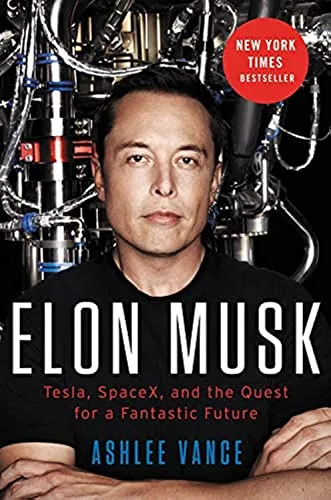
Elon Musk
Tesla, SpaceX, and the Quest for a Fantastic Future
by Ashlee Vance
- Published
- 2015
- Pages
- 400 pages
- Publisher
- Ecco
- Readers
- 1 member has read this
Bloomberg Businessweek reporter Ashlee Vance's 2015 biography follows Elon Musk from a bruising South African childhood through Zip2, PayPal and the 2008 crisis that nearly sank SpaceX and Tesla at once. It is the best account of how Musk raised money, took risk and drove engineers in the years before he became the world's richest man.
Vance covered technology for The Register, The New York Times and Bloomberg Businessweek, and wrote an earlier guide, Geek Silicon Valley. Musk at first refused to cooperate, then changed his mind and sat for roughly 30 hours of interviews, and Vance also interviewed hundreds of other people, from family members and co-founders to employees and rivals. The result covers Musk's first four decades, with its core in the period around 2008, when his rocket and car companies both came within weeks of running out of money.
It is the book to read on how Musk operates as a capital allocator and manager. He pulls cost out of hardware, owns every engineering decision and treats near-impossible deadlines as normal. Reviewers found it more balanced than a hagiography. It reports harsh treatment of staff, and Musk publicly disputed at least two of those stories. One reviewer also flagged thin technical detail on Tesla and sloppy copyediting. The story stops in 2015.
Read it alongside Walter Isaacson's 2023 biography for the later years. It suits venture investors, Tesla shareholders and anyone studying founder-led companies.
- Physics, not precedent, sets the price. Musk breaks rockets and battery packs down to their raw materials and asks why the finished product costs so much more. That is how SpaceX undercut incumbent launch prices by a wide margin.
- Vertical integration buys speed. SpaceX makes most of its parts in-house. That cut supplier delays and markups, and it let engineers change designs in days.
- Founders who stake everything get no margin for error. In 2008 Musk had put most of his PayPal money into SpaceX and Tesla. Both nearly failed in the same quarter, and a few weeks of runway decided the outcome.
- Narrative is a financing tool. Musk's Mars and sustainable-energy story helped him raise capital, recruit staff and keep customers loyal through repeated delays. Investors should price the story separately from the operating results.
- Key-person risk cuts both ways. Musk's hands-on control drives execution, but the turnover, burnout and disputed episodes Vance documents show how much depends on one temperament.
The book runs roughly chronologically. Musk's ventures overlap in the middle chapters, and Vance shifts between SpaceX and Tesla as their crises converge.
- South Africa and Canada. The opening chapters cover Musk's family history, his reading binges and the beatings he took at school, his difficult father, and his exit to Canada at 17. He studies at Queen's University and then Penn.
- Zip2 and PayPal. Musk and his brother Kimbal build Zip2, an online directory for newspapers, and sell it to Compaq in 1999. His online bank X.com merges with the company that became PayPal. He is pushed out as CEO but leaves rich when eBay buys PayPal in 2002.
- Founding SpaceX. After a 2002 trip to Russia to buy launch vehicles goes nowhere, Musk decides to build rockets himself. He hires engineers in Los Angeles and tests in Texas and on Kwajalein atoll.
- Tesla and SolarCity. Vance follows Musk's investment in Tesla, his clashes with its founders, the Roadster's delays, and the solar company he backed for his cousins.
- 2008. Three Falcon 1 failures, a fourth launch that finally reaches orbit in September, a divorce, and a Christmas-season scramble for money that keeps both companies alive.
- Revival. The Model S, NASA cargo missions, the reported 2013 Google talks, and a closing assessment of Musk's grand plan and the costs to the people around him.
In the spirit of Steve Jobs and Moneyball, Elon Musk is both an illuminating and authorized look at the extraordinary life of one of Silicon Valley’s most exciting, unpredictable, and ambitious entrepreneurs—a real-life Tony Stark—and a fascinating exploration of the renewal of American invention and its new makers.” Elon Musk spotlights the technology and vision of Elon Musk, the renowned entrepreneur and innovator behind SpaceX, Tesla, and SolarCity, who sold one of his Internet companies, PayPal, for $1.5 billion. Ashlee Vance captures the full spectacle and arc of the genius’s life and work, from his tumultuous upbringing in South Africa and flight to the United States to his dramatic technical innovations and entrepreneurial pursuits. Vance uses Musk’s story to explore one of the pressing questions of our age: can the nation of inventors and creators who led the modern world for a century still compete in an age of fierce global competition? He argues that Musk—one of the most unusual and striking figures in American business history—is a contemporary, visionary amalgam of legendary inventors and industrialists including Thomas Edison, Henry Ford, Howard Hughes, and Steve Jobs. More than any other entrepreneur today, Musk has dedicated his energies and his own vast fortune to inventing a future that is as rich and far-reaching as the visionaries of the golden age of science-fiction fantasy. Thorough and insightful, Elon Musk brings to life a technology industry that is rapidly and dramatically changing by examining the life of one of its most powerful and influential titans.
Reader reviews
No reviews yet. Join to write the first one.