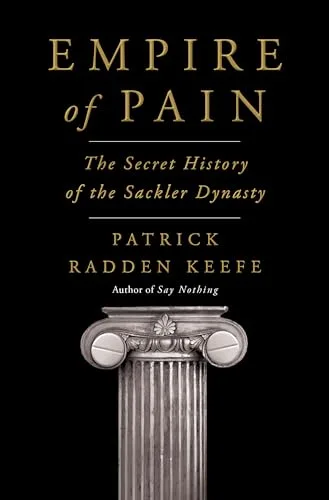
Empire of Pain
The Secret History of the Sackler Dynasty
- Published
- 2021
- Pages
- 560 pages
- Publisher
- Doubleday
- Readers
- 2 members have read this
A three-generation history of the Sackler family, from Arthur Sackler's pioneering drug advertising to Purdue Pharma's marketing of OxyContin and the legal maneuvers that protected the family fortune. For finance readers, it is a study in how a private, family-controlled company priced in legal risk, captured regulators and kept its name on museum walls for decades.
Patrick Radden Keefe's history of the Sacklers shows that the family fortune predates OxyContin. The methods Arthur Sackler refined selling drugs such as Librium and Valium directly to physicians became the template for Purdue's sales force when his brothers' branch of the family launched OxyContin in 1996.
Keefe, a New Yorker staff writer and the author of Say Nothing, expanded a 2017 New Yorker article into the book. The family did not cooperate. He relied on interviews, court records and internal documents released through litigation, and he describes the family's efforts to derail publication. The book won the 2021 Baillie Gifford Prize and was shortlisted for the Financial Times and McKinsey Business Book of the Year.
What sets it apart from Barry Meier's Pain Killer and Beth Macy's Dopesick is its focus on ownership: who controlled Purdue, who profited and how the family stayed out of criminal court. New York magazine called it principally a family history, and a BMJ blog reviewer found Keefe's portrait of Arthur ambiguous.
It rewards anyone who analyzes governance, litigation risk or reputational risk, and anyone who has wondered how much a board can claim not to know.
- Marketing can be the product. Arthur Sackler's insight was that drug sales depend on persuading doctors, and Purdue scaled that playbook for OxyContin. A business that wins on promotion carries risks a spreadsheet will not show.
- Private ownership hides concentration. A family-controlled company with no public shareholders faced little outside scrutiny of its board, its distributions or its strategy.
- Settlements are a business decision. Keefe shows Purdue treating legal penalties as a cost of doing business, from the 2007 plea to the bankruptcy. Read fines against profits before concluding that a company has been punished.
- Regulatory capture is a real risk. The FDA examiner who approved OxyContin's label later went to work for Purdue. Investors should weigh how much of a moat rests on regulators' goodwill.
- Reputation can turn fast. After decades of philanthropy, the Sackler name came off museum walls within a few years once journalists and activists made the link to opioids.
The book is organized in three parts, moving from the founding generation to the reckoning.
- Patriarch. Arthur Sackler grows up poor in Brooklyn, trains as a psychiatrist and builds a medical advertising and publishing empire. He markets tranquilizers to doctors, collects art, gives to museums and keeps his conflicts of interest out of view. He also helps his brothers buy the small drug company Purdue Frederick.
- Dynasty. After Arthur's death in 1987, his heirs sell their stake to Mortimer and Raymond. Under Richard Sackler, Purdue develops OxyContin, wins FDA approval with a label claiming lower abuse potential, and launches an aggressive campaign to sell it for chronic pain.
- Legacy. Addiction and overdoses spread. Federal prosecutors in Virginia build a case, and in 2007 Purdue pleads guilty to misleading doctors and patients and pays $600 million, while three executives plead guilty and no Sackler is charged. Lawsuits multiply, Nan Goldin's protests target museums, Purdue files for bankruptcy, and the family agrees in 2020 to a $225 million civil penalty while keeping most of its fortune.
NEW YORK TIMES BEST SELLER • A grand, devastating portrait of three generations of the Sackler family, famed for their philanthropy, whose fortune was built by Valium and whose reputation was destroyed by OxyContin. From the prize-winning and bestselling author of Say Nothing, as featured in the HBO documentary Crime of the Century. The Sackler name adorns the walls of many storied institutions—Harvard, the Metropolitan Museum of Art, Oxford, the Louvre. They are one of the richest families in the world, known for their lavish donations to the arts and the sciences. The source of the family fortune was vague, however, until it emerged that the Sacklers were responsible for making and marketing a blockbuster painkiller that was the catalyst for the opioid crisis. Empire of Pain begins with the story of three doctor brothers, Raymond, Mortimer and the incalculably energetic Arthur, who weathered the poverty of the Great Depression and appalling anti-Semitism. Working at a barbaric mental institution, Arthur saw a better way and conducted groundbreaking research into drug treatments. He also had a genius for marketing, especially for pharmaceuticals, and bought a small ad firm. Arthur devised the marketing for Valium, and built the first great Sackler fortune. He purchased a drug manufacturer, Purdue Frederick, which would be run by Raymond and Mortimer. The brothers began collecting art, and wives, and grand residences in exotic locales. Their children and grandchildren grew up in luxury. Forty years later, Raymond’s son Richard ran the family-owned Purdue. The template Arthur Sackler created to sell Valium—co-opting doctors, influencing the FDA, downplaying the drug’s addictiveness—was employed to launch a far more potent product: OxyContin. The drug went on to generate some thirty-five billion dollars in revenue, and to launch a public health crisis in which hundreds of thousands would die. This is the saga of three generations of a single family and the mark they would leave on the world, a tale that moves from the bustling streets of early twentieth-century Brooklyn to the seaside palaces of Greenwich, Connecticut, and Cap d’Antibes to the corridors of power in Washington, D.C. Empire of Pain chronicles the multiple investigations of the Sacklers and their company, and the scorched-earth legal tactics that the family has used to evade accountability. The history of the Sackler dynasty is rife with drama—baroque personal lives; bitter disputes over estates; fistfights in boardrooms; glittering art collections; Machiavellian courtroom maneuvers; and the calculated use of money to burnish reputations and crush the less powerful. Empire of Pain is a masterpiece of narrative reporting and writing, exhaustively documented and ferociously compelling. It is a portrait of the excesses of America’s second Gilded Age, a study of impunity among the super elite and a relentless investigation of the naked greed and indifference to human suffering that built one of the world’s great fortunes.
Reader reviews
No reviews yet. Join to write the first one.