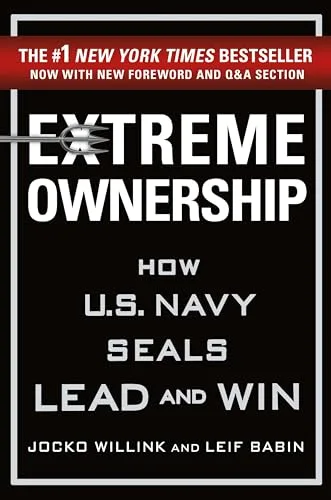
Extreme Ownership
How U.S. Navy SEALs Lead and Win
by Jocko Willink and Leif Babin
- Published
- 2015
- Pages
- 384 pages
- Publisher
- St. Martin's Press
- Readers
- 1 member has read this
Two former SEAL officers who led Task Unit Bruiser through the 2006 battle of Ramadi turn their combat lessons into a leadership manual. Each principle gets a battlefield story, a plain statement and a business case. Its core claim is that a leader owns every outcome on the team, with no excuses, and that applies as much to a deal team or trading desk as to a platoon.
The book rests on one idea: a leader is responsible for everything in his or her world, including subordinates' mistakes and orders that came from above. From there Willink and Babin derive a set of principles they first taught to SEAL officers and now sell to companies, starting with the claim that there are no bad teams, only bad leaders.
The authors were there. Willink, a 20-year SEAL veteran awarded the Silver Star and Bronze Star, commanded Task Unit Bruiser of SEAL Team Three in Ramadi, and Babin served under him as a platoon commander. Afterward they ran SEAL leadership training and founded Echelon Front, the consultancy that supplies the book's corporate examples.
It stands out for its format. Every chapter pairs a Ramadi or training story with a principle and an application at a client company, so the lessons are concrete rather than motivational. The weaknesses are the other side of that simplicity. Some principles read like familiar military doctrine, the business vignettes are thinner than the combat scenes, and the no-bad-teams slogan overstates the case when taken literally.
It suits first-time managers, deal-team leads, desk heads and founders who want a short, practical code for accountability.
- Own the outcome, including what you did not control. When a deal slips or a trade goes wrong, the leader's first question is what they failed to explain, resource or check. Blaming others ends the learning.
- Standards are what you tolerate. A team's real standard is the worst performance its leader accepts without consequence, not the one written in the memo.
- Simple plans survive contact. If juniors cannot restate the plan and the reason for it, it will fail under stress. That applies to closing checklists and risk procedures too.
- Prioritize and execute. When several fires break out at once, step back, pick the one that matters most, fix it and move to the next, rather than splitting effort across all of them.
- Decentralize with clear intent. Leaders who explain the why and set boundaries can let people closest to the problem decide, which is faster and scales better than central control.
The book has three parts. Each chapter follows the same pattern: a combat or training story, the principle it illustrates, and an example of applying it at a company Echelon Front advised.
- Winning the War Within. The mindset chapters. Extreme Ownership opens with Willink taking full responsibility for a deadly friendly-fire incident in Ramadi. No Bad Teams, Only Bad Leaders uses a BUD/S boat-crew race to show how one leader changes a team's results. Believe argues that leaders must understand and accept the mission before they can sell it. Check the Ego shows how pride wrecks cooperation.
- The Laws of Combat. Four rules for running operations: Cover and Move, about teams supporting each other rather than competing; Simple, about plans everyone can understand; Prioritize and Execute, about taking the most important problem first under pressure; and Decentralized Command, about pushing decisions down with clear intent.
- Sustaining Victory. The closing chapters cover mission planning, leading up and down the chain of command, making decisions without complete information, and balancing discipline against flexibility. That last theme the authors developed further in The Dichotomy of Leadership.
The 2017 updated edition adds an excerpt from that follow-up book.
The #1 New York Times bestseller Sent to the most violent battlefield in Iraq, Jocko Willink and Leif Babin’s SEAL task unit faced a seemingly impossible mission: help U.S. forces secure Ramadi, a city deemed all but lost.” In gripping firsthand accounts of heroism, tragic loss, and hard-won victories in SEAL Team Three’s Task Unit Bruiser, they learned that leadership—at every level—is the most important factor in whether a team succeeds or fails.Willink and Babin returned home from deployment and instituted SEAL leadership training that helped forge the next generation of SEAL leaders. After departing the SEAL Teams, they launched Echelon Front, a company that teaches these same leadership principles to businesses and organizations. From promising startups to Fortune 500 companies, Babin and Willink have helped scores of clients across a broad range of industries build their own high-performance teams and dominate their battlefields. Now, detailing the mind-set and principles that enable SEAL units to accomplish the most difficult missions in combat, Extreme Ownership shows how to apply them to any team, family or organization. Each chapter focuses on a specific topic such as Cover and Move, Decentralized Command, and Leading Up the Chain, explaining what they are, why they are important, and how to implement them in any leadership environment. A compelling narrative with powerful instruction and direct application, Extreme Ownership revolutionizes business management and challenges leaders everywhere to fulfill their ultimate purpose: lead and win.
Reader reviews
No reviews yet. Join to write the first one.