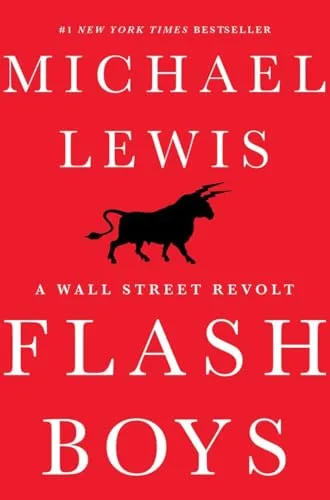
Flash Boys
A Wall Street Revolt
- Published
- 2014
- Pages
- 288 pages
- Publisher
- W. W. Norton & Company
- Readers
- 6 members have read this
Michael Lewis follows RBC trader Brad Katsuyama as he works out why the prices on his screen vanish the moment he tries to trade, and traces the answer to high-frequency traders who profit from being microseconds faster. It is the book that put market structure, dark pools and the founding of IEX in front of a general audience.
Lewis builds the book around Brad Katsuyama, who ran electronic trading at Royal Bank of Canada in New York, and the colleagues who worked out how faster traders were racing ahead of his orders. Through them Lewis maps how Regulation NMS, exchange order types and bank dark pools let speed become a business.
As in Liar's Poker and The Big Short, Lewis tells the story through outsiders who see what insiders miss, and Publishers Weekly praised how clearly he explains the technology.
The book was controversial. Lewis's claim that the market is rigged was rejected by SEC chair Mary Jo White, and Tradeworx chief executive Manoj Narang called it more fiction than fact. Noah Smith liked the book but argued that Lewis cast fund managers as victims while ignoring their own costly overtrading, and the blogger Scott Locklin pointed out that Lewis did not interview or cite a single high-frequency trader.
Read it for a vivid and one-sided account of how modern equity markets route and fill orders, then read the rebuttals.
- Displayed prices are not always available. In a fragmented market the quote on your screen may vanish once your order reaches the first exchange, which is a hidden cost for any large trade.
- Market structure is a profit center. Rules such as Regulation NMS, exchange maker-taker rebates and special order types create opportunities that firms with the fastest connections can monetize.
- Ask where your orders go. Brokers and dark pools can route client orders in ways that benefit the intermediary, so institutions should measure execution quality rather than trust it.
- Speed bumps can level the field. IEX's 350-microsecond delay showed that exchange design can limit the value of latency arbitrage, an approach the SEC later approved when IEX became a registered exchange in 2016.
- Read the counterargument. The SEC, HFT firms and some reviewers rejected the claim that markets are rigged and argued that high-frequency traders supply liquidity, so weigh Lewis's account against theirs.
The book opens with the 2009 arrest of Goldman Sachs programmer Sergey Aleynikov, moves from a puzzle to an investigation to a new exchange, and returns to Aleynikov at the end.
- The fiber line. The first chapter follows Spread Networks, which spent about $300 million on a straighter cable between Chicago and New Jersey to cut transmission time from 17 to 13 milliseconds, and shows how much speed is worth.
- Brad's problem. At RBC, Katsuyama finds that the market on his screen is an illusion for large orders. Experiments with order timing lead to Thor, which sends the pieces of an order so they reach every exchange at the same moment and faster traders cannot get ahead of them.
- Mapping the predators. Katsuyama recruits Ronan Ryan, who knows how exchange connections are built, and a group of technologists. They explain to institutional investors how exchange rebates, order types and bank dark pools can be used against them.
- Building IEX. The team leaves RBC to launch the Investors Exchange, with a deliberate delay that blunts the speed advantage, and asks investors and banks to send it their orders.
- The Goldman programmer. The final chapter returns to Aleynikov, prosecuted after he left the bank for a trading startup, and to what his case revealed about the code behind Wall Street trading.
- Epilogue. Lewis rides along a line of microwave towers on the Spread Networks route, which could beat the fiber by milliseconds, suggesting the race for speed would continue.
Reader reviews
No reviews yet. Join to write the first one.