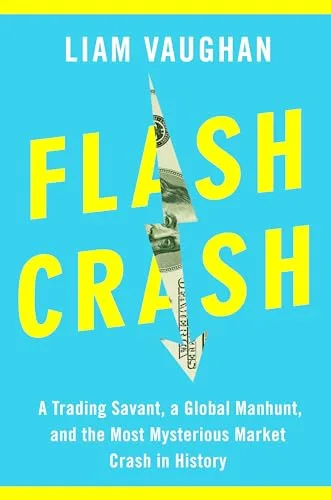
Flash Crash
A Trading Savant, a Global Manhunt, and the Most Mysterious Market Crash in History
by Liam Vaughan
- Published
- 2020
- Pages
- 272 pages
- Publisher
- Doubleday
- Readers
- 3 members have read this
The story of Navinder Singh Sarao, a West London trader who made tens of millions of dollars from his parents' house by spoofing the E-mini S&P 500 futures market, and who US prosecutors later linked to the crash of May 6, 2010. Bloomberg's Liam Vaughan uses the case to explain how electronic markets, high-frequency traders and regulators actually work.
Five years after the flash crash of May 6, 2010, when the Dow fell nearly 1,000 points in minutes, the US charged a little-known British day trader, Navinder Singh Sarao, with helping cause it by flooding the market with orders he never meant to fill. The official SEC and CFTC report had blamed a large sell order in E-mini futures and the high-frequency traders who passed contracts back and forth.
Vaughan, a Bloomberg reporter and coauthor of The Fix, a book on the Libor scandal, tells Sarao's story and uses it to explain spoofing and the electronic markets he traded against.
Kirkus called it a clear-eyed account, found Sarao close to a sympathetic figure and noted that the computer-driven market itself is examined and found wanting. Vaughan leaves readers to weigh whether one trader could have caused the crash, and whether Sarao was a fraudster or a small player fighting back against the high-frequency firms that dominate futures trading.
Anyone who trades futures, builds execution algorithms or works in market surveillance should read it, as should anyone who wants a readable explanation of market microstructure.
- Orders are information. Spoofing works because algorithms read the order book, so large visible orders that are never meant to fill can push prices in a trader's favor.
- Market structure creates new abuses. The move from open-outcry pits to screens made some forms of manipulation easier to commit and harder to see without detailed data.
- Crashes rarely have one cause. The 2010 flash crash involved a large sell program, thin liquidity and fast algorithms, and blaming one trader oversimplifies how cascades happen.
- Enforcement follows the data. Regulators only built a case once they reconstructed order-level records years later, a reminder of how hard real-time surveillance is.
- Trading skill is not financial judgment. Sarao read prices brilliantly but handed much of his fortune to questionable investment schemes.
The book alternates between Sarao's life and the wider story of how futures markets moved from the pits to the screen.
- The making of a trader. Sarao grows up in Hounslow, near Heathrow, and joins a trading arcade, where his speed and pattern recognition on the E-mini contract stand out.
- Man versus machine. As high-frequency firms crowd the market, Sarao trades from his parents' home, grows convinced the system is rigged against him and commissions custom software to place and cancel large orders.
- The crash. On May 6, 2010, the market collapses and rebounds within about half an hour, and the official report focuses on a mutual fund's sell program, leaving many questions open.
- The investigation. Years later, an analysis of order data leads the CFTC and the Justice Department to Sarao, and in April 2015 he is arrested at his parents' house on a US extradition request.
- Reckoning. Sarao fights extradition, pleads guilty to spoofing and fraud in Chicago, cooperates with prosecutors and in 2020 is sentenced to a year of home confinement, while much of his fortune has been lost to bad investments.
An extraordinary tale—Wall Street Journal Compelling and engaging—Financial Times Magnificently detailed yet pacy...Think Trading Places meets Wall Street—Sunday Times (UK) The riveting story of a trading prodigy who amassed $70 million from his childhood bedroom—until the US government accused him of helping trigger an unprecedented market collapse On May 6, 2010, financial markets around the world tumbled simultaneously and without warning. In the span of five minutes, a trillion dollars of valuation was lost. The Flash Crash, as it became known, represented what was then the fastest drop in market history. When share values rebounded less than half an hour later, experts around the globe were left perplexed. What had they just witnessed? Navinder Singh Sarao hardly seemed like a man who would shake the world's financial markets to their core. Raised in a working-class neighborhood in West London, Nav was a preternaturally gifted trader who played the markets like a computer game. By the age of thirty, he had left behind London's trading arcades, working instead out of his childhood home. For years the money poured in. But when lightning-fast electronic traders infiltrated markets and started eating into his profits, Nav built a system of his own to fight back. It worked—until 2015, when the FBI arrived at his door. Depending on whom you ask, Sarao was a scourge, a symbol of a financial system run horribly amok, or a folk hero who took on the tyranny of Wall Street and the high-frequency traders. A real-life financial thriller, Flash Crash uncovers the remarkable, behind-the-scenes narrative of a mystifying market crash, a globe-spanning investigation into international fraud, and a man at the center of them both.
Reader reviews
No reviews yet. Join to write the first one.