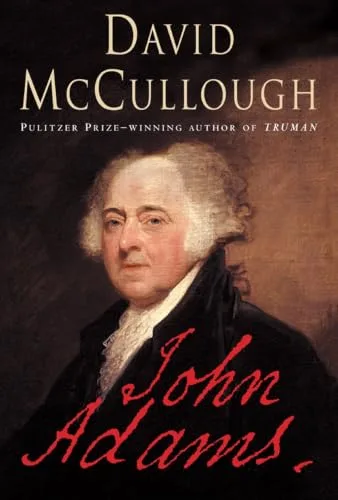
John Adams
- Published
- 2001
- Pages
- 751 pages
- Publisher
- Simon & Schuster
- Readers
- 1 member has read this
David McCullough's Pulitzer Prize-winning biography of the second US president, from Braintree farmer's son and Boston lawyer through the Continental Congress, diplomacy in Paris, the Netherlands and London, and a single embattled term. Built on Adams's letters with Abigail and Jefferson, it is general history, not finance, and a study of judgment and character under pressure.
McCullough's biography covers Adams's whole life, from his Massachusetts boyhood to his long retirement in Quincy. Two relationships anchor the book: his marriage to Abigail, his closest adviser, and his rivalry and late reconciliation with Thomas Jefferson.
McCullough, who also won a Pulitzer for Truman and two National Book Awards, began planning a joint biography of Adams and Jefferson before narrowing to Adams. He spent six years on it, reading the books Adams read and drawing heavily on the Adams family papers. It won the 2002 Pulitzer Prize for Biography and became the basis of HBO's 2008 miniseries starring Paul Giamatti.
Gordon Wood praised it in the New York Review of Books. The New Republic and the Claremont Institute faulted it for saying little about Adams's political thought and writings, and Kirkus, while admiring the prose, noted that it carries almost a second biography of Jefferson. In 2009 McCullough acknowledged misattributing a phrase to Jefferson after a Harper's review flagged it.
There is little here on markets. Finance readers will get a lesson in negotiation, in making unpopular calls that hold up, and in the bitter partisan fights of the 1790s, told by one of the best narrative historians of his generation.
- Make the unpopular call when it's right. Adams defended the British soldiers in 1770 and pursued peace with France in 1799 knowing both choices would cost him politically.
- Credit follows credibility. His persistence in the Netherlands won recognition and loans from Amsterdam bankers when the young country had little to offer but its promise to pay.
- A trusted counselor is an edge. The letters show Abigail as his sharpest adviser and the manager of the family farm and household during his long absences.
- Rivals can be reconciled. Adams and Jefferson broke bitterly over politics, then rebuilt their friendship by letter for the last 14 years of their lives.
- Institutions outlast administrations. Adams lost in 1800 but kept the country out of a full war with France and handed power peacefully to an opposing party, a precedent that mattered more than his own term.
The book is arranged in three chronological parts: Revolution, Distant Shores and Independence Forever. The last is split in two here.
- Revolution. Adams's road from Braintree farm boy to Boston lawyer, his defense of the soldiers after the Boston Massacre, and his role in the Continental Congress as the leading voice for independence in 1776.
- Distant shores. His appointment to France alongside Benjamin Franklin, the mission to the Netherlands that won Dutch recognition and loans for the new republic, the peace negotiations that ended the war, Abigail's arrival in Paris and his years as the first American minister to Britain.
- Heir apparent and statesman. The frustrations of the vice presidency under Washington and his presidency from 1797, dominated by the crisis with France, the XYZ affair, the Alien and Sedition Acts and his decision to pursue peace, which split his party and helped cost him the 1800 election.
- Journey's end. Retirement in Quincy, Abigail's death in 1818, the renewed friendship and correspondence with Jefferson, and the deaths of both men on July 4, 1826, the fiftieth anniversary of the Declaration of Independence.
Reader reviews
No reviews yet. Join to write the first one.