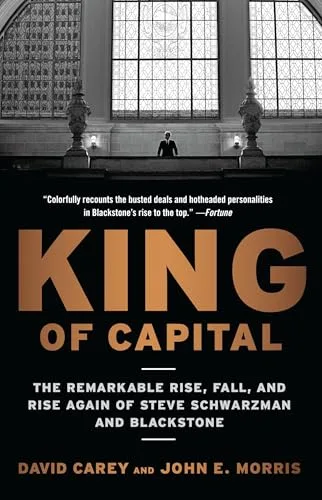
King of Capital
The Remarkable Rise, Fall, and Rise Again of Steve Schwarzman and Blackstone
by David Carey and John E. Morris
- Published
- 2010
- Pages
- 400 pages
- Publisher
- Currency
- Readers
- 5 members have read this
A history of Blackstone, from a two-man shop founded by Steve Schwarzman and Pete Peterson in 1985 to its $4 billion IPO in 2007 and the crisis that followed. It doubles as one of the clearest histories of the buyout industry, explaining how leverage, debt markets and dealmaking turned private equity into a pillar of modern finance.
David Carey and John E. Morris tell the story of Blackstone, from its 1985 start as a mergers advisory boutique run by two Lehman Brothers alumni, Pete Peterson and Steve Schwarzman, through the buyout booms and busts that came after, to its 2007 listing.
The authors are veteran private equity reporters. Carey covered private equity for The Deal from 1999 and later for Bloomberg News. Morris, a former lawyer, was an assistant managing editor at The Deal and deputy managing editor at Dow Jones Investment Banker. They had unusual access to Schwarzman, his partners and alumni, and Henny Sender wrote in the Financial Times that the access did not compromise their objectivity.
The book reads as a biography of an industry as much as of a man. The Economist singled out its explanation of how debt markets moved from junk bonds to securitized loans and how that changed which deals buyout firms could finance. Schwarzman comes across as driven, cautious about losses and occasionally abrasive, and his pay and lifestyle are reported plainly.
Because the authors worked with Schwarzman's cooperation, readers should weigh the portrait accordingly, though reviewers in the Philadelphia Inquirer and Bloomberg Brief found it even-handed and frank about his excesses and failed deals. For anyone heading into private equity, M&A or leveraged finance, it remains a standard introduction.
- Leverage is the engine. Buyout returns depend on borrowed money, and the supply of credit decides which deals happen. The move from junk bonds to securitized loans changed private equity as much as any dealmaker did.
- Avoid the big loss first. Blackstone's culture prized not losing money, and that caution helped it survive downturns that broke more aggressive rivals.
- Fundraising is the hard part. Even well-connected founders struggled to raise a first fund. A track record and limited partner trust are the real barriers to entry.
- Diversify the platform. Real estate, hedge funds and advisory work turned a buyout shop into an alternative asset manager with steadier fees, a model the rest of the industry later copied.
- Public scrutiny follows success. The IPO and Schwarzman's visible wealth brought political attention to pay and taxes, a reminder that reputation is part of a financial firm's risk.
The narrative runs in rough chronological order, with Blackstone's deals used to explain how each stage of the buyout business worked.
- Founding. Peterson recruits Schwarzman, the pair leave Lehman, and Blackstone opens as an advisory boutique. Raising the first fund proves far harder than expected until investors such as Nikko Securities, Prudential and the General Motors pension fund commit.
- Building the franchise. Blackstone positions itself as a friendly partner to management rather than a corporate raider. It survives the late-1980s bust that broke rivals and branches into real estate, hedge funds and advisory work. Larry Fink's BlackRock starts life inside Blackstone, until a falling-out over money leads Schwarzman to sell the stake, a decision he later called his worst.
- The boom. As financing shifts from Drexel-era junk bonds to securitized loans, buyouts grow larger. Blackstone outgrows its older rival KKR, and Schwarzman becomes the face of a new class of Wall Street fortunes.
- The peak. The 2007 IPO and Schwarzman's 60th birthday party make the firm a symbol of the era and a political target over pay and taxes.
- Crash and recovery. The credit crisis hits Blackstone's share price and portfolio, and the closing chapters show how the firm recovered while the banks that once financed its deals were weakened.
Strippers and Flippers . . . or a New Positive Force Helping to Drive the Economy . . . The untold story of Steve Schwarzman and Blackstone, the financier and his financial powerhouse that avoided the self-destructive tendencies of Wall Street. David Carey and John Morris show how Blackstone (and other private equity firms) transformed themselves from gamblers, hostile-takeover artists, and ‘barbarians at the gate’ into disciplined, risk-conscious investors. The financial establishment—banks and investment bankers such as Citigroup, Bear Stearns, Lehman, UBS, Goldman Sachs, Merrill Lynch, Morgan Stanley—were the cowboys, recklessly assuming risks, leveraging up to astronomical levels and driving the economy to the brink of disaster. Blackstone is now ready to break out once again since it is sitting on billions of dollars that can be invested at a time when the market is starved for capital. The story of a financial revolution—the greatest untold success story on Wall Street:Not only have Blackstone and a small coterie of competitors wrested control of corporations around the globe, but they have emerged as a major force on Wall Street, challenging the likes of Goldman Sachs and Morgan Stanley for dominance. Great human interest story:How Blackstone went from two guys and a secretary to being one of Wall Street’s most powerful institutions, far outgrowing its much older rival KKR; and how Steve Schwarzman, with a pay packet one year of $398 million and $684 million from the Blackstone IPO, came to epitomize the spectacular new financial fortunes amassed in the 2000s. Controversial:Analyzes the controversies surrounding Blackstone and whether it and other private equity firms suck the lifeblood out of companies to enrich themselves—or whether they are a force that helps make the companies they own stronger and thereby better competitors. The story by two insiders with access:Insightful and hard-hitting, filled with never-before-revealed details about the workings of a heretofore secretive company that was the personal fiefdom of Schwarzman and Peter Peterson. Forward-looking:How Blackstone and private equity will drive the economy and provide a model for how financing will work. From the Hardcover edition.
Reader reviews
No reviews yet. Join to write the first one.