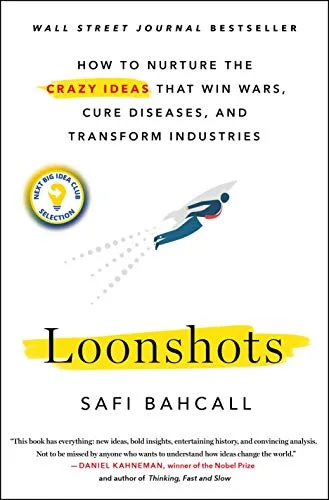
Loonshots
How to Nurture the Crazy Ideas That Win Wars, Cure Diseases, and Transform Industries
by Safi Bahcall
- Published
- 2019
- Pages
- 368 pages
- Publisher
- St. Martin's Press
- Readers
- 2 members have read this
A physicist turned biotech CEO argues that organizations reject great ideas because of their structure, not their culture, and that small changes to incentives and team design can flip a firm from innovating to stagnating, the way water suddenly freezes. Investors judging whether a company can keep inventing will find a practical framework here.
Safi Bahcall trained as a theoretical physicist at Harvard and Stanford, worked at McKinsey, and then co-founded Synta Pharmaceuticals, which he took public on Nasdaq in 2007 and ran for 13 years. He defines a loonshot as a widely dismissed idea whose backers are written off as cranks. His question is why groups full of talented people so often kill those ideas.
His answer borrows from the physics of phase transitions. Just as water turns into ice at a critical temperature, a team can suddenly flip from welcoming risky ideas to protecting its existing franchises. Bahcall argues that the switch depends on structure, not culture: on how big teams are, and on the balance between stake in a project's outcome and the rewards of rank. He builds this into what he calls the Bush-Vail rules, after Vannevar Bush and Theodore Vail, and illustrates them with stories ranging from radar and statins to Pan Am and Polaroid.
Publishers Weekly called it spirited but not groundbreaking, though it found the presentation persuasive, and readers who know the innovation literature will find many of its ideas familiar. It works best for managers, venture and biotech investors, and analysts who need a way to judge whether a company's structure supports innovation or smothers it.
- Structure beats culture. The same people behave differently depending on incentives and team design, so look at how a firm is organized, not just what it says about innovation.
- Separate artists and soldiers, then manage the transfer. Radical research and the core franchise need different groups and rules. The hard part is moving ideas between them.
- Early failure can mislead. Many breakthrough drugs and products looked dead early on. Tests that are designed or read badly can kill good ideas.
- Strategy loonshots hide in plain sight. Incumbents often miss business-model shifts, not technology shifts. Bahcall's airline chapter sets Pan Am's product bets against the strategy innovations of Robert Crandall's American Airlines.
- Incentives tip at scale. As a firm grows, the payoff from politicking rises relative to the payoff from good work. Rewarding project outcomes rather than promotions raises the size at which a company stops innovating.
The book works through a run of case-study chapters that build what Bahcall calls the Bush-Vail rules, then turns to the physics behind them.
- How loonshots won a war. Bahcall opens with Vannevar Bush, who ran American military research in World War II, and pairs him with Theodore Vail of AT&T. Their lesson is to keep a separate group for risky ideas and a separate group for the core business, and to manage the transfer between them rather than favoring either side.
- Fragile ideas. Breakthroughs usually pass through a stage where they look like failures. The examples include the long road to statins and Lipitor, and the first James Bond film, which studios passed on.
- Two types of loonshots. A chapter that sets Pan Am's Juan Trippe against American Airlines' Robert Crandall separates product loonshots, which are new technologies, from strategy loonshots, which are new ways of doing business that incumbents tend to miss.
- The Moses trap. Edwin Land's Polaroid shows what happens when progress depends on a revered leader personally choosing which ideas go forward. A second chapter covers how firms escape the trap.
- The science of sudden change. Two chapters on phase transitions show how incentive structure and team size set a critical size, the magic number, past which politics beats projects. The rules come down to separating the phases, creating dynamic equilibrium, spreading a system mindset and raising the magic number. Bahcall also applies the model to nations, asking why imperial China under the Qing stopped nurturing new ideas.
- Instant WSJ bestseller * Translated into 18 languages * #1 Most Recommended Book of the year (Bloomberg annual survey of CEOs and entrepreneurs) * An Amazon, Bloomberg, Financial Times, Forbes, Inc., Newsweek, Strategy + Business, Tech Crunch, Washington Post Best Business Book of the year * Recommended by Bill Gates, Daniel Kahneman, Malcolm Gladwell, Dan Pink, Adam Grant, Susan Cain, Sid Mukherjee, Tim Ferriss Why do good teams kill great ideas? Loonshots reveals a surprising new way of thinking about the mysteries of group behavior that challenges everything we thought we knew about nurturing radical breakthroughs. Bahcall, a physicist and entrepreneur, shows why teams, companies, or any group with a mission will suddenly change from embracing new ideas to rejecting them, just as flowing water will suddenly change into brittle ice. Mountains of print have been written about culture. Loonshots identifies the small shifts in structure that control this transition, the same way that temperature controls the change from water to ice. Using examples that range from the spread of fires in forests to the hunt for terrorists online, and stories of thieves and geniuses and kings, Bahcall shows how a new kind of science can help us become the initiators, rather than the victims, of innovative surprise. Over the past decade, researchers have been applying the tools and techniques of this new science—the science of phase transitions—to understand how birds flock, fish swim, brains work, people vote, diseases erupt, and ecosystems collapse. Loonshots is the first to apply this science to the spread of breakthrough ideas. Bahcall distills these insights into practical lessons creatives, entrepreneurs, and visionaries can use to change our world. Along the way, readers will learn how chickens saved millions of lives, what James Bond and Lipitor have in common, what the movie Imitation Game got wrong about WWII, and what really killed Pan Am, Polaroid, and the Qing Dynasty. If The Da Vinci Code and Freakonomics had a child together, it would be called Loonshots.” —Senator Bob Kerrey
Reader reviews
No reviews yet. Join to write the first one.