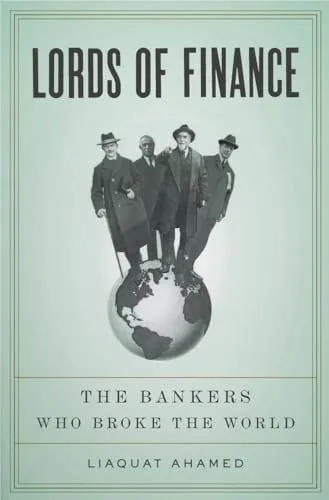
Lords of Finance
The Bankers Who Broke the World
- Published
- 2009
- Pages
- 564 pages
- Publisher
- Penguin Press
- Readers
- 3 members have read this
A Pulitzer Prize-winning history of the four central bankers who ran the world's money between the two world wars, and of how their loyalty to the gold standard turned a 1929 stock crash into a global depression. It is the best narrative introduction to how monetary policy, war debts and capital flows can break an economy.
Liaquat Ahamed tells the story of the interwar economy through four central bankers: Montagu Norman of the Bank of England, Benjamin Strong of the Federal Reserve Bank of New York, Emile Moreau of the Banque de France and Hjalmar Schacht of the Reichsbank. He argues that their efforts to rebuild the prewar gold standard, made largely out of public view, fed the late-1920s boom and then turned the downturn after 1929 into a worldwide collapse. John Maynard Keynes runs through the book as the critic who was usually right.
Ahamed spent his career in markets rather than academia. He headed the World Bank's investment division and was chief investment officer and later chief executive of the bond manager Fischer Francis Trees & Watts. That background shows in his clear handling of exchange rates, gold flows and interest rates.
The book won the 2010 Pulitzer Prize for History and the 2009 Financial Times and Goldman Sachs Business Book of the Year award. Joe Nocera in the New York Times admired its sweep and its characters. The New Left Review, while calling it the most engaging account of the run-up to 1929, argued that it is too kind to modern central bankers by comparison. Economists such as Barry Eichengreen cover the same ground in more technical form in Golden Fetters.
Read it to understand why central bank independence, reserve currencies and fixed exchange rates matter.
- Fixed exchange rates transmit shocks. Under the gold standard, a squeeze in one country forced others to tighten, which spread the Depression around the world.
- The wrong parity costs a decade. Britain's 1925 return to gold at the prewar rate left sterling overvalued and the economy weak for years.
- Debt chains are fragile. German reparations, Allied war debts and American lending formed a loop that broke when US capital stopped flowing.
- Easy money can feed a bubble elsewhere. Ahamed argues that Strong's 1927 rate cut, made to help Europe, also fueled speculation on Wall Street.
- Leaving the system early helped. Countries that abandoned gold early, such as Britain in 1931, generally recovered sooner than those that held on.
The book is organized in five parts, moving chronologically from 1914 to 1944.
- The Unexpected Storm, August 1914. Ahamed describes the financial panic at the outbreak of war, then introduces his four bankers, from the reclusive Norman to Strong, Moreau and Schacht, and the war finance that left Europe in debt.
- After the Deluge, 1919-23. He covers the peace settlement and Keynes's attack on reparations, America's insistence on repayment of war loans, and German hyperinflation, which Schacht helped end with a new currency.
- Sowing a New Wind, 1923-28. The Dawes Plan restarts lending to Germany, Winston Churchill returns sterling to gold at its prewar parity in 1925, Moreau stabilizes the franc, and Strong eases US credit in 1927 to support Britain.
- Reaping Another Whirlwind, 1928-33. After Strong's death the Fed tightens, Wall Street crashes, and bank failures spread from Austria to Germany, a run on sterling forces Britain off gold in 1931, and the US banking system collapses.
- Aftermath, 1933-44. Franklin Roosevelt takes the dollar off gold, recovery begins in the countries that abandoned it, and the part closes in 1944, the year of the Bretton Woods conference, followed by an epilogue.
Argues that the stock market crash of 1929 and subsequent Depression occurred as a result of poor decisions on the part of four central bankers who jointly attempted to reconstruct international finance by reinstating the gold standard.
Reader reviews
No reviews yet. Join to write the first one.