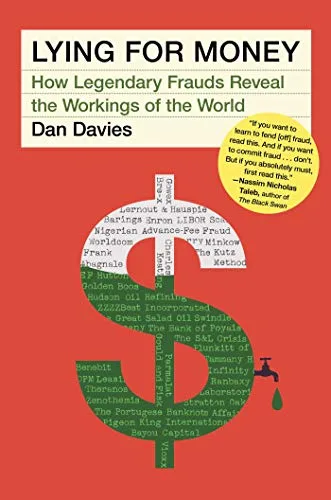
Lying for Money
How Legendary Frauds Reveal the Workings of the World
by Dan Davies
- Published
- 2018
- Pages
- 304 pages
- Publisher
- Scribner
- Readers
- 2 members have read this
A former Bank of England regulatory economist and bank analyst sorts financial fraud into four basic types: the long firm, counterfeiting, control fraud and market crimes. He shows how each one exploits the trust that makes commerce cheap. Funny and analytical, it teaches finance readers to think like auditors and to see why every fraud eventually has to grow, or collapse.
Most white-collar crime, Dan Davies argues, works by manipulating institutional psychology. The fraudster creates something that looks as much as possible like a normal set of transactions, and the drama comes only when it unwinds. Davies insists there are only a few basic ways to do this: the long firm, counterfeiting, control fraud and market crimes. His cases run from the fictional country of Poyais to Bre-X and Theranos.
Davies spent about twenty years around bank regulation, first as a junior economist at the Bank of England and then as an analyst for investment banks, and his work touched the LIBOR and forex scandals. That background gives the book its main idea. Modern economies run on trust because checking everything is too expensive, so some fraud is the price of an efficient system.
The Sunday Times praised its wit and insight, John Kay called it indispensable, and Nassim Taleb recommended it to anyone who wants to fend off fraud. The Financial Times noted that Davies handles the gray areas of fraud well. Kirkus suggested it suits readers who like economics mixed into their true crime.
It is for auditors, credit analysts, compliance officers, short sellers and anyone doing due diligence.
- Fraud is a betrayal of trust, not of security. Businesses skip most checks because checking everything would be too expensive. Fraudsters target the shortcuts that make commerce efficient.
- Four templates cover almost everything. Ask whether a suspected scheme is a long firm, a counterfeit, a control fraud or a market crime. The category tells you where to look.
- Frauds must grow. Covering past losses requires ever larger new inflows, so fast growth combined with opaque accounts should raise suspicion rather than admiration.
- Insiders are the biggest risk. Control frauds by the people running a company or bank do the most damage, because they control the audit trail and the information investors see.
- Zero fraud is the wrong target. A system tight enough to stop every fraud would choke normal business. The real job is setting checks where the expected losses justify them.
After an opening chapter, The Way of the World, which uses a dark-web drug dealer's confession to show that the classic frauds are ancient, the book works through the four basic types and then draws general lessons.
- The long firm. Fraudsters build a record as reliable customers, take as much credit as they can and disappear. Davies traces the pattern from mob bust-outs to online marketplaces.
- Counterfeiting. Faked goods, documents, securities and assets attack the verification systems that commerce relies on. The book's historical cases include the Portuguese Banknote Affair of the 1920s.
- Control fraud. Executives turn an institution's own systems against its investors, as in the savings-and-loan crisis, where rapid growth hid bad loans until they aged.
- Market crimes. Price manipulation, rigged benchmarks and other abuses of market information turn trust in prices into a weapon.
- The economics of fraud. Davies explains why frauds must grow exponentially, why they collapse, why auditors and regulators miss them, and why a society that eliminated fraud would have to give up the efficiency that trust provides.
An entertaining, deeply informative explanation of how high-level financial crimes work, written by an industry insider who’s an expert in the field. The way most white-collar crime works is by manipulating institutional psychology. That means creating something that looks as much as possible like a normal set of transactions. The drama comes later, when it all unwinds. Financial crime seems horribly complicated, but there are only so many ways you can con someone out of what’s theirs. In Lying for Money, veteran regulatory economist and market analyst Dan Davies tells the story of fraud through a genealogy of financial malfeasance, including: the Great Salad Oil swindle, the Pigeon King International fraud, the fictional British colony of Poyais in South America, the Boston Ladies’ Deposit Company, the Portuguese Banknote Affair, Theranos, and the Bre-X scam. Davies brings new insights into these schemes and shows how all frauds, current and historical, belong to one of four categories (long firm,” counterfeiting, control fraud, and market crimes) and operate on the same basic principles. The only elements that change are the victims, the scammers, and the terminology. Davies has years of experience picking the bones out of some of the most famous frauds of the modern age. Now he reveals the big picture that emerges from their labyrinths of deceit and explains how fraud has shaped the entire development of the modern world economy.
Reader reviews
No reviews yet. Join to write the first one.