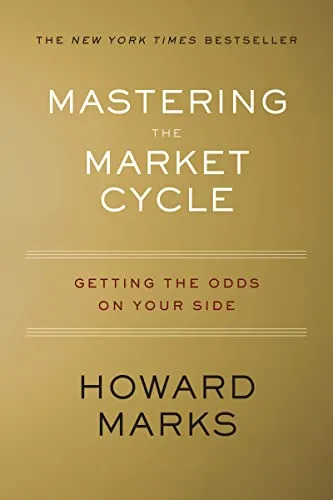
Mastering the Market Cycle
Getting the Odds on Your Side
by Howard Marks
- Published
- 2018
- Pages
- 336 pages
- Publisher
- Harper Business
- Readers
- 3 members have read this
Oaktree co-founder Howard Marks argues that nobody can forecast the market, but a disciplined investor can judge where we stand in the cycle and tilt the odds. He takes apart the economic, profit, credit, distressed debt and real estate cycles and shows how investor psychology links them, which is the kind of judgment that separates good credit and value investors from the rest.
Howard Marks co-founded Oaktree Capital Management, one of the largest investors in distressed debt, and is known on Wall Street for the client memos he has written since 1990. This is his second book after The Most Important Thing (2011). Its question is narrow and practical: since we can't know the future, can we at least know where we are? Marks says yes. By watching valuations, credit terms and how other investors behave, you can tell whether the market is hot or cold and set your aggressiveness to match.
The central image is the pendulum. Markets spend little time at fair value and swing between greed and fear, credulity and skepticism, risk tolerance and risk aversion. Marks shows how each cycle feeds the next, from profits to sentiment to credit to the distressed debt and real estate cycles.
Much of the book's authority comes from Marks's own record in distressed debt through the 1990 bust and the 2008 Lehman collapse. Reviewers have noted limits. In the CFA Institute's Enterprising Investor, Robert Farago found it repetitive in places, more common sense than revelation, and silent on the commodity and political cycles, though he concluded that it had sharpened his thinking.
It suits credit, value and multi-asset investors, and any analyst who wants a vocabulary for talking about risk appetite. Read it after The Most Important Thing and alongside the Oaktree memos.
- Know where you are, not where you are going. You can't forecast the macro outlook, but you can judge whether assets are priced for perfection or for disaster and whether lenders are loose or tight.
- Risk is highest when it feels lowest. Rising prices make investors more comfortable with risk, which pushes prices higher and lowers future returns. The reverse is true at the bottom.
- Watch the credit window. Easy issuance, weak covenants and eager buyers of risky debt are among the most reliable signs that a cycle is late. When the window closes it can cause a downturn on its own.
- Calibrate, don't flip. The aim is to adjust a portfolio's aggressiveness at the margins as conditions get extreme, not to go all in or all out on a market call.
- Success sows the seeds of excess. Strong results bring complacency, leverage and new entrants, so a firm's or a market's best years often set up its worst ones.
The book runs eighteen short chapters that move from theory to the individual cycles and then to what an investor can do about them.
- Why and how cycles work (chapters 1-3). Marks compares investing to drawing balls from an urn whose mix changes over time. Cycles are chains of cause and effect driven by overreaction, they are irregular in length, and they rarely rest at the midpoint.
- The underlying cycles (chapters 4-6). The economic cycle, government attempts to smooth it through monetary and fiscal policy, and the profit cycle, which swings harder than GDP because of operating and financial leverage.
- Psychology and risk (chapters 7-8). The pendulum of investor psychology and the cycle in attitudes toward risk. When investors believe risk is low, they bid prices up until risk is high.
- Credit, distress and property (chapters 9-11). The credit window opens and slams shut, sometimes causing recessions by itself. Marks's own distressed debt cycle and the long lags of real estate development amplify the swings.
- Using the cycle (chapters 12-15). Marks puts it all together as the market cycle, explains how to take the market's temperature, and shows how to position a portfolio between aggressive and defensive. He illustrates the method with Oaktree's calls in the 2000s and around 2008, then sets out the limits of what this can achieve.
- Closing (chapters 16-18). The cycle in success, the future of cycles, and a summary of their essence.
A NEW YORK TIMES, WALL STREET JOURNAL, AND USA TODAY BESTSELLER The legendary investor shows how to identify and master the cycles that govern the markets. We all know markets rise and fall, but when should you pull out, and when should you stay in? The answer is never black or white, but is best reached through a keen understanding of the reasons behind the rhythm of cycles. Confidence about where we are in a cycle comes when you learn the patterns of ups and downs that influence not just economics, markets, and companies, but also human psychology and the investing behaviors that result. If you study past cycles, understand their origins and remain alert for the next one, you will become keenly attuned to the investment environment as it changes. You’ll be aware and prepared while others get blindsided by unexpected events or fall victim to emotions like fear and greed. By following Marks’s insights—drawn in part from his iconic memos over the years to Oaktree’s clients—you can master these recurring patterns to have the opportunity to improve your results.
Reader reviews
No reviews yet. Join to write the first one.