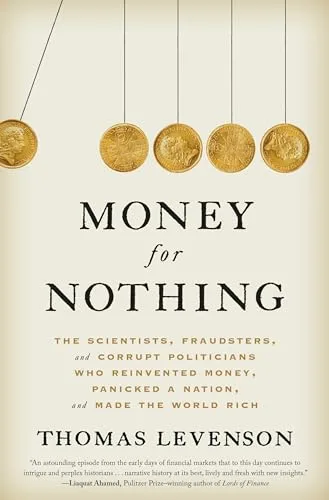
Money for Nothing
The Scientists, Fraudsters, and Corrupt Politicians Who Reinvented Money, Panicked a Nation, and Made the World Rich
- Published
- 2020
- Pages
- 480 pages
- Publisher
- Random House
- Readers
- 2 members have read this
A history of the South Sea Bubble of 1720 that starts with Isaac Newton and Edmond Halley, not with the crash. Levenson shows how the quantitative thinking of the Scientific Revolution gave Britain the tools of modern finance, from life tables to tradable government debt, and how the same tools fed one of history's great frauds before they made the country rich.
Most accounts of the South Sea Bubble treat it as a parable of greed. Levenson tells a longer and more useful story: how English thinkers after Newton's Principia began to apply numbers to human affairs, how a state at war learned to borrow against future taxes, and how that led to the mania of 1720 that ruined thousands of investors, Newton among them.
Levenson, a professor of science writing at MIT and author of Newton and the Counterfeiter, is at home with both the science and the politics. His case is that the bubble was a scam and also a beginning: the wreckage was managed into a stable system of long-term public credit that financed British power for the next century.
James Grant reviewed it in The Wall Street Journal and John Plender in the Financial Times, which named it an economics book of the year. Publishers Weekly praised its eye for revealing anecdotes. The Spectator noted the tale is familiar, if told with a light touch.
Read it for the origins of the bond market, actuarial pricing and central banking, and for a clear case of how financial innovation and fraud tend to arrive together. It pairs well with Edward Chancellor's Devil Take the Hindmost.
- Innovation and fraud share a birthday. The tools that made modern finance possible, from tradable debt to actuarial pricing, were first used at scale in a scheme built on bribery and hype.
- Public credit is a technology. Britain's ability to borrow cheaply against future taxes, not its gold, financed its wars and empire, and that capacity had to be built and protected.
- Mathematics made risk priceable. Halley's life table turned mortality into something that could be calculated, the basis for annuities, insurance and the pricing of time.
- Leverage drives manias. South Sea shares rose on installment purchases and loans secured by the shares themselves, a pattern that reappears in later bubbles.
- Intelligence is no protection. Newton lost heavily in 1720, a reminder that understanding the physical world does not translate into reading crowds.
The book moves from the Scientific Revolution to the bubble and its aftermath, closing with reflections on modern crises.
- Numbers meet the world. Newton's work during the plague years, the Royal Society and Halley's life table show a new habit of measuring and calculating human affairs, including risk and mortality.
- War and money. England's long struggle with France forces the state to borrow on a new scale, through the Bank of England in 1694, lotteries and annuities, while Newton oversees the great recoinage at the Mint.
- The South Sea Company. Founded in 1711 to take on government debt in return for trading rights in Spanish America, the company has few ships and little trade, but a gift for financial engineering.
- The bubble of 1720. The company's directors propose converting the national debt into shares, bribe politicians to win approval, and drive the price up through installment sales and loans against stock, while John Law runs a parallel scheme in France. Then the price collapses.
- Aftermath and invention. Parliament investigates, and Walpole steers a settlement that preserves public credit, leaving Britain with a durable system of state finance that Levenson links to the 2008 crisis and today's markets.
The sweeping story of how the greatest minds of the Scientific Revolution applied their new ideas to people, money, and markets—and along the way, invented modern finance. An astounding episode from the early days of financial markets that to this day continues to intrigue and perplex historians . . . narrative history at its best, lively and fresh with new insights.”—Liaquat Ahamed, Pulitzer Prize–winning author of Lords of Finance Money for Nothing chronicles the moment when the needs of war, discoveries of natural philosophy, and ambitions of investors collided. It's about how the Scientific Revolution intertwined with finance to set England—and the world—off in an entirely new direction. At the dawn of the eighteenth century, England was running out of money due to a prolonged war with France. Parliament tried raising additional funds by selling debt to its citizens, taking in money now with the promise of interest later. It was the first permanent national debt, but still they needed more. They turned to the stock market—a relatively new invention itself—where Isaac Newton's new mathematics of change over time, which he applied to the motions of the planets and the natural world, were fast being applied to the world of money. What kind of future returns could a person expect on an investment today? The Scientific Revolution could help. In the hub of London's stock market—Exchange Alley—the South Sea Company hatched a scheme to turn pieces of the national debt into shares of company stock, and over the spring of 1720 the plan worked brilliantly. Stock prices doubled, doubled again, and then doubled once more, getting everyone in London from tradespeople to the Prince of Wales involved in money mania that consumed the people, press, and pocketbooks of the empire. Unlike science, though, with its tightly controlled experiments, the financial revolution was subject to trial and error on a grand scale, with dramatic, sometimes devastating, consequences for people's lives. With England at war and in need of funds and stock-jobbers looking for any opportunity to get in on the action, this new world of finance had the potential to save the nation—but only if it didn't bankrupt it first.
Reader reviews
No reviews yet. Join to write the first one.