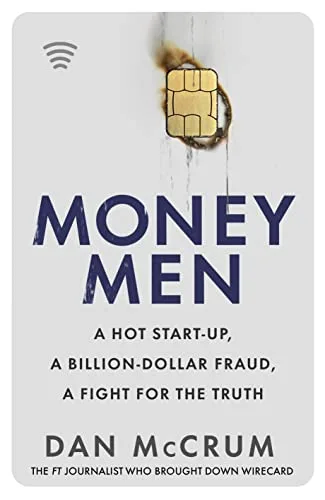
Money Men
A Hot Startup, a Billion Dollar Fraud, a Fight for the Truth
by Dan McCrum
- Published
- 2022
- Pages
- 336 pages
- Publisher
- Bantam Press
- Readers
- 3 members have read this
The Financial Times reporter who exposed Wirecard tells how a German payments company inflated its business through partners in Asia, reached the DAX, and spent years attacking the journalists and short sellers who doubted it, until €1.9 billion turned out not to exist in June 2020. A first-hand account of a fraud that auditors and regulators missed.
Wirecard was Germany's answer to Silicon Valley: a Munich payments processor that joined the DAX in 2018 and was briefly worth more than Deutsche Bank. Dan McCrum spent more than five years arguing that much of its business was fake, until the company became insolvent in 2020 after admitting that €1.9 billion of cash could not be found. Money Men is his account of that investigation.
McCrum is unusually well placed to tell it. He worked in Citigroup's equity research department, joined the FT in 2007 and wrote for FT Alphaville before moving to investigations. His Wirecard reporting won him Press Gazette's journalist of the year award for 2020 and two Gerald Loeb Awards.
What sets it apart from other fraud books is how much of it happens to the author, from surveillance and hacking attempts to a criminal investigation that Munich prosecutors opened against him and his colleague Stefania Palma. It also shows how Germany's regulator BaFin sided with the company against its critics, and how EY signed off on its accounts year after year. The Economist called the book required reading for investors and financial regulators.
It is essential for short sellers, auditors, compliance staff and anyone who has been told a high-flying stock is being unfairly attacked.
- Check where the profit comes from. Wirecard's earnings depended on a handful of opaque partners in Asia, a concentration that should have alarmed analysts long before the cash went missing.
- Cash on the balance sheet still needs verifying. EY accepted trust-account confirmations for years, and the €1.9 billion turned out not to exist.
- Regulators can pick the wrong side. BaFin banned short selling and pursued journalists while the fraud continued, a reminder that official support for a company is not evidence.
- Attacks on critics are a warning sign. Wirecard's surveillance and harassment of skeptics were themselves a strong signal that something was being hidden.
- Short sellers and reporters are part of market discipline. The case shows how much investors depend on people willing to dig, publish and take the legal risk.
McCrum tells the story as a chronological investigation, alternating between his reporting and the company's response.
- The tip. In 2014 John Hempton points McCrum at Wirecard's unusual acquisitions and Asian operations. McCrum's 2015 Alphaville series, House of Wirecard, questions the numbers, and Wirecard dismisses its critics.
- The short sellers. A 2016 attack by the anonymous Zatarra Research report crashes the stock, but regulators investigate the critics rather than the company. McCrum describes the private investigators and intimidation that follow skeptics.
- The whistleblower. A Wirecard lawyer in Singapore, later revealed as Pav Gill, passes McCrum a trove of internal documents. FT stories in January 2019 about suspect transactions in Singapore knock billions off Wirecard's value, and BaFin responds by banning short selling and filing a complaint against the reporters.
- The documents. McCrum and Stefania Palma show that much of Wirecard's profit came through a few opaque third-party partners. In October 2019 the FT publishes documents suggesting revenue was inflated, and a special audit by KPMG later fails to verify the profits.
- The collapse. In June 2020 Wirecard admits the €1.9 billion supposedly held in Philippine trust accounts is missing. CEO Markus Braun is arrested, chief operating officer Jan Marsalek disappears, and the company files for insolvency.
When journalist Dan McCrum followed a tip to investigate the hot new tech company challenging Silicon Valley, everything about Wirecard looked a little too good to be true: offices were sprouting up around the world, it was reporting runaway growth and the CEO even wore a black turtleneck in tribute to Steve Jobs. In the space of a few short years, the company had come from nowhere to overtake industry giants like Commerzbank and Deutsche Bank on the stock market.
As McCrum dug deeper, he encountered a story stranger and more dangerous than he ever imagined: a world of short sellers and whistleblowers, pornographers and private militias, hackers and spies. Before long he realised that he wasn't the only one in pursuit. Shadowy figures were following him through the streets of London, high-flying lawyers were sending ominous letters to his boss, and he was named as the prime suspect in a criminal inquiry. The race was on to prove his suspicions and clear his name.
Money Men is the astonishing true story of Wirecard's multi-billion-dollar fraud, Europe's biggest new tech darling revealed as a house of cards.
Uncovering fake bank accounts, fake offices and possibly even a fake death, McCrum offers a searing exposé that will finally lay bare the truth.
Reader reviews
No reviews yet. Join to write the first one.