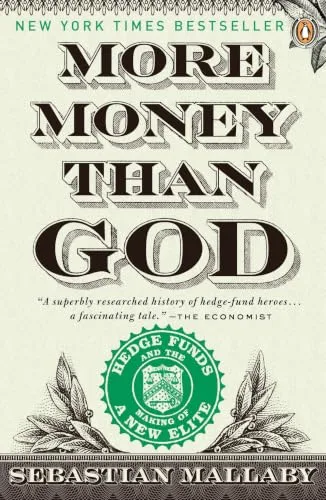
More Money Than God
Hedge Funds and the Making of a New Elite
- Published
- 2010
- Pages
- 512 pages
- Publisher
- Penguin Books
- Readers
- 3 members have read this
The definitive history of the hedge fund industry, from Alfred Winslow Jones's first hedged fund in the 1940s through Soros, Tiger, LTCM, Renaissance and John Paulson's subprime short. Sebastian Mallaby explains each manager's actual edge and makes a provocative case that hedge funds are less dangerous to the financial system than the banks that regulators protect.
Sebastian Mallaby tells the story of hedge funds through the people who built them, one chapter per figure or firm. He starts with Alfred Winslow Jones, who in the late 1940s paired long and short positions with leverage and a performance fee, then traces how successors from Julian Robertson and George Soros to Jim Simons each found a different way to beat the market. Unlike most books on the subject, it focuses on investment method rather than glamour.
Mallaby, a senior fellow at the Council on Foreign Relations and a former Economist correspondent and Washington Post columnist, brings a macroeconomist's eye. He is at his best on the big macro trades, such as Soros's 1992 bet against sterling, and in explaining what Long-Term Capital Management got wrong. The Wall Street Journal named it one of the ten best books of 2010, and it was shortlisted for the FT and Goldman Sachs Business Book of the Year.
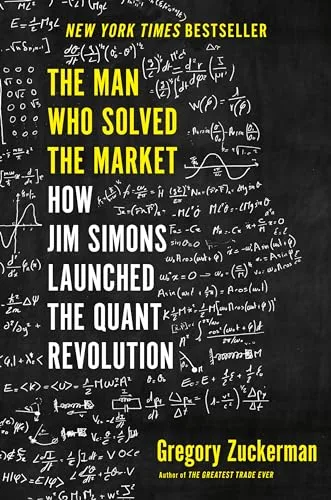
The argument is pointed: because managers invest their own money alongside clients and their funds are small enough to fail, hedge funds are more prudent than heavily regulated, too-big-to-fail banks and should be left largely free. Publishers Weekly found that enthusiasm for unfettered risk-taking not always convincing, and Kirkus noted that the story contains almost no women. Readers wanting the quantitative side in depth should pair it with Gregory Zuckerman's The Man Who Solved the Market. For anyone heading to a fund or allocating to one, this is the essential history.
- The original model was about risk control. Jones combined long and short positions so that skill, not the market's direction, drove returns, an idea every long-short fund still sells.
- Every great fund had a specific edge. Steinhardt's order flow, Soros's macro reading, Robertson's stock research and Simons's statistics were different advantages, and the book shows that edges decay as others copy them.
- Leverage plus crowding kills. LTCM's 1998 collapse showed how borrowed money and positions copied across the market can turn a modest move in spreads into a run on the fund.
- Skin in the game changes behavior. Mallaby argues that managers with their own capital at risk and no government backstop take more care than bank executives do.
- Policy creates the biggest trades. Fixed exchange rates and central-bank surprises, from sterling in 1992 to bonds in 1994, handed macro funds their largest profits.
The book runs chronologically in sixteen chapters plus a conclusion, each built around a manager or firm and the market episode that defined it.
- The founders. Alfred Winslow Jones invents the hedged fund, block trader Michael Steinhardt profits from Wall Street's plumbing, and Commodities Corporation, the subject of a chapter on Paul Samuelson's secret, trains a generation of futures traders.
- The macro giants. George Soros's reflexivity, Julian Robertson's Tiger and Paul Tudor Jones lead into the September 1992 sterling trade, which Mallaby calls White Wednesday, and the 1994 bond market shock from the Greenspan Fed.
- Crises of the late 1990s. Soros's fund contends with its own size and its founder's public profile through the emerging-market crises, and Long-Term Capital Management's 1998 collapse shows how leverage and crowded trades can sink a fund whose partners included Nobel laureates.
- Bubbles and new models. Hedge funds ride and fight the dot-com bubble, David Swensen's Yale endowment and Yale men such as Tom Steyer of Farallon spread event-driven investing, and quantitative firms led by Renaissance Technologies crack markets with code.
- 2006-2008. Amaranth Advisors' natural gas blowup serves as a premonition, John Paulson's subprime short pays off, other funds ride out the 2008 crash, and the conclusion argues that banks, not hedge funds, are the scarier institutions.
The first book of its kind: a fascinating and entertaining examination of hedge funds today Shortlisted for the Financial Times/Goldman Sachs Business Book of the Year Award The New York Times bestseller
Reader reviews
No reviews yet. Join to write the first one.