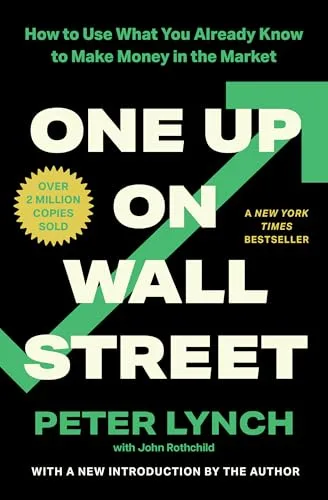
One Up On Wall Street
How to Use What You Already Know to Make Money in the Market
by Peter Lynch and John Rothchild
- Published
- 1989
- Pages
- 304 pages
- Publisher
- Simon & Schuster
- Readers
- 7 members have read this
Peter Lynch ran Fidelity's Magellan Fund from 1977 to 1990, averaging about 29 percent a year as it grew from $18 million to more than $14 billion. Here he explains how individual investors can find tenbaggers by noticing good businesses in daily life and then doing the homework: sorting companies into types, checking the numbers and holding on.
Peter Lynch was the most celebrated fund manager of the 1980s. He ran Fidelity Magellan from 1977 to 1990, taking it from about $18 million to more than $14 billion with an average return of about 29 percent a year. He wrote this book with John Rothchild, a former financial columnist for Time and Fortune, and it has sold more than a million copies.
Lynch's argument is that amateurs have advantages over professionals. They can spot promising companies at the mall or at work long before Wall Street analysts cover them, and they are free of the committees, career risk and size limits that hobble institutions. Spotting a company is only the start: Lynch shows how to classify it, what each category can and cannot deliver, and which balance-sheet and earnings numbers matter.
The writing is conversational and full of his own winners and losers, from Dunkin' Donuts to Chrysler. The common misreading is that he told people to buy what they like shopping for; he actually insists on research before buying. Readers should also note that the examples are from the 1970s and 1980s, and the Millennium edition's new introduction, written at the height of the 1990s bull market, admits that the internet had passed him by.
It is one of the best first books on picking individual stocks, and a useful corrective for professionals who forget how much an observant generalist can see.
- Your edge starts with what you see. Products you use and companies in your own industry can surface ideas before analysts notice. The edge is time, not certainty.
- Know what kind of stock you own. A slow grower, stalwart, fast grower, cyclical, turnaround and asset play each call for different expectations, valuation and selling rules.
- Be able to tell the story in two minutes. If you cannot explain why the company will make more money and what has to happen, you do not understand the investment.
- Earnings drive prices over time. Watch earnings growth, balance-sheet strength and price relative to growth, and be wary of hot stocks in hot industries and diworseification.
- Don't try to time the market. Lynch argues that nobody can reliably forecast the market or the economy, so the effort is better spent on the companies you own, holding good ones through declines.
After a new Millennium introduction and a prologue, Lynch's introduction sets out the advantages of what he calls dumb money, and the book proceeds in three parts.
- Preparing to invest. Lynch tells how he became a stockpicker, explains why professional fund managers are hemmed in, compares stocks with other uses of money and asks readers to decide honestly whether they have the temperament, cash and time horizon for stocks. He also argues that predicting the market is pointless.
- Picking winners. The core of the book shows where to find ideas in everyday life, sorts companies into six categories, describes the traits of a perfect stock and the kinds of stocks to avoid, explains why earnings drive prices, and lays out the two-minute drill, the facts to gather and the numbers that matter.
- The long-term view. Lynch covers how to build a portfolio, when to buy and sell, the silly and dangerous things people say about stock prices, and his skeptical view of options, futures and short selling for amateurs. An epilogue follows.
The manager of a top investment fund discusses how individuals can make a killing in the market through research and investment techniques that confound conventional market wisdom.
Reader reviews
No reviews yet. Join to write the first one.