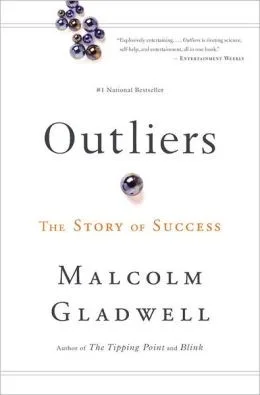
Outliers
The Story of Success
- Published
- 2008
- Pages
- 320 pages
- Publisher
- Little, Brown and Company
- Readers
- 5 members have read this
Gladwell argues that extraordinary success owes less to individual genius than to timing, accumulated advantage, practice and inherited culture. The chapter on Joe Flom and the rise of takeover law is a sharp lesson for anyone in finance on how being in the right place when the rules change can build a career.
Outliers sets out to explain high achievers by looking at where they came from rather than what they are like. Gladwell's cases run from Canadian hockey players born early in the year to the Beatles and Bill Gates, and his recurring idea is that small early advantages compound, and that the opportunities a person gets depend heavily on birth date, generation and culture.
Gladwell, a New Yorker staff writer, had already written The Tipping Point and Blink. As in those books he works from academic research, notably K. Anders Ericsson's studies of expert violinists, which he turned into the widely repeated 10,000-hour rule.
The book was a huge bestseller and also drew heavy criticism. The Wall Street Journal's reviewer praised the clarity of the writing but said Gladwell reduces complex social patterns to pithy explanations, and Steven Pinker, in The New York Times, faulted its cherry-picked anecdotes. Ericsson and other researchers later said he misstated their findings, and a 2014 meta-analysis by Brooke Macnamara and colleagues found that deliberate practice explains much less of performance than the book implies, especially in professions. His account of Korean Air's safety record has also been disputed.
Read it as a set of arguments to test, not settled science. For a young analyst it is a useful corrective to the self-made-genius story the industry likes to tell, and a good prompt to think about which structural shifts are creating opportunities now.
- Advantages compound. Small early edges, such as being the oldest in a cohort, earn more coaching and practice, which turns a small gap into a large one.
- Timing shapes careers. Gladwell argues that birth year put some people in place to exploit industrial expansion or the personal computer; ask which structural shifts are open today.
- Rule changes create winners. Joe Flom spent years on takeover work that established firms avoided, and was ready when the 1970s and 1980s merger wave arrived.
- Practice matters, but less than the slogan. The 10,000-hour rule is a simplification; later research suggests deliberate practice explains only part of performance.
- Culture affects how teams talk. The cockpit chapter argues that deference to seniority can stop juniors from raising the alarm, a point that applies to trading desks and deal teams.
The book has an introduction, two parts and an epilogue.
- Introduction: the Roseto mystery. Gladwell opens with a Pennsylvania town of Italian immigrants whose low rates of heart disease seemed to come from its close-knit community rather than diet or genes.
- Part One, Opportunity: compounding advantage. He shows how cutoff dates give older children a head start in Canadian hockey, then sets out the 10,000-hour rule using the Beatles and Bill Gates, and notes how heavily Americans born in the 1830s are represented on a list of the 75 richest people in history.
- Part One continued: genius and its limits. Two chapters compare the very high IQ but stalled Chris Langan with J. Robert Oppenheimer, arguing that family background and learned social skills mattered more than raw intelligence. A chapter on Joe Flom explains how Jewish lawyers shut out of white-shoe firms built practices in litigation and takeover work that became hugely valuable in the 1970s and 1980s.
- Part Two, Legacy: culture. Gladwell links feuding in Harlan, Kentucky, to herding cultures, attributes some airline crashes to deference in the cockpit, connects rice farming to persistence in math, and uses KIPP schools to argue that summer learning loss widens achievement gaps.
- Epilogue. He applies the framework to his own family's history in Jamaica.
From the bestselling author of The Bomber Mafia, learn what sets high achievers apart—from Bill Gates to the Beatles—in this seminal work from a singular talent (New York Times Book Review). In this stunning book, Malcolm Gladwell takes us on an intellectual journey through the world of outliers—the best and the brightest, the most famous and the most successful. He asks the question: what makes high-achievers different? His answer is that we pay too much attention to what successful people are like, and too little attention to where they are from: that is, their culture, their family, their generation, and the idiosyncratic experiences of their upbringing. Along the way he explains the secrets of software billionaires, what it takes to be a great soccer player, why Asians are good at math, and what made the Beatles the greatest rock band. Brilliant and entertaining, Outliers is a landmark work that will simultaneously delight and illuminate.
Reader reviews
No reviews yet. Join to write the first one.