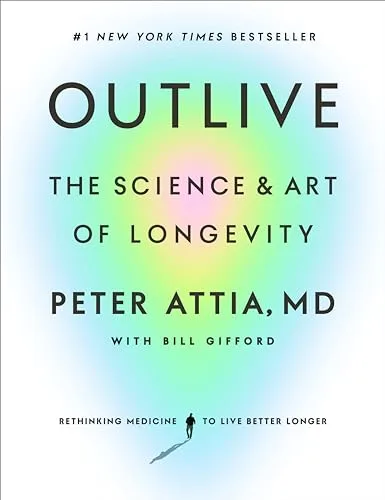
Outlive
The Science and Art of Longevity
by Peter Attia and Bill Gifford
- Published
- 2023
- Pages
- 496 pages
- Publisher
- Harmony
- Readers
- 2 members have read this
A physician's manual for extending healthspan, the years lived in good health, by attacking the four chronic diseases that kill most people: heart disease, cancer, neurodegenerative disease and type 2 diabetes. It is not a finance book, but its case for early, measured, long-horizon prevention will appeal to anyone who thinks about risk for a living.
Peter Attia argues that conventional medicine, which he calls Medicine 2.0, waits too long. It treats heart disease, cancer, Alzheimer's and metabolic disease once they are diagnosed, when decades of slow damage have already been done. His Medicine 3.0 is preventive and personalized: measure risk early, act years before symptoms appear, and focus on healthspan, the quality of the later decades, as much as on lifespan.
Attia trained at Stanford medical school and in surgery at Johns Hopkins, worked at the National Cancer Institute and McKinsey, co-founded the Nutrition Science Initiative with Gary Taubes, and now runs a longevity practice and the Drive podcast. The science writer Bill Gifford, author of Spring Chicken, is credited as co-author.
The book's most distinctive argument is that exercise is the most powerful longevity tool available, more than any drug or diet, organized around what he calls the centenarian decathlon: the physical tasks you want to be able to do in your last decade. Publishers Weekly praised its rigor and clarity. The Guardian called it exhaustive and lucid but noted that the lifestyle changes it asks for can seem onerous. GQ said it raised more questions than it answered. It has sold millions of copies.
For finance readers, it is a guide to managing the long-horizon health risks of desk-bound, high-stress careers, written with the same respect for data, base rates and compounding that good investing requires.
- Act decades early. The chronic diseases of aging build silently for years, so prevention has to start long before symptoms, much as compounding rewards an early start.
- Exercise is the strongest lever. Cardiorespiratory fitness and muscle strength are among the best predictors of lifespan, which makes training a long-term investment rather than a hobby.
- Plan backward from the last decade. The centenarian decathlon asks what you want to be able to do at 85 or 90 and builds a training program to get there.
- Measure what matters. Attia argues for tests beyond the standard panel, such as apoB for cardiovascular risk, and for acting on the results.
- Healthspan includes the mind. Emotional health, sleep and relationships are part of longevity, a point aimed squarely at people who run themselves hard in demanding careers.
The book is organized in three parts, moving from mindset to the diseases to the tactics.
- The long game. Attia explains the shift from fast deaths to slow deaths, sets out the difference between Medicine 2.0 and Medicine 3.0, and lays out his framework of objective, strategy and tactics. The goal is to extend healthspan as well as lifespan.
- The four horsemen. He reviews what centenarians and longevity research, including work on rapamycin and caloric restriction, can teach, then takes each chronic killer in turn: metabolic dysfunction and type 2 diabetes, atherosclerotic heart disease, cancer, and Alzheimer's and other neurodegenerative diseases, with the tests and interventions he uses for each.
- Tactics. The longest part covers exercise in detail (zone 2 aerobic training, VO2 max, strength and stability), then nutrition, which he approaches as personalized biochemistry rather than a single diet, then sleep.
- Emotional health. The final chapter turns personal. Attia describes his own struggles with anger and emotional health and argues that a long life is not worth much without the relationships and peace of mind to enjoy it.
Wouldn’t you like to live longer? And better? In this operating manual for longevity, Dr. Peter Attia draws on the latest science to deliver innovative nutritional interventions, techniques for optimizing exercise and sleep, and tools for addressing emotional and mental health.
For all its successes, mainstream medicine has failed to make much progress against the diseases of aging that kill most people: heart disease, cancer, Alzheimer’s disease, and type 2 diabetes. Too often, it intervenes with treatments too late to help, prolonging lifespan at the expense of healthspan, or quality of life. Dr. Attia believes we must replace this outdated framework with a personalized, proactive strategy for longevity, one where we take action now, rather than waiting.
This is not “biohacking,” it’s science: a well-founded strategic and tactical approach to extending lifespan while also improving our physical, cognitive, and emotional health. Dr. Attia’s aim is less to tell you what to do and more to help you learn how to think about long-term health, in order to create the best plan for you as an individual. In Outlive, readers will discover:
• Why the cholesterol test at your annual physical doesn’t tell you enough about your actual risk of dying from a heart attack. • That you may already suffer from an extremely common yet underdiagnosed liver condition that could be a precursor to the chronic diseases of aging. • Why exercise is the most potent pro-longevity “drug”—and how to begin training for the “Centenarian Decathlon.” • Why you should forget about diets, and focus instead on nutritional biochemistry, using technology and data to personalize your eating pattern. • Why striving for physical health and longevity, but ignoring emotional health, could be the ultimate curse of all.
Aging and longevity are far more malleable than we think; our fate is not set in stone. With the right roadmap, you can plot a different path for your life, one that lets you outlive your genes to make each decade better than the one before.
Reader reviews
No reviews yet. Join to write the first one.