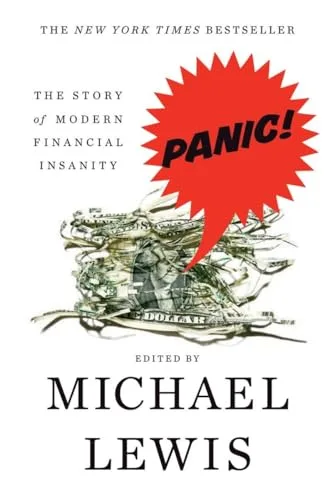
Panic
The Story of Modern Financial Insanity
- Published
- 2009
- Pages
- 400 pages
- Publisher
- W. W. Norton & Company
- Readers
- 3 members have read this
Michael Lewis edits an anthology of journalism written while five modern financial crises were unfolding, from the 1987 crash and the collapse of Long-Term Capital Management to the dot-com bust and subprime. Reading what smart observers said at the time is a useful corrective to hindsight, and shows how often the same mistakes come back.
Panic is not a Michael Lewis narrative but a collection he selected and introduced, published in January 2009 as the subprime crisis was peaking. It covers five episodes from the 1987 crash to the subprime mortgage crisis. For each, Lewis gathers newspaper and magazine pieces written as events happened, so readers see what was known, believed and missed at the time rather than the tidy story told later.
The contributors include economists Paul Krugman and Joseph Stiglitz and Wall Street Journal reporters Gregory Zuckerman and Roger Lowenstein, alongside excerpts from Lewis's own work. Lewis, a former Salomon bond salesman and the author of Liar's Poker and Moneyball, writes the connecting commentary.
The common thread is that each panic grew out of new financial complexity that even sophisticated participants did not understand, and out of risk models and principles that broke down under stress. Publishers Weekly found the selections varied and learned and the arguments on target, but noted that much of the material is previously published, that no single crisis gets deep treatment, and that readers looking for solutions will not find them.
Read it as a primary-source companion to longer histories such as When Genius Failed and The Big Short, or as a quick way to see how commentators read each crisis in real time.
- Complexity hides risk. In each episode new instruments or strategies, from the trading strategies blamed for the 1987 crash to mortgage securities, behaved in ways their users did not anticipate.
- Models fail in a crisis. LTCM showed how assumptions that held in normal markets broke down when everyone tried to sell at once.
- Crises travel. A default in Russia or a currency collapse in Asia reached New York through leverage and shared positions.
- Real-time judgment is hard. Contemporary accounts show how hard it was, even for experts, to tell a correction from a collapse.
- The pattern repeats. Each boom produced the same confidence that this time was different, followed by a scramble for liquidity.
The anthology runs chronologically through five crises, with Lewis's introductions linking them.
- The 1987 crash. Contemporary coverage of Black Monday and the role of new trading strategies, with Lewis's own view from Salomon Brothers' trading floor.
- The Asian currency crisis. Pieces on the 1997 collapse of currencies and capital flight across Asia, with analysis from economists as well as reporters.
- Russia and Long-Term Capital Management. The 1998 Russian default and the near failure of the celebrated hedge fund, whose models and leverage turned a distant default into a threat to Wall Street.
- The internet bubble. Reporting and commentary on the dot-com boom of the late 1990s and the bust that followed, including Lewis's own writing from the period.
- Subprime. The final section collects reporting on the housing bubble, mortgage securities and the credit crisis that was still unfolding when the book went to press.
Reader reviews
No reviews yet. Join to write the first one.