Principles
Life and Work
by Ray Dalio
- Published
- 2017
- Pages
- 592 pages
- Publisher
- Simon & Schuster
- Readers
- 5 members have read this
Bridgewater founder Ray Dalio sets out the rules he used to build the world's biggest hedge fund, drawing on the 1982 call that nearly broke him. Part memoir, part operating manual, it explains radical transparency, believability-weighted decisions and his habit of turning mistakes into written rules, ideas that are widely debated across the investment industry.
Dalio founded Bridgewater Associates in 1975 out of his two-bedroom New York apartment. The formative moment was a public bet in 1982 that Mexico's default would trigger a depression. He was badly wrong, had to let his staff go, and drew the lesson behind everything that follows: a fear of being wrong and a search for people who would disagree with him.
The book has three parts: a memoir of his career and Bridgewater's growth; life principles, including his formula that pain plus reflection equals progress; and work principles, describing Bridgewater as an idea meritocracy run on radical truth and radical transparency, where views are weighted by each person's track record. A shorter version posted online in 2011 was downloaded more than three million times, and the book became a #1 New York Times bestseller.
The New York Times called it instructive and surprisingly moving. Critics were harsher about the management system. The Wall Street Journal found the principles reductive and contradictory, and a New York Times DealBook review noted that a firm preaching radical transparency remains secretive. Rob Copeland's 2023 book The Fund later alleged that the culture produced surveillance and public shaming.
Read it for Part I, one of the better first-person accounts of building a macro fund, and treat Parts II and III as one manager's system rather than a proven recipe.
- Being wrong is the best teacher. Dalio's 1982 loss, when he forecast a depression that never came, taught him to assume he might be wrong and to stress-test his views before betting on them.
- Pain plus reflection equals progress. Mistakes are useful only if you study them, write down what you learned and turn it into a rule you will follow next time.
- Weight opinions by track record. Bridgewater's believability-weighted decision making gives more say to people who have repeatedly been right on a given question, rather than to seniority or volume.
- Systematize your judgment. Writing down decision rules, then encoding them where possible, lets a firm test its logic against history and apply it consistently under pressure.
- Use the five-step loop. Set clear goals, surface the problems in the way, diagnose their root causes, design a plan and then do it, repeating the loop as results come in.
The book is divided into three parts that move from story to rules.
- Where I'm Coming From. Dalio recounts his early fascination with markets, founding Bridgewater in 1975, the 1982 Mexico call that nearly ended the firm, and the rebuilding that followed as he systematized his decision rules and grew Bridgewater into the largest hedge fund. He includes the 1993 memo in which his lieutenants told him how his manner was demoralizing staff.
- Life Principles. He argues for embracing reality and dealing with it, using a five-step process of setting goals, identifying problems, diagnosing them, designing a plan and executing it. He covers radical open-mindedness, the ego and blind-spot barriers that block learning, how people are wired differently, and how to make decisions by weighing believability.
- Work Principles. He describes Bridgewater's culture as an idea meritocracy that aims for meaningful work and relationships through radical transparency. He explains how to get the culture right, how to hire and evaluate people, and how to manage the organization as a machine that can be diagnosed and redesigned when outcomes fall short.
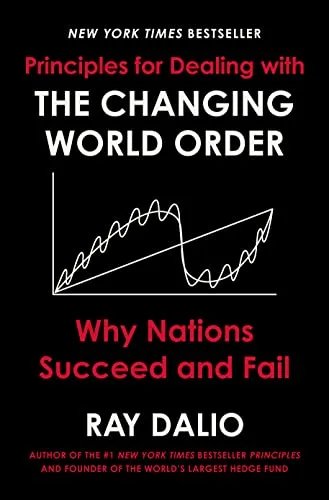
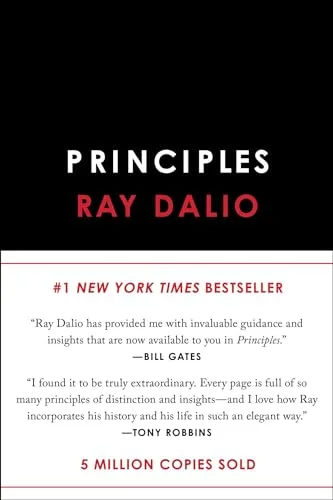
#1 New York Times Bestseller Significant...The book is both instructive and surprisingly moving.” —The New York Times Ray Dalio, one of the world’s most successful investors and entrepreneurs, shares the unconventional principles that he’s developed, refined, and used over the past forty years to create unique results in both life and business—and which any person or organization can adopt to help achieve their goals. In 1975, Ray Dalio founded an investment firm, Bridgewater Associates, out of his two-bedroom apartment in New York City. Forty years later, Bridgewater has made more money for its clients than any other hedge fund in history and grown into the fifth most important private company in the United States, according to Fortune magazine. Dalio himself has been named to Time magazine’s list of the 100 most influential people in the world. Along the way, Dalio discovered a set of unique principles that have led to Bridgewater’s exceptionally effective culture, which he describes as an idea meritocracy that strives to achieve meaningful work and meaningful relationships through radical transparency.” It is these principles, and not anything special about Dalio—who grew up an ordinary kid in a middle-class Long Island neighborhood—that he believes are the reason behind his success. In Principles, Dalio shares what he’s learned over the course of his remarkable career. He argues that life, management, economics, and investing can all be systemized into rules and understood like machines. The book’s hundreds of practical lessons, which are built around his cornerstones of radical truth” and radical transparency,” include Dalio laying out the most effective ways for individuals and organizations to make decisions, approach challenges, and build strong teams. He also describes the innovative tools the firm uses to bring an idea meritocracy to life, such as creating baseball cards” for all employees that distill their strengths and weaknesses, and employing computerized decision-making systems to make believability-weighted decisions. While the book brims with novel ideas for organizations and institutions, Principles also offers a clear, straightforward approach to decision-making that Dalio believes anyone can apply, no matter what they’re seeking to achieve. Here, from a man who has been called both the Steve Jobs of investing” and the philosopher king of the financial universe” (CIO magazine), is a rare opportunity to gain proven advice unlike anything you’ll find in the conventional business press.
Reader reviews
No reviews yet. Join to write the first one.