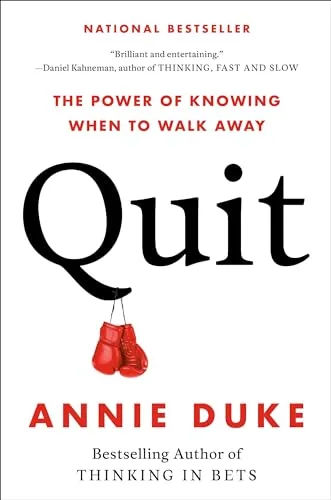
Quit
The Power of Knowing When to Walk Away
by Annie Duke
- Published
- 2022
- Pages
- 336 pages
- Publisher
- Portfolio
- Readers
- 1 member has read this
A former poker champion and decision researcher argues that quitting is a skill, not a failure, and that sunk costs, loss aversion and identity keep people in losing jobs, projects and positions far too long. For anyone who manages a portfolio, a pipeline of deals or a career, it offers practical tools such as kill criteria and quitting coaches.
Annie Duke's starting point is that grit and quitting are two sides of the same decision, and that our culture celebrates only one of them. Because most choices are made under uncertainty, new information should regularly change whether a path is still worth following. Yet people stay too long: they escalate commitment to failing ventures, honor sunk costs, overvalue what they already own and protect identities built around a choice.
Duke made her name at the poker table, where folding a hand that might still win is routine. She won a World Series of Poker bracelet and the WSOP Tournament of Champions in 2004, studied cognitive psychology at the University of Pennsylvania, and co-founded the Alliance for Decision Education. Quit follows her earlier books Thinking in Bets and How to Decide.
The book mixes behavioral research, from Kahneman and Tversky's prospect theory to Steven Levitt's coin-flip study, with cases such as Stewart Butterfield turning the failed game Glitch's internal chat tool into Slack. Kirkus, reviewing the audiobook, called it well researched and easy to follow, though it noted that the business jargon sometimes gets heavy. Publishers Weekly called it a no-nonsense survey.
Investors will recognize the disposition effect and the stop-loss in these pages, and Duke draws the connection herself. The book is most useful for portfolio managers, founders and anyone who allocates time or capital and needs a disciplined way to cut losses.
- Quitting on time feels early. By the time quitting feels obviously right, you have usually waited too long, so act on the evidence rather than the feeling.
- Set kill criteria in advance. Decide before you start which states and dates would make you walk away, the way climbers set a turnaround time, and write them down.
- Do the hardest part first. Testing the riskiest assumption early stops you from piling up easy progress, and sunk costs, on a project that cannot work.
- Sunk costs and identity are the real enemies. Escalation of commitment and the urge to look consistent keep people in losing positions, which is why an outside quitting coach helps.
- Goals need an unless clause. Fixed targets ignore new information, so restate goals with explicit conditions under which you would abandon them.
The book is organized in four sections that move from the case for quitting to the forces that stop us and the tools that help.
- The case for quitting. Duke argues that grit and quitting are the same decision viewed from two sides, that quitting on time usually feels like quitting too early, and that expected value is the right test. She uses Butterfield's move from Glitch to Slack, Levitt's coin-flip experiment, New York cab drivers and stop-loss orders in trading to show how loss aversion distorts timing.
- In the losses. Chapters on escalation of commitment and the sunk cost effect explain why people double down when behind. Duke borrows Astro Teller's monkeys-and-pedestals rule from Google's X lab: tackle the hardest part first, and set kill criteria in advance, in the form of states and dates.
- Identity and other impediments. The endowment effect and status quo bias, extended to beliefs as well as possessions, and the pull of identity and cognitive dissonance. The fix is a quitting coach, someone who cares about you but will tell you hard truths, and Duke cites investor Ron Conway's view that founders do not owe it to employees to keep a failing company going.
- Opportunity cost. Lessons from forced quitting, such as layoffs, show the value of exploring options before you have to. A final chapter on the myopia of goals argues for attaching an unless clause to every target.
Discover when to grit, and when to quit We are often told that the secret to success is hard work, determination, and hours of practice. But in a fast-changing world, what if the really crucial skill is knowing when to stick at something and when to change track and walk away? Quit makes the under-appreciated case for quitting and also shows you how to get really good at it. Drawing on stories from elite athletes to Everest climbers, comedians to musicians, Annie Duke (who left a successful poker career) explains why learning to quit well is often crucial to success. She provides clear strategies for working out when to cut your losses from a business product that isn't working, a relationship turned toxic, or a career that won't take you where you want to go. You'll learn how to spot the blocks to good quitting behaviour -- escalation commitment, desire for certainty and the status quo bias -- and also how to use tools like quitting contracts, flexible goal-setting and premortems to help you quit cleanly and confidently. Whether you're facing a make-or-break business decision, a life-altering personal choice or simply wanting to take more control of your life, Quit provides a toolkit for change to help you make the best next move.
Reader reviews
No reviews yet. Join to write the first one.