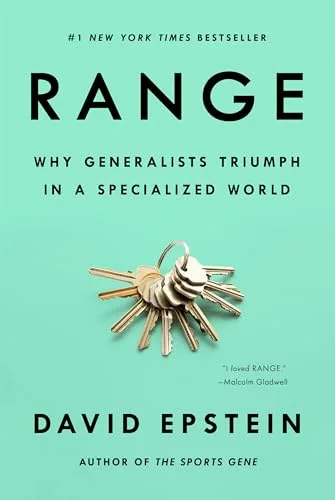
Range
Why Generalists Triumph in a Specialized World
- Published
- 2019
- Pages
- 352 pages
- Publisher
- Riverhead Books
- Readers
- 3 members have read this
David Epstein challenges the idea that success requires an early start and narrow specialization. Drawing on sports, science, music and business, he argues that in messy fields with slow, misleading feedback, broad experience and late specialization usually win. Anyone who forecasts markets or hires analysts should take that seriously.
Epstein's argument is that early specialization, the path Tiger Woods took, works in kind learning environments such as golf and chess, where the rules are fixed and feedback is quick and accurate. Most of life and work happens in wicked environments, where the rules shift and feedback is delayed or wrong. There, broad experience and analogies drawn from other fields, the path Roger Federer took, do better.
Epstein was a senior writer at Sports Illustrated and an investigative reporter at ProPublica, and his first book was The Sports Gene. Range was a number one New York Times bestseller and was shortlisted for the Financial Times and McKinsey Business Book of the Year. Many readers took it as an answer to Malcolm Gladwell's 10,000-hour rule.
Its value for finance comes from its chapters on expertise, which draw on Philip Tetlock's research to show that forecasters who know one big idea predict worse than broad thinkers who update their views. Publishers Weekly liked the craft but found the run of short profiles a little scattershot and said the book doesn't fully dismantle the case for deep expertise.
The book is for managers building teams, for career-changers, and for investors who want to know why confident specialists so often miss turning points.
- Know which kind of environment you are in. Repetition builds expertise only where feedback is fast and accurate. Markets are a wicked environment, so years of experience do not guarantee good judgment.
- Broad thinkers forecast better. The research Epstein cites finds that experts wedded to one big theory make worse predictions than eclectic thinkers who change their minds when the evidence shifts.
- Testing several careers is rational. Trying different paths improves match quality, so a late switch into finance or out of it is often a sign of good search, not failure.
- Analogies from other fields solve problems. Outsiders and people who borrow ideas from unrelated domains often crack problems that specialists have framed too narrowly.
- Data-only cultures can be blind. As at NASA before Challenger, organizations that dismiss judgment unless it comes with hard numbers can overrule people who sense real risk.
The book is organized as an argument that builds from learning to work to organizations. It has twelve chapters between an introduction on Roger Federer and Tiger Woods and a conclusion on expanding your own range.
- The head start myth. The opening chapters, The Cult of the Head Start and How the Wicked World Was Made, set kind learning environments against wicked ones. They also show how modern work rewards conceptual, cross-domain thinking.
- How learning works. Chapters on sampling, desirable difficulty and analogical reasoning argue that slow, varied and frustrating practice builds knowledge that transfers better than drilling a single skill.
- Careers and match quality. Epstein borrows the economists' idea of match quality, the fit between a person and their work. With late starters such as Vincent van Gogh and Frances Hesselbein, he argues that grit is overrated and that trying things out is a rational way to find that fit.
- Outsiders and old technology. He shows how outsiders often solve problems that insiders cannot, and how Nintendo's Gunpei Yokoi built the Game Boy with cheap, well-understood parts.
- When experts fail. The closing chapters cover forecasters fooled by their own experience, organizations such as NASA before Challenger that cling to familiar tools and procedures, and the case for staying a deliberate amateur.
The #1 New York Times bestseller that has all America talking: as seen/heard on CNN's Fareed Zakaria GPS, Morning Joe, CBS This Morning, The Bill Simmons Podcast, Rich Roll, and more. Fascinating. . . . If you're a generalist who has ever felt overshadowed by your specialist colleagues, this book is for you. --Bill Gates The most important business--and parenting--book of the year. --Forbes Urgent and important. . . an essential read for bosses, parents, coaches, and anyone who cares about improving performance. --Daniel H. Pink Shortlisted for the Financial Times/McKinsey Business Book of the Year Award Plenty of experts argue that anyone who wants to develop a skill, play an instrument, or lead their field should start early, focus intensely, and rack up as many hours of deliberate practice as possible. If you dabble or delay, you'll never catch up to the people who got a head start. But a closer look at research on the world's top performers, from professional athletes to Nobel laureates, shows that early specialization is the exception, not the rule. David Epstein examined the world's most successful athletes, artists, musicians, inventors, forecasters and scientists. He discovered that in most fields--especially those that are complex and unpredictable--generalists, not specialists, are primed to excel. Generalists often find their path late, and they juggle many interests rather than focusing on one. They're also more creative, more agile, and able to make connections their more specialized peers can't see. Provocative, rigorous, and engrossing, Range makes a compelling case for actively cultivating inefficiency. Failing a test is the best way to learn. Frequent quitters end up with the most fulfilling careers. The most impactful inventors cross domains rather than deepening their knowledge in a single area. As experts silo themselves further while computers master more of the skills once reserved for highly focused humans, people who think broadly and embrace diverse experiences and perspectives will increasingly thrive.
Reader reviews
No reviews yet. Join to write the first one.