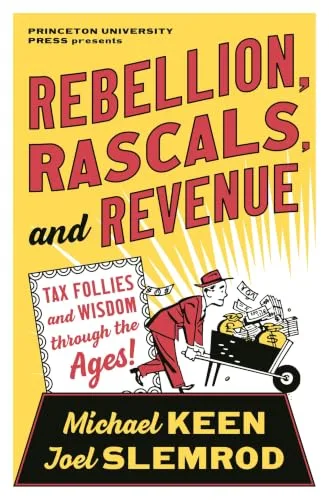
Rebellion, Rascals, and Revenue
Tax Follies and Wisdom through the Ages
by Michael Keen and Joel Slemrod
- Published
- 2021
- Pages
- 536 pages
- Publisher
- Princeton University Press
- Readers
- 1 member has read this
A longtime senior IMF tax official and a leading University of Michigan public-finance economist use thousands of years of tax history to teach the economics of taxation, from Britain's window tax and Peter the Great's beard tax to corporate inversions and the Panama Papers. It is the most entertaining way to learn who really bears a tax and how people and companies change their behavior to avoid it.
Governments have always had to raise money in ways that are effective and tolerably fair, and they have often failed in spectacular ways. Michael Keen and Joel Slemrod use that history, from a hut tax that set off a rebellion in Sierra Leone to an Incan tax payable in lice, to teach the timeless principles of tax design. Each story illustrates an idea economists use today, such as tax incidence, excess burden, the costs of enforcement and the limits of taxing mobile capital.
Keen was deputy director of the IMF's Fiscal Affairs Department, and Slemrod is a professor of business economics and public policy at the University of Michigan and co-author of Taxing Ourselves. Both have won the National Tax Association's Holland Medal for lifetime contributions to public finance.
The Wall Street Journal called it erudite and good-humored, and the Financial Times said it offers a historical precedent for almost any tax debate. Barry Eichengreen, in Foreign Affairs, found it timely and entertaining. The book is long and organized by theme rather than chronology, so it reads best in sections. Readers looking for current policy proposals will find mostly principles, though the authors do float the idea of a world tax organization.
It is for investors, tax and corporate-finance professionals, and policy watchers who want intuition for how tax changes really affect prices, profits and behavior.
- The payer is not the bearer. Who writes the check to the government says little about whose prices, wages or returns fall. Incidence analysis is essential for valuing how a tax change hits a company.
- Taxes change behavior, sometimes absurdly. People rebuild houses, ships and business models to cut their tax bills. Those distortions create costs beyond the revenue raised.
- A lower rate can raise revenue when evasion is rampant. Britain's eighteenth-century cut in the tea tax raised receipts by making smuggling unprofitable, a lesson for any heavily evaded tax.
- Collection is policy. Withholding, information reporting and enforcement capacity determine what a tax system can actually achieve.
- Mobile capital limits national tax power. From early corporate inversions to the Panama Papers, firms and the wealthy move to lower-tax jurisdictions, which pushes governments toward international coordination.
The book is arranged by theme, with stories from across history and the world grouped around the core questions of tax policy.
- Taxes then and now. The authors trace how states have raised revenue, from the Rosetta Stone's record of tax breaks for Egyptian priests to the tax systems of today. Even the oldest records show that tax breaks are as old as taxes.
- Fairness and who really pays. Through rebellions and protests, from the Sierra Leone hut tax to the Boston Tea Party, they show how the legal payer of a tax often differs from the person who bears it, and why perceived unfairness topples governments.
- Behavior and excess burden. The window tax, ship-measurement rules, colored margarine and the rise of big-box stores show how taxes reshape what people build, buy and sell, often in strange ways.
- Enforcement and collection. Stories of evasion, avoidance and collectors show that how a tax is collected matters as much as its rate.
- Taxing across borders. The Vestey brothers' move abroad in the First World War, a war over a Bolivian tax that cost the country its coast, and modern profit shifting lead to the authors' case for stronger international tax cooperation.
An engaging and enlightening account of taxation told through lively, dramatic, and sometimes ludicrous stories drawn from around the world and across the ages Governments have always struggled to tax in ways that are effective and tolerably fair. Sometimes they fail grotesquely, as when, in 1898, the British ignited a rebellion in Sierra Leone by imposing a tax on huts—and, in repressing it, ended up burning the very huts they intended to tax. Sometimes they succeed astonishingly, as when, in eighteenth-century Britain, a cut in the tax on tea massively increased revenue. In this entertaining book, two leading authorities on taxation, Michael Keen and Joel Slemrod, provide a fascinating and informative tour through these and many other episodes in tax history, both preposterous and dramatic—from the plundering described by Herodotus and an Incan tax payable in lice to the (misremembered) Boston Tea Party and the scandals of the Panama Papers. Along the way, readers meet a colorful cast of tax rascals, and even a few tax heroes. While it is hard to fathom the inspiration behind such taxes as one on ships that tended to make them sink, Keen and Slemrod show that yesterday’s tax systems have more in common with ours than we may think. Georgian England’s window tax now seems quaint, but was an ingenious way of judging wealth unobtrusively. And Tsar Peter the Great’s tax on beards aimed to induce the nobility to shave, much like today’s carbon taxes aim to slow global warming. Rebellion, Rascals, and Revenue is a surprising and one-of-a-kind account of how history illuminates the perennial challenges and timeless principles of taxation—and how the past holds clues to solving the tax problems of today.
Reader reviews
No reviews yet. Join to write the first one.