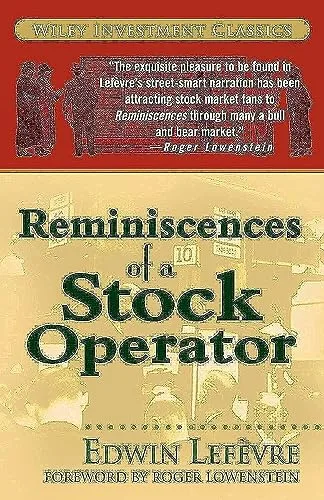
Reminiscences of a Stock Operator
- Published
- 1923
- Pages
- 288 pages
- Publisher
- Wiley
- Readers
- 4 members have read this
A thinly fictionalized memoir of Jesse Livermore, the speculator who beat the bucket shops as a teenager, shorted the 1906 earthquake and the 1907 panic, and went broke more than once. A century on, it is still the best book on how traders think, and how their own hope, fear and impatience undo them.
Edwin Lefèvre was a financial journalist who interviewed Jesse Livermore at length and turned what he heard into a first-person account told by a trader called Larry Livingston. It first ran as a series in The Saturday Evening Post and came out as a book in 1923. Nobody was fooled about who the narrator was.
The book is unusually honest about losses, and each episode ends in a rule the narrator paid to learn: the trend matters more than the tip, the big money comes from sitting tight, and averaging down on a losing position is how good traders blow up.
No other trading book has lasted as well. Alan Greenspan praised its investing wisdom in his memoir, and traders profiled in Jack Schwager's Market Wizards cite it as a formative read. Some of its world is gone: bucket shops, ticker tape, and pool operations and manipulation that were legal in the 1920s. Readers should also remember that the real Livermore went bankrupt again in 1934 and took his own life in 1940, which says something about the limits of the method.
It rewards anyone who takes market risk, from a first-year analyst to a portfolio manager. The Wiley Investment Classics paperback, with a foreword by Roger Lowenstein, is the standard modern text. Wiley's annotated edition, with notes by Jon D. Markman, identifies the real people behind the pseudonyms.
- Patience pays more than brilliance. Livingston says his big profits came from sitting tight in a correct position, not from clever entries. Cutting winners early is the commonest and costliest mistake.
- Trade the main trend, not the tape's noise. Old Partridge's refrain that it is a bull market is about knowing the market's direction before you pick stocks or time trades.
- Hope and fear are backwards in trading. Traders hope when they should fear a loss and fear when they should hope a profit grows. The fix is to cut losses fast and let gains run.
- Never average down a losing trade. The cotton disaster shows how buying more to defend a position can turn a manageable loss into ruin.
- Do your own thinking. Tips, insiders and persuasive experts cost Livingston millions. A plausible story from a brilliant person is still not a reason to trade.
The book runs roughly chronologically across 24 chapters, from Livingston's start as a teenager in the 1890s to his comeback in the First World War years.
- The bucket shops. At 14 he posts prices at a brokerage, learns to read the tape and makes his first thousand dollars by 15 betting against bucket shops, which eventually ban him.
- Learning a real market. In New York his bucket-shop system fails on the exchange, where orders take time to fill. He goes broke and works out the difference between reading the tape and reading the market.
- Hunches and the big swing. He shorts Union Pacific from a branch office in Atlantic City the day before the San Francisco earthquake, absorbs old Mr. Partridge's lesson that it is a bull market, and builds a huge short position into the panic of October 1907. When a leading banker asks him to stop selling, he covers and buys.
- Ruin by persuasion. The charismatic cotton operator Percy Thomas talks him out of his own judgment. He loses most of his fortune, ends up deep in debt and files for bankruptcy.
- The comeback. Waiting for a sure setup, he rebuilds his stake on Bethlehem Steel in 1915, profits from the war markets and is forced out of a coffee trade by the War Industries Board's Price Fixing Committee.
- Manipulation and the public. Late chapters explain how operators such as James R. Keene distributed stock, why insiders' tips mislead, and why the public keeps losing.
First published in 1923, Reminiscences of a Stock Operator is the most widely read, highly recommended investment book ever. Generations of readers have found that it has more to teach them about markets and people than years of experience. Among the most compelling and enduring pieces ever written on trading, the new Illustrated Edition brings this story to life like never before. Although Reminiscences...was first published some seventy years ago, its take on crowd psychology and market timing is as timely as last summer's frenzy on the foreign exchange markets.?Worth magazine The most entertaining book written on investing is Reminiscences of a Stock Operator, by Edwin Lefèvre, first published in 1923.?The Seattle Times After twenty years and many re-reads, Reminiscences is still one of my all-time favourites.?Kenneth L. Fisher, Forbes A must-read classic for all investors, whether brand-new or experienced.?William O'Neil, founder and Chairman, Investor's Business Daily Whilst stock market tomes have come and gone, this remains popular and in print eighty years on.?GQ magazine
Reader reviews
No reviews yet. Join to write the first one.