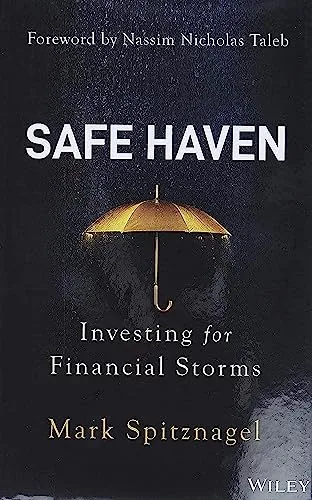
Safe Haven
Investing for Financial Storms
- Published
- 2021
- Pages
- 240 pages
- Publisher
- Wiley
- Readers
- 2 members have read this
Universa Investments founder Mark Spitznagel argues that a hedge is worth owning only if it raises a portfolio's compound growth rate, not just its comfort. Using Bernoulli's math, simple wagers and bootstrapped S&P 500 returns, he tests bonds, gold, trend following and tail insurance, and finds most popular safe havens too expensive to hold.
Spitznagel's core claim is that risk mitigation should pay for itself. Because returns compound, a large loss does more damage than its arithmetic average suggests, and a hedge that cuts those losses cheaply enough can leave an investor richer over time, not just calmer. In his tests, Treasuries, trend-following funds and broad diversification may damp volatility but cost so much in forgone growth that they lower long-run wealth.
The author trades for a living. He was apprenticed at 16 to the Chicago grain trader Everett Klipp, co-founded the tail-hedging fund Empirica Capital in 1999 with Nassim Nicholas Taleb, who wrote the foreword, and in 2007 founded Universa, which aims to make money in crashes by holding far out-of-the-money put options.
The book is more about how to think than what to buy. Spitznagel says plainly that he will not reveal Universa's methods and that the approach is not for amateurs. Expect long passages on Daniel Bernoulli and Nietzsche, and a fair amount of math. The case for insurance-style hedges also matches the product Universa sells, and the performance he cites is his own firm's.
Portfolio managers, pension and endowment staff, and anyone who has questioned whether their hedges earn their keep will find a rigorous framework here, though it gives no recipe.
- Judge hedges by compound growth. A safe haven earns its place only if the portfolio holding it grows faster over time than the portfolio without it. Lower volatility on its own is not enough.
- Big losses hurt more than averages show. Because wealth compounds, a 50% drop needs a 100% gain to recover. Arithmetic averages hide that cost.
- Most popular havens cost too much. Spitznagel argues that bonds and broad diversification often reduce risk only by reducing wealth, and that Treasuries are effective in some crashes but rarely cost-effective.
- Small, explosive positions can do the work. An insurance-style hedge that pays off sharply in a crash lets an investor keep most of the portfolio in risk assets. A small allocation can matter more than a large defensive one.
- Don't predict. The framework requires no market timing. It asks investors to accept small, frequent losses on protection, a lesson from Klipp's maxim that a small loss is a good loss.
The book has two parts and an afterword, moving from first principles to tests on real assets.
- Part One, What Comes First. At War with Luck sets out the problem of protecting against crashes without giving up returns and lays down Spitznagel's first principle: investing happens sequentially through time, so returns compound. Nature's Admonition introduces the Bernoulli family, the Saint Petersburg paradox and the geometric average. The Eternal Return uses Nietzsche's thought experiment and simple wagers to show why the average outcome is not the one an investor actually lives through.
- Part Two, What Comes After. A Taxonomy sorts safe havens into store-of-value, alpha and insurance types, and flags imposters he calls hopeful, unsafe and diworsifier havens. Holism argues that a hedge must be judged by its effect on the whole portfolio, using bootstrapped S&P 500 returns. Bold Conjectures tests real-world candidates such as cash, Treasuries, gold, trend-following CTA strategies and bitcoin.
- Afterword, Amor Fati. Spitznagel closes with the discipline needed to accept small losses and stay with a strategy that looks wasteful most of the time.
What is a safe haven? What role should they play in an investment portfolio? Do we use them only to seek shelter until the passing of financial storms? Or are they something more? Contrary to everything we know from modern financial theory, can higher returns actually come as a result of lowering risk? In Safe Haven, hedge fund manager Mark Spitznagel—one of the top practitioners of safe haven investing and portfolio risk mitigation in the world—answers these questions and more. Investors who heed the message in this book will never look at risk mitigation the same way again.
Reader reviews
No reviews yet. Join to write the first one.