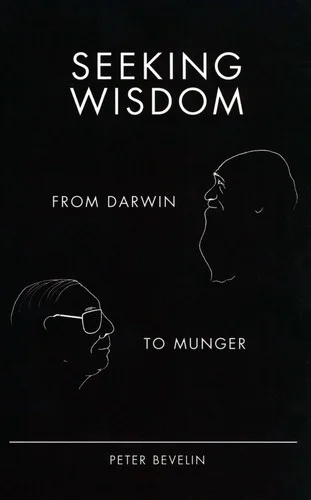
Seeking Wisdom
From Darwin to Munger
- Published
- 2003
- Pages
- 328 pages
- Publisher
- PCA Publications
- Readers
- 1 member has read this
A Swedish investor's field guide to why smart people make bad decisions, built on Charlie Munger's psychology of misjudgment and on ideas from evolution, physics and mathematics. It is the most complete single-volume treatment of the Munger approach to thinking, and it gives investors a checklist of the errors that cost the most money.
Peter Bevelin is a Swedish investor. At 42, drawn in by Charlie Munger's talks, he took a year off from business to study human behavior and judgment, and wrote down what he learned as a memo for himself. That memo became this book. Munger, a friend, read and commented on the manuscript before publication.
The book asks why people misjudge and how to misjudge less. Bevelin starts with biology: many errors are side effects of wiring, shaped by natural selection, that once helped people survive. He then catalogs 28 psychological causes of misjudgment, adds nine principles from physics and mathematics that people routinely get wrong, and closes with 12 guidelines for better thinking, drawing on Darwin, Munger, Warren Buffett and Richard Feynman.
The book sits between Munger's Psychology of Human Misjudgment speech and the academic behavioral-finance literature. It covers the same tendencies Munger described, in more depth and with more cross-disciplinary support. Nassim Taleb has called Bevelin one of the smartest people around. The honest caveat, which even a sympathetic reviewer at InvestingByTheBooks concedes, is that Bevelin adds little original argument. Much of the text is a dense weave of other people's ideas and quotations, so it rewards rereading more than a single pass.
Read it if Munger's mental-models approach shaped how you invest and you want the whole framework in one place, or if you set incentives or run a research process.
- Incentives explain more than intentions. Two of Bevelin's 28 tendencies are underestimating the power of rewards and punishment, and underestimating bias from self-interest. Before trusting an analyst, a manager or your own thesis, ask who is paid for what.
- Biases compound. The most dangerous misjudgments come from several tendencies acting together, such as social proof, authority and consistency. That kind of combination can pull careful investors into a mania.
- Invert the problem. Following Munger, the book argues that you will improve results more by finding out what causes failure and avoiding it than by searching for brilliance. You cannot eliminate mistakes, but you can avoid the ones that ruin you.
- Respect numbers and probabilities. The mathematics chapters warn against treating vivid anecdotes and coincidences as evidence, and push readers to weigh probabilities, scale and the range of possible scenarios before acting.
- Set rules and filters in advance. Simple rules, filters and checklists catch errors that intelligence alone does not. Bevelin's guidelines push readers to decide their criteria before stress, emotion or social pressure take over.
The library catalog lists four parts. Bevelin moves from how the mind is built, to how it fails, to what to do about it.
- What influences our thinking. Bevelin treats a person as one system of brain, body, genes, environment and experience. He then explains evolution, natural selection, the pull of pleasure and pain, and cultural evolution, which together account for why our instincts misfire in modern settings.
- The psychology of misjudgments. The core of the book lists 28 tendencies, close to Munger's own list. They include bias from self-interest and incentives, self-deception and denial, consistency, deprival syndrome, anchoring, social proof, authority, envy, the pull of vivid recent information, do-something syndrome, and the combined effect of several tendencies acting at once.
- The physics and mathematics of misjudgments. Nine sections cover systems thinking, scale and limits, causes, what numbers mean, probabilities and the number of possible outcomes, scenarios, coincidences, the reliability of case evidence and misleading evidence.
- Guidelines to better thinking. Twelve tools close the book: models of reality, meaning, simplification, rules and filters, goals, alternatives, consequences, quantification, evidence, backward thinking (inversion), risk and attitudes.
A bibliography of about a dozen pages follows. Reviewers treat it as a reading list in its own right.
Reader reviews
No reviews yet. Join to write the first one.