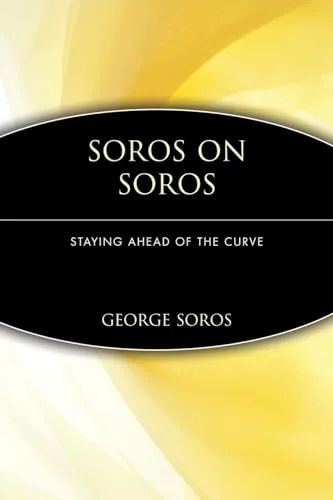
Soros on Soros
Staying Ahead of the Curve
by George Soros, Byron Wien and Krisztina Koenen
- Published
- 1995
- Pages
- 336 pages
- Publisher
- Wiley
- Readers
- 0 members have read this
A book-length interview in which George Soros, then running the Quantum Fund, explains his theory of reflexivity, his 1992 bet against sterling, his costly yen trade and his philanthropy in the former Soviet bloc. It is the most direct look at how the most famous macro trader of his era thought, told in his own words and on his own terms.
George Soros was at the height of his fame in 1995, with one of the best records in the business at his Quantum Fund and more than $1 billion made in 1992 as sterling was forced out of the European Exchange Rate Mechanism. He had refused to cooperate with Robert Slater, whose unauthorized biography appeared the same season, and this book is his own version. It takes the form of extended interviews, two with Byron Wien, Morgan Stanley's investment strategist and a longtime friend, and one with the journalist Krisztina Koenen.
Soros covers his life and the building of Soros Fund Management, explains reflexivity, his idea that market participants' biased perceptions can change the fundamentals they are trying to price, and discusses his wins and losses before turning to his foundations and the future of open society.
The book's value is access: no other source gives this much of Soros explaining himself in 1995. The caveats come from the format. Library Journal noted that the interview structure limits coverage, and Booklist observed that the questions were softly lobbed and the conversation controlled. Readers wanting a balanced portrait should pair it with an independent biography, and those wanting his theory in full should read The Alchemy of Finance.
It suits macro traders, students of currency crises and anyone curious how Soros connected philosophy to position-taking.
- Markets are never simply right. Soros's reflexivity holds that prices reflect participants' biases and can change the fundamentals they discount, which is how booms and busts feed on themselves.
- Look for unsustainable regimes. The sterling trade shows the method: identify a policy or exchange rate that cannot last, and take a position large enough to matter when it breaks.
- Admit mistakes quickly. Soros presents his fallibility as an edge. The yen loss shows that conviction must give way when the market proves you wrong.
- A fund is also a business and a test of nerve. His account of building Soros Fund Management and of the crises that nearly undid him shows that managing the organization, and oneself, is part of the job.
- Macro investing is political economy. His views on Europe, Russia and emerging markets show why a currency trader has to understand governments and institutions as well as balance sheets.
The book is a set of interviews arranged in three parts, followed by an appendix of Soros's selected writings.
- The investor (with Byron Wien). Soros describes growing up in Budapest, surviving the Nazi occupation, studying philosophy in London and failing as a tobacco salesman before drifting into finance. He then tells the story of the Quantum Fund and how he ran Soros Fund Management, including the personal and professional crises that more than once nearly undid him.
- Theory in action. Still with Wien, he sets out reflexivity, his account of how perceptions and reality feed back on each other, and applies it to specific episodes: his $1 billion profit against the British pound in 1992, the fortune he lost speculating on the yen, and the devaluation of the Mexican peso.
- Geopolitics, philanthropy and global change (with Krisztina Koenen). He explains what his foundations were trying to achieve in Eastern Europe and the former Soviet Union, how he came to act as a stateless statesman, and how he sees the future of the United States and of open society.
- Philosophy (with Wien). The last part returns to the ideas behind both his investing and his giving, his view of himself as a failed philosopher, and the gap between his real power and the myth around it.
George Soros Ends the Speculation The outcome [of this book] is a summing up of my life's work. . . As I finish the book, I feel I have succeeded.-George Soros from the Preface Critical praise for Soros on Soros If you have ever wanted to sit down for a candid conversation with a phenomenal financial success, George Soros's book provides the opportunity. You will meet a complex man and a first-rate mind.-Henry A. Kissinger The best expert on Soros is undoubtedly George Soros! After all, who is better equipped to tell us what he really thinks and how he thinks, a matter of some importance given the fact that he has translated a remarkable personal financial success into a truly generous and historically significant effort to promote postcommunist democracy. -Zbigniew Brzezinski The best X-ray of the mind of the master yet. -Barton M. Biggs George Soros brings a lot more to the world of finance than the intuition and nerve of a born trader-and in Soros on Soros he's no longer bashful about telling us about it. A philosopher at heart, George attributes his success at investing to a theory of the interaction of reality and human perception. What really drives the man now, with a personal fortune beyond all personal need, is a different kind of strategic investing-investment to build in Eastern Europe the kind of open societies he came to value in his own life. -Paul A. Volcker Financial guru George Soros is one of the most colorful and intriguing figures in the financial world today. Now in Soros on Soros, readers are given their most intimate and revealing look yet into the life and mind of the one BusinessWeek dubbed, The Man Who Moves Markets. Soros on Soros interweaves financial theory and personal reminiscence, political analysis and moral reflection to offer a compelling portrait of the world (and its markets) according to Soros. In an interview-style narrative with Byron Wien, Managing Director at Morgan Stanley, and with German journalist Krisztina Koenen, Soros vividly describes the genesis of his brilliant financial career and shares his views on investing and global finance, politics and the emerging world order, and the responsibility of power. Speaking with remarkable candor, he traces his progress from Holocaust survivor to philosophy student, unsuccessful tobacco salesman to the world's most powerful and profitable trader and introduces us to the people and events that helped shape his character and his often controversial views. In describing the investment theories and financial strategies that have made him a superstar among money managers (The New York Times), Soros tells the fascinating story of the phenomenally successful Soros Fund Management and its $12 billion flagship, Quantum Fund. He also offers fresh insights into some of his most sensational wins and losses, including a firsthand account of the $1 billion he made going up against the British pound and the fortune he lost speculating on the yen. Plus: Soros's take on the devaluation of the peso and currency fluctuations internationally. He tells of the personal and professional crises that more than once threatened to destroy him and of the personal resources he drew upon to turn defeat into resounding victory. And he explains his motivations for establishing the Soros Foundation and the Open Society Institute through which he worked to build open societies in postcommunist countries in Eastern Europe and the former Soviet Union. Finally, turning his attention to international politics, Soros offers keen insights into the current state of affairs in Russia and the former communist bloc countries and analyzes the reasons behind and likely consequences of the West's failure to properly integrate them into the free world. He also explores the crisis of the ERM and analyzes the pros and cons of investing in a number of emerging markets. Find out what makes one of the greatest financial wizards of this or any age tick. Soros on Soros is a must read for anyone interested in world finance and international policy.
Reader reviews
No reviews yet. Join to write the first one.