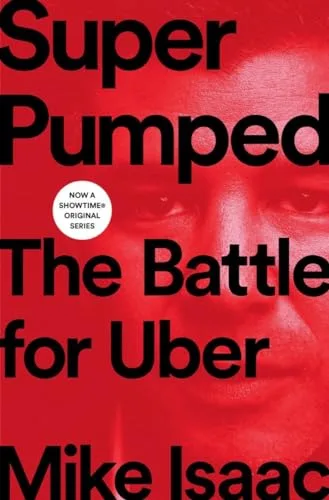
Super Pumped
The Battle for Uber
by Mike Isaac
- Published
- 2019
- Pages
- 408 pages
- Publisher
- W. W. Norton & Company
- Readers
- 1 member has read this
The New York Times reporter who broke many of Uber's worst stories tells how Travis Kalanick built the company by ignoring regulators and rules, and how the same culture got him forced out by his own investors in 2017. A close study of founder control, growth at any cost and what venture capital tolerates while the valuation keeps rising.
Mike Isaac's account of Uber centers on Travis Kalanick, the combative cofounder and chief executive whose appetite for growth drove the company into city after city before regulators could react, and whose tolerance for misconduct inside the company finally cost him his job. Isaac covered Uber for The New York Times through its worst stretch and broke several of the stories in this book, including the Greyball program used to evade officials. He says he drew on interviews with more than 200 people.
For finance readers, the book is a case study in governance. Kalanick held super-voting shares, investors kept funding losses as long as growth held, and only a cascade of scandals in 2017 pushed Benchmark and other backers to act. The book was a New York Times Book Review Editors' Choice and the basis for a 2022 Showtime series.
Reviewers praised the pace and the reporting. One wanted more on what drove Kalanick personally, and another pointed out that drivers, who did the actual work, appear only briefly. Read it alongside No Filter and Bad Blood for a picture of how Silicon Valley money handles founders.
- Valuation hides governance risk. Investors overlooked misconduct and losses for years because each funding round marked the company up, and the reckoning arrived only when scandal threatened the IPO.
- Founder control cuts both ways. Kalanick's voting power and board seats let him move fast, and also made him very hard to remove once he became a liability.
- Regulatory arbitrage has a bill. Launching first and asking permission later won markets, but programs like Greyball turned regulators and prosecutors into lasting adversaries.
- Culture comes from the top. The values Kalanick wrote down, rewarding hustle and confrontation, shaped how managers behaved across hundreds of cities.
- Subsidized growth is not a business model. Uber bought market share with investor money in fights with Lyft and Didi, deferring the question of whether rides could ever turn a profit.
The book moves chronologically from Kalanick's early ventures to his ouster and the company's reset under a new chief executive.
- The making of a founder. Kalanick's file-sharing startup Scour is sued by the entertainment industry, and his second company, Red Swoosh, struggles before a sale. Garrett Camp then brings him into a black-car service called UberCab, which he soon runs as chief executive.
- Growth at any cost. Uber launches city by city, ignores cease-and-desist orders, fights taxi lobbies and subsidizes rides to beat Lyft, while managers are encouraged to act the same way.
- The culture hardens. Kalanick's company values reward aggression, and the book traces Greyball, the Apple episode, the handling of a rape case in India and a party atmosphere at the top.
- The year everything broke. In 2017, the #DeleteUber campaign, Susan Fowler's blog post, a video of Kalanick berating a driver, the Waymo suit and an outside investigation by Eric Holder's firm pile up in months.
- The investors move. Benchmark and other shareholders demand Kalanick's resignation in June 2017, Dara Khosrowshahi takes over, SoftBank buys in, and the company heads toward its 2019 IPO.
A New York Times technology correspondent presents the dramatic rise and fall of Uber, set against the rapid upheaval in Silicon Valley during the mobile era.
In June 2017, Travis Kalanick, the hard-charging CEO of Uber, was ousted in a boardroom coup that capped a brutal year for the transportation giant. Uber had catapulted to the top of the tech world yet for many came to symbolize everything wrong with Silicon Valley. In the tradition of Brad Stone’s Everything Store and John Carreyrou’s Bad Blood, award-winning investigative reporter Mike Isaac’s Super Pumped delivers a gripping account of Uber’s rapid rise, its pitched battles with taxi unions and drivers, the company’s toxic internal culture and the bare-knuckle tactics it devised to overcome obstacles in its quest for dominance.
Based on hundreds of interviews with current and former Uber employees, along with previously unpublished documents, Super Pumped is a pause-resisting story of ambition and deception, obscene wealth and bad behavior that explores how blistering technological and financial innovation culminated in one of the most catastrophic 12-month periods in American corporate history.
Reader reviews
No reviews yet. Join to write the first one.