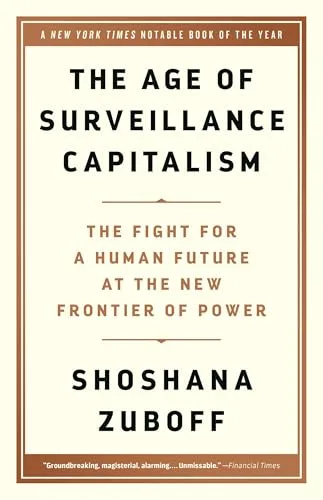
The Age of Surveillance Capitalism
The Fight for a Human Future at the New Frontier of Power
- Published
- 2019
- Pages
- 704 pages
- Publisher
- PublicAffairs
- Readers
- 2 members have read this
Harvard Business School professor Shoshana Zuboff argues that Google, and then Facebook and others, built a new kind of capitalism: they take personal data as a free raw material and sell predictions of what people will do. For anyone valuing ad-driven platforms, it is the most influential critique of how those business models make money and why regulators target them.
Shoshana Zuboff spent decades at Harvard Business School studying how technology changes work and business; her earlier books include In the Age of the Smart Machine (1988). This long book gives a name, surveillance capitalism, to the business model she says Google discovered and others copied: users' behavioral data feeds machine learning, which produces prediction products sold to advertisers. To make those predictions more certain, she argues, firms move from watching behavior to shaping it.
The book was widely praised. The Financial Times called it a masterwork, the New Yorker put it among the best nonfiction of 2019, and Barack Obama listed it as a favorite. It has also drawn serious criticism. Kirkus found it sprawling and repetitive at more than 700 pages. In The Baffler, Evgeny Morozov argued that its theory is circular, and that data extraction follows from the ordinary pursuit of profit and market power rather than from a new logic of capitalism.
It is not an investing book. Analysts covering Alphabet, Meta or ad tech will find it useful for understanding the privacy and antitrust case against those companies, and the political pressure on their margins.
- The user is the source, not the customer. In Zuboff's account, ad-funded platforms take behavioral data from users and sell predictions to advertisers. That is the core of the revenue model.
- Surplus data is the moat. Collecting more data than a service needs, and using it to train prediction systems, is what gives incumbents scale advantages that rivals struggle to copy.
- The economics push toward intervention. Better predictions pay more, and the surest prediction is one you can make come true, which pushes firms from observing behavior to nudging it.
- Regulatory risk is structural. If lawmakers adopt Zuboff's framing, the response targets the business model itself, not just privacy settings. That is a different kind of risk for valuations.
- Read the critics too. Morozov and others argue that data extraction is ordinary profit-seeking and market power, a view that points toward antitrust remedies rather than a ban on prediction markets.
The book has three parts, each built on the last, plus an introduction and conclusion.
- The foundations of surveillance capitalism. After the dot-com crash, Google discovers that the behavioral data left over from search can be turned into targeted advertising. Zuboff traces how the company protected this model with speed, secrecy and political ties, and how a four-stage cycle she calls incursion, habituation, adaptation and redirection let it claim new territory before law caught up.
- The advance of surveillance capitalism. The model expands from the screen into the physical world: smartphones, wearables, smart homes and cars. Zuboff describes the rendering of experience into data, the push into emotions and personality, and the step from predicting behavior to shaping it, with Pokémon Go and Facebook's contagion experiments as examples. She ends the part with a defense of a right to the future tense, the freedom to decide one's own actions.
- Instrumentarian power. Zuboff contrasts this new power with totalitarianism, tracing its intellectual roots to B.F. Skinner's behaviorism and describing the hive-like social life that platforms encourage, especially among young people. She argues for a right to sanctuary from constant observation.
- Conclusion. She calls the whole development a coup from above and urges democratic societies to answer it with new laws and collective action rather than accept it as the inevitable price of digital life.
The challenges to humanity posed by the digital future, the first detailed examination of the unprecedented form of power called surveillance capitalism, and the quest by powerful corporations to predict and control our behavior. In this masterwork of original thinking and research, Shoshana Zuboff provides startling insights into the phenomenon that she has named surveillance capitalism. The stakes could not be higher: a global architecture of behavior modification threatens human nature in the twenty-first century just as industrial capitalism disfigured the natural world in the twentieth. Zuboff vividly brings to life the consequences as surveillance capitalism advances from Silicon Valley into every economic sector. Vast wealth and power are accumulated in ominous new behavioral futures markets, where predictions about our behavior are bought and sold, and the production of goods and services is subordinated to a new means of behavioral modification. The threat has shifted from a totalitarian Big Brother state to a ubiquitous digital architecture: a Big Other operating in the interests of surveillance capital. Here is the crucible of an unprecedented form of power marked by extreme concentrations of knowledge and free from democratic oversight. Zuboff's comprehensive and moving analysis lays bare the threats to twenty-first century society: a controlled hive of total connection that seduces with promises of total certainty for maximum profit--at the expense of democracy, freedom, and our human future. With little resistance from law or society, surveillance capitalism is on the verge of dominating the social order and shaping the digital future--if we let it.
Reader reviews
No reviews yet. Join to write the first one.