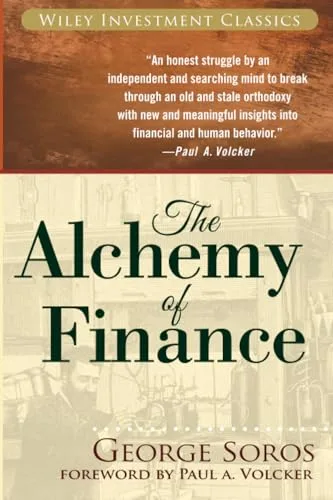
The Alchemy of Finance
by George Soros
- Published
- 1987
- Pages
- 416 pages
- Publisher
- Wiley
- Readers
- 4 members have read this
George Soros sets out his theory of reflexivity, the feedback loop between what market participants believe and what actually happens, and then tests it in public with a trading diary of his Quantum Fund from August 1985 to November 1986. It is the closest thing to a manual from one of the great macro speculators, and still the standard text on boom-bust dynamics.
Soros's core claim is that markets do not drift toward equilibrium. Investors act on biased views, their actions change the fundamentals they are trying to price, and the result is a self-reinforcing boom that eventually turns into a bust. He applies the idea to stocks, currencies, bank lending and the 1980s debt crisis. Then, unusually for an investment book, he records his real positions as they happen, so readers can see where the theory helped him and where it did not.
The book first appeared in 1987, when Soros had run his fund for nearly two decades with returns that put him among the best investors in the world. Wiley's 2003 edition adds a foreword by former Fed chairman Paul Volcker. The diary period was one of his best: the fund's net asset value per share roughly doubled, helped by a large yen position he built the night of the September 1985 Plaza meeting.
Nothing else in the literature shows a top macro manager reasoning in real time about currencies, interest rates and policy. Readers should expect hard going, though. The prose is abstract and the philosophy of science is heavy. Even admirers find it harder going than Soros on Soros, and some treat the political theorizing as a price to pay for the market chapters. Academic critics have argued that the reflexivity model is less novel than Soros claims.
It rewards macro traders, strategists and anyone who has watched a credit cycle or a crowded trade feed on itself.
- Prices shape fundamentals. A rising share price lets a company raise capital and make acquisitions, and a strong currency attracts inflows. Market views are part of the system they describe, not neutral forecasts.
- Booms follow a recognizable sequence. An unrecognized trend gets reinforced by a prevailing bias, survives tests, overshoots and then reverses. Identifying the stage matters more than predicting the endpoint.
- Write the thesis down and keep score. Soros's diary shows him stating a hypothesis, sizing to it and changing course when the market proved him wrong. That discipline is easy to copy.
- Press the bet when the trend confirms. He added to his yen and mark positions as the dollar fell after the Plaza meeting, at times holding currencies worth nearly twice the fund's capital.
- Credit cycles are policy cycles. His account of the debt crisis and Reagan-era imbalances shows how lenders, regulators and governments reinforce one another, which is why macro investors have to model policymakers as well as markets.
The book has five parts, plus forewords, a preface and an introduction.
- Theory. Soros introduces reflexivity, the two-way link between participants' thinking and market reality, and shows how it plays out in the stock market, the currency market and the credit and regulatory cycle.
- Historical perspective. He applies the framework to the international debt problem and the collective system of bank lending that followed it, to Reagan's imperial circle of strong dollar, budget deficits and capital inflows, and to the evolution of the banking system and the consolidation of corporate America.
- The real-time experiment. Starting in August 1985, he keeps a diary of the Quantum Fund's views and positions through a first phase to December 1985, a control period in the first half of 1986, and a second phase ending in November 1986. It records his big currency bets around the Plaza Accord.
- Evaluation. He grades the experiment, considers how far financial alchemy can go, and explains why the social sciences cannot match the predictive power of the natural sciences.
- Prescription. Closing chapters weigh free markets against regulation, propose an international central bank, discuss the paradox of systemic reform and interpret the Crash of 1987.
New chapter by Soros on the secrets to his success along with a new Preface and Introduction. New Foreword by renowned economist Paul Volcker An extraordinary . . . inside look into the decision-making process of the most successful money manager of our time. Fantastic. —The Wall Street Journal George Soros is unquestionably one of the most powerful and profitable investors in the world today. Dubbed by BusinessWeek as the Man who Moves Markets, Soros made a fortune competing with the British pound and remains active today in the global financial community. Now, in this special edition of the classic investment book, The Alchemy of Finance, Soros presents a theoretical and practical account of current financial trends and a new paradigm by which to understand the financial market today. This edition's expanded and revised Introduction details Soros's innovative investment practices along with his views of the world and world order. He also describes a new paradigm for the theory of reflexivity which underlies his unique investment strategies. Filled with expert advice and valuable business lessons, The Alchemy of Finance reveals the timeless principles of an investing legend. This special edition will feature a new chapter by Soros on the secrets of his success and a new Foreword by the Honorable Paul Volcker, former Chairman of the Federal Reserve. George Soros (New York, NY) is President of Soros Fund Management and Chief Investment Advisor to Quantum Fund N.V., a $12 billion international investment fund. Besides his numerous ventures in finance, Soros is also extremely active in the worlds of education, culture, and economic aid and development through his Open Society Fund and the Soros Foundation.
Reader reviews
No reviews yet. Join to write the first one.