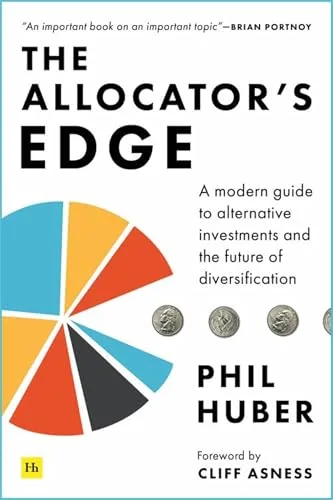
The Allocator's Edge
A Modern Guide to Alternative Investments and the Future of Diversification
by Phil Huber
- Published
- 2021
- Pages
- 324 pages
- Publisher
- Harriman House
- Readers
- 1 member has read this
A wealth manager's field guide to alternatives, written for advisers who suspect the 60/40 portfolio will not deliver what it used to. Phil Huber covers private equity, alternative risk premia, catastrophe reinsurance, real assets, private credit and digital assets, then shows how to choose fund structures, size the positions and keep clients invested when diversifiers lag.
Phil Huber's starting point is that stocks and bonds were both expensive in 2021, so a traditional balanced portfolio faced low expected returns and less protection from bonds. His answer is to move a slice of the portfolio into a broad mix of alternatives, which new fund structures have made far easier for individual investors and their advisers to buy.
Huber wrote the book as chief investment officer of Savant Wealth Management. He is a CFA charterholder and CFP and writes the blog bps and pieces. He later joined Cliffwater, an alternatives investment firm, so readers should keep in mind that he works on the side of the industry that builds these portfolios. AQR's Cliff Asness wrote the foreword.
The book is organized as a reference. Each chapter takes one family of strategies and covers its history, return drivers, risks and how to get access, and the final part covers implementation, including the behavioral problem of owning assets that zig when everything else zags.
The main caveat comes from the foreword itself: Asness says he is more cynical than Huber about private assets, whose dampened reported volatility can flatter them. Advisers, family-office staff and analysts who evaluate alternative funds will get the most from it.
- Starting valuations set expectations. When stocks and bonds are expensive at the same time, a balanced portfolio's expected return is lower than its history suggests. That is the case for looking further afield.
- Alternatives is not one asset class. Private equity, reinsurance, alternative risk premia and private credit have different return drivers and risks. Judge each on its own merits rather than as a single bucket.
- Uncorrelated returns feel bad. Most allocators like the idea of diversification but dislike owning assets that lag when markets boom. Plan for that tracking error before you allocate.
- Structure matters as much as strategy. Liquidity, fees, taxes and reporting differ widely across liquid funds and private vehicles. A good strategy in the wrong wrapper can disappoint.
- Smoothed returns can mislead. Private assets report less volatility partly because they are marked infrequently, a point Asness raises in the foreword. Adjust risk estimates before comparing them with public markets.
The book is laid out in three parts plus appendices that list investment options and further reading.
- Part I, The Allocator's Dilemma. Chapters on the impaired outlook for 60/40 portfolios, why alternatives is such a loaded word, and how asset allocation evolved until alternatives became available to ordinary investors.
- Part II, The Past, Present and Future of Alternative Investments. A tour of the established categories (private equity, hedge funds and other usual suspects), then systematic alternative risk premia, catastrophe reinsurance and insurance-linked securities, real assets that offer cash flow and inflation protection, non-traditional lending, and novel assets where finance meets technology, such as digital assets.
- Part III, Building Better Portfolios. Huber matches each strategy to the right structure, from daily-liquid funds to private vehicles. He then shows how to design a portfolio of diversifiers and closes with the client side: setting expectations and having the courage to hold strategies through long stretches of underperformance.
We are entering a golden age of alternative investments. Alternative asset classes including private equity, hedge funds, catastrophe reinsurance, real assets, non-traditional credit, alternative risk premia, digital assets, collectibles, and other novel assets are now available to investors and their advisors in a way that they never have been before. The pursuit of diversification is not as straightforward as it once was — and the classic 60/40 portfolio may no longer be sufficient in helping investors achieve their most important financial goals. With the ever-present need for sustainable income and risk management, alternative assets are poised to play a more prominent role in investor portfolios. Phil Huber is the Chief Investment Officer for a multi-billion dollar wealth management firm and acts as your guide on a journey through the past, present, and future of alternative investments. In this groundbreaking tour de force, he provides detailed coverage across the spectrum of alternative assets: their risk and return characteristics, methods to gain exposure, and how to fit everything into a balanced portfolio. The three parts of The Allocator’s Edge address: 1. Why the future may present challenges for traditional portfolios; why the adoption of alternatives has remained elusive for many allocators; and why the case for alternatives is more compelling than ever thanks to financial evolution and innovation. 2. A comprehensive survey of the asset classes and strategies that comprise the vast universe of alternative investments. 3. How to build durable and resilient portfolios that harness alternative assets; and how to sharpen the client communication skills needed to establish proper expectations and make the unfamiliar familiar. The Allocator’s Edge is written with the practitioner in mind, providing financial advisors, institutional allocators, and other professional investors the confidence and courage needed to effectively understand, implement, and translate alternatives for their clients. Alternative investments are the allocator’s edge for the portfolios of tomorrow — and this is the essential guide for advisors and investors looking to seize the opportunity.
Reader reviews
No reviews yet. Join to write the first one.