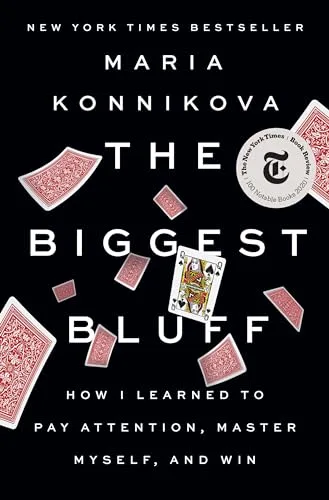
The Biggest Bluff
How I Learned to Pay Attention, Master Myself, and Win
- Published
- 2020
- Pages
- 368 pages
- Publisher
- Penguin Press
- Readers
- 2 members have read this
A psychologist who barely knew the rules of poker talks Hall of Famer Erik Seidel into coaching her and, within a couple of years, wins a major tournament title. Maria Konnikova's memoir uses that apprenticeship to explore luck, skill and decision-making under uncertainty, the same problems every trader and portfolio manager faces.
Konnikova came to poker sideways. A string of bad luck in her own life sent her looking for a way to tell skill from chance, and John von Neumann's work on game theory, which drew on poker, pointed her to the table. With Erik Seidel, one of the game's most respected players, as her mentor, she went from beginner to a title at the PokerStars Caribbean Adventure and a professional career.
She brings unusual credentials to a sports memoir. Konnikova holds a PhD in psychology from Columbia, where she studied under Walter Mischel and wrote her dissertation on self-control, the illusion of control and risky financial decisions. She is also the author of Mastermind and The Confidence Game. The book mixes poker scenes with research on emotion, attention and bias.
Critics were largely enthusiastic. Michael Paterniti in the New York Times Book Review called it an engaging underdog story, and Wray Herbert in the Washington Post praised its honesty and humor. Liv Boeree, a former professional player, wrote in Nature that it is the best portrayal of poker she had read, while noting that it will not teach you how to play specific hands. Dominic Maxwell in The Times found that the science sections sometimes slow the story and that the book sprawls.
For finance readers, it is an entertaining companion to Annie Duke's Thinking in Bets, with more narrative and less framework.
- Separate decisions from outcomes. A good call can lose and a bad one can win. Judge yourself on the quality of the process, not on any single result.
- Beware the illusion of control. People routinely overrate how much of an outcome they can steer, the bias Konnikova studied in risky financial choices before she ever played a hand.
- Emotion is a cost. Tilt, the anger or frustration that follows a bad beat, leads to compounding errors, so recognizing your own state is part of the edge.
- Being too passive is also a mistake. Seidel pushes her to bet and raise when the odds favor it, a reminder that excessive caution can cost as much as recklessness.
- Pay attention to what others are telling you. Much of her edge came from observing opponents closely and noticing how they perceived her, a skill that carries over to negotiating, interviewing and reading counterparties.
The book follows Konnikova's apprenticeship roughly in order, alternating hands at the table with the psychology behind them.
- Why poker. After a run of personal misfortune, she sets out to understand how much of life is chance and how much is choice, and settles on poker as a laboratory because, unlike roulette, it mixes luck with skill.
- Finding a teacher. She persuades Erik Seidel to take her on, despite knowing almost nothing about the game, and starts by learning to count outs, think in probabilities and stop playing too passively.
- Learning to read people and herself. She learns to read opponents and works on her own emotional control, discovering how tilt, fatigue and gender stereotypes at the table distort decisions, and how other players read her.
- Moving up. She works her way from small games through the tournament circuit, starting with her first major event in Monte Carlo in 2017 and aiming at the World Series of Poker in Las Vegas, with all the swings in bankroll and confidence that implies.
- The win and what it means. Her victory at the PokerStars Caribbean Adventure brings her experiment to an unexpected peak, and she reflects on what poker taught her about controlling what you can and accepting what you cannot.
The New York Times bestseller! A New York Times Notable Book The tale of how Konnikova followed a story about poker players and wound up becoming a story herself will have you riveted, first as you learn about her big winnings, and then as she conveys the lessons she learned both about human nature and herself.” —The Washington Post It's true that Maria Konnikova had never actually played poker before and didn't even know the rules when she approached Erik Seidel, Poker Hall of Fame inductee and winner of tens of millions of dollars in earnings, and convinced him to be her mentor. But she knew her man: a famously thoughtful and broad-minded player, he was intrigued by her pitch that she wasn't interested in making money so much as learning about life. She had faced a stretch of personal bad luck, and her reflections on the role of chance had led her to a giant of game theory, who pointed her to poker as the ultimate master class in learning to distinguish between what can be controlled and what can't. And she certainly brought something to the table, including a Ph.D. in psychology and an acclaimed and growing body of work on human behavior and how to hack it. So Seidel was in, and soon she was down the rabbit hole with him, into the wild, fiercely competitive, overwhelmingly masculine world of high-stakes Texas Hold'em, their initial end point the following year's World Series of Poker. But then something extraordinary happened. Under Seidel's guidance, Konnikova did have many epiphanies about life that derived from her new pursuit, including how to better read, not just her opponents but far more importantly herself; how to identify what tilted her into an emotional state that got in the way of good decisions; and how to get to a place where she could accept luck for what it was, and what it wasn't. But she also began to win. And win. In a little over a year, she began making earnest money from tournaments, ultimately totaling hundreds of thousands of dollars. She won a major title, got a sponsor, and got used to being on television, and to headlines like How one writer's book deal turned her into a professional poker player. She even learned to like Las Vegas. But in the end, Maria Konnikova is a writer and student of human behavior, and ultimately the point was to render her incredible journey into a container for its invaluable lessons. The biggest bluff of all, she learned, is that skill is enough. Bad cards will come our way, but keeping our focus on how we play them and not on the outcome will keep us moving through many a dark patch, until the luck once again breaks our way.
Reader reviews
No reviews yet. Join to write the first one.