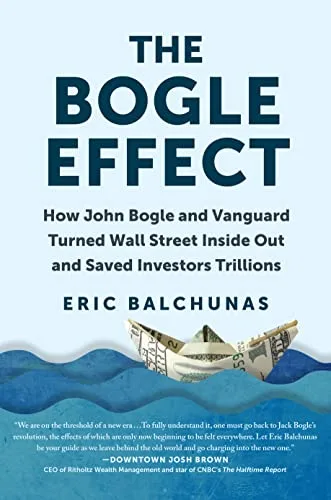
The Bogle Effect
How John Bogle and Vanguard Turned Wall Street Inside Out and Saved Investors Trillions
- Published
- 2022
- Pages
- 336 pages
- Publisher
- Matt Holt Books
- Readers
- 3 members have read this
Bloomberg's senior ETF analyst explains how Jack Bogle's decision to make Vanguard owned by its own fund investors set off a migration of trillions of dollars toward low-cost funds. The book follows that shift through active management, ETFs, financial advice and trading apps. It is less a biography than an account of how one fee structure reshaped the asset management business.
Eric Balchunas's thesis is that Bogle's most important invention was not the index fund but Vanguard's ownership structure. Because the funds own the management company, profits go back to investors as lower fees, and over roughly 50 years that set off what Balchunas calls a great cost migration across the industry. Index funds were the product that rode it.
Balchunas is a senior ETF analyst at Bloomberg Intelligence, a co-creator of Bloomberg's Trillions podcast and ETF IQ show, and the author of The Institutional ETF Toolbox. He spent hours interviewing Bogle in the years before his death in January 2019, and dozens of others who worked with him, lived with him, were influenced by him or disagreed with him.
The book complicates the Boglehead version of its hero. Bogle did not invent indexing; Wells Fargo's researchers got there first. He started as an active manager, Vanguard remains one of the largest active managers, and Bogle disliked ETFs even as they spread his low-cost model. He also rejected the efficient-market hypothesis in favor of what he called the cost matters hypothesis. A Banker on Wheels review rated it 3.6 out of 5 and warned that readers expecting a full biography or an indexing primer will find the scope narrower than that.
It pairs naturally with Robin Wigglesworth's Trillions, which tells the wider history of indexing. Anyone working in asset management, wealth management or product development should read it to understand why fees keep falling.
- Ownership drives price. Because Vanguard's fund investors own the company, its profits are returned as lower fees. That structure, more than any product, explains Vanguard's pricing power.
- Costs are the one sure variable. Bogle's cost matters hypothesis holds that investors cannot control returns but can control what they pay, and lower costs leave more for the investor every year.
- Competitors had to follow. Vanguard's fees forced price cuts across the industry, from active funds to ETFs, which is why fee compression keeps squeezing asset managers' margins.
- Heroes are complicated. Bogle opposed ETFs and smart beta, yet ETFs carried his ideas further than his own funds did. Distinguish the person from the movement named after him.
- Inaction is a strategy. Bogle's biggest gift to investors was persuading them to buy, hold and stop trading. The behavior matters as much as the product.
The book opens with Bogle's story and then turns to his effect on each corner of the investment business.
- The man and the structure. Balchunas covers Bogle's career at Wellington, his ouster, and the founding of Vanguard in 1974 with funds owning the management company, plus the launch of the first index mutual fund in 1976.
- The slow climb. Vanguard's low-cost model takes decades to gain ground. It took about 25 years to reach roughly a tenth of the market before the shift picked up speed.
- Myths and contradictions. He separates Bogle from the legends: indexing's roots at Wells Fargo, Bogle's own active management, his opposition to ETFs and smart beta, and his preference for cost over market-efficiency theory.
- The effect. Chapters follow the cost migration through active managers, ETFs, financial advisers, quant funds, ESG, behavioral finance and trading platforms, using interviews with industry figures.
- What comes next. Balchunas closes on Bogle's lesson about the value of doing nothing, and argues that the shift he set off is still under way.
The index fund wouldn’t be jack without Jack. It was just one innovation fueled by The Vanguard Group founder Jack Bogle’s radical idea in 1975 to make investors the actual owners of his new fund company. While the move was as much to save his job as it was to save investors, the end result was powerful: a fund company for the people and by the people. Bogle began a 50-year process of lowering costs inch by inch, which ultimately unleashed a populist revolt that has saved average investors trillions of dollars while reforming and right-sizing much of the entire financial industry.
Reader reviews
No reviews yet. Join to write the first one.