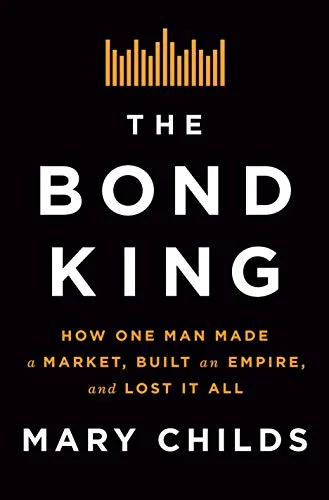
The Bond King
How One Man Made a Market, Built an Empire, and Lost It All
by Mary Childs
- Published
- 2022
- Pages
- 336 pages
- Publisher
- Flatiron Books
- Readers
- 2 members have read this
Mary Childs tells the story of Bill Gross, the former blackjack card counter who co-founded Pimco and built the Total Return Fund into the largest bond fund in the world, and who was then forced out of his own firm in 2014. Along the way she explains how active bond management became one of the most powerful businesses in finance.
Bonds were long the dull side of Wall Street, a business of clipping coupons and holding to maturity. Bill Gross treated them as something to trade, and built Pimco's Total Return Fund into the world's largest bond fund, with close to $300 billion at its peak. Mary Childs follows his career through the internal feud that ended with Mohamed El-Erian's resignation as CEO and Gross's own exit to Janus.
Childs reported on markets for Bloomberg News, the Financial Times and Barron's, covered Gross's settlement with Pimco for the New York Times, and later co-hosted NPR's Planet Money. In the New York Times, James B. Stewart called the book admirably thorough. James Grant praised it in the Wall Street Journal, and Literary Hub put it on its list of the best books of 2022.
The book is as much about corporate culture as about markets. Childs shows a firm famous for its returns that was also secretive, fiercely competitive and dependent on one man's moods. Readers who want a manual on fixed-income investing should look elsewhere. Those who want to understand how a star manager, an asset-management business and a giant bond market shaped one another will find this the most thorough account available.
It is for fixed-income professionals, allocators who choose active managers, and anyone weighing key-person risk at an investment firm.
- Bonds can be traded for total return. Gross's central idea was that fixed income could be managed actively for price gains as well as income. That idea reshaped how institutions and individuals invest in bonds.
- Key-person risk is real. When a firm's brand and culture rest on one manager, his decline or departure can set off very large withdrawals almost overnight.
- Size changes the game. At hundreds of billions of dollars, a fund's trades move markets, and its edge can come from scale, access and structure as much as forecasting.
- Proximity to policy is an asset. Pimco's dealings with Washington and its readiness for government action around the 2008 crisis show how much money there is in understanding the state's role in credit markets.
- Culture shows up in returns, then in outflows. A secretive, high-pressure workplace can produce results for years, until the same dynamics drive out talent and clients.
The book follows Gross's life and Pimco's history in rough chronological order, from founding to rupture.
- The gambler. A 1966 Duke graduate, Gross played blackjack professionally in Las Vegas for a stretch, counting cards, then served in the Navy and earned an MBA at UCLA in 1971.
- Building Pimco. At Pacific Mutual he helped start a fixed-income unit in 1971 that began with about $12 million. Gross and his partners turned bonds into an actively traded asset class and built a culture known for performance and secrecy.
- The empire. The Total Return Fund grew into the largest bond fund in the world, Allianz bought Pimco in 2000, and Gross became a media fixture whose monthly Investment Outlook letters moved markets.
- Crisis and influence. During and after the 2008 financial crisis, Pimco profited from its bets around Fannie Mae and Freddie Mac and worked closely with policymakers, while its chief executive Mohamed El-Erian became a prominent public voice.
- The fall. Poor performance, outflows and open conflict at the top led to El-Erian's departure in 2014 and Gross's exit to Janus later that year. His lawsuit against Pimco and Allianz settled in 2017, and he retired from managing money in 2019.
From the host of NPR’s Planet Money, the deeply-investigated story of how one visionary, ruthless investor changed American finance forever. Before Bill Gross was known among investors as the Bond King, he was a gambler. In 1966, a fresh college grad, he went to Vegas armed with his net worth ($200) and a knack for counting cards. $10,000 and countless casino bans later, he was hooked: so he enrolled in business school. The Bond King is the story of how that whiz kid made American finance his casino. Over the course of decades, Bill Gross turned the sleepy bond market into a destabilized game of high risk, high reward; founded Pimco, one of today’s most powerful, secretive, and cutthroat investment firms; helped to reshape our financial system in the aftermath of the Great Recession—to his own advantage; and gained legions of admirers, and enemies, along the way. Like every American antihero, his ambition would also be his undoing. To understand the winners and losers of today’s money game, journalist Mary Childs argues, is to understand the bond market—and to understand the bond market is to understand the Bond King.
Reader reviews
No reviews yet. Join to write the first one.