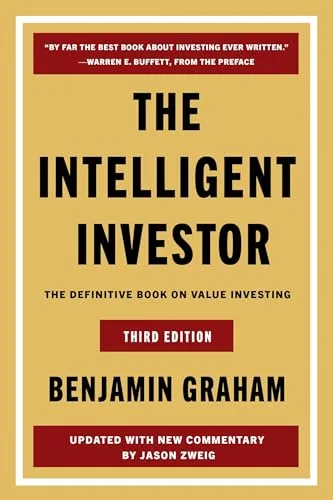
The Intelligent Investor
The Definitive Book on Value Investing
- Published
- 1949
- Pages
- 640 pages
- Publisher
- Harper Business
- Readers
- 10 members have read this
Benjamin Graham's 1949 guide to investing without losing your shirt: treat stocks as stakes in businesses, demand a margin of safety, and use Mr. Market's mood swings instead of joining them. Warren Buffett calls it the best book on investing ever written, and the current edition pairs Graham's text with Jason Zweig's chapter-by-chapter commentary.
Benjamin Graham taught at Columbia, co-wrote Security Analysis with David Dodd in 1934 and ran the Graham-Newman partnership, where a young Warren Buffett worked for him. The Intelligent Investor, first published in 1949, was his book for the non-professional; the fourth revised edition of 1973 is the text in print today.
The book's central idea is the distinction between investment and speculation. An investment, in Graham's sense, protects principal and promises an adequate return after thorough analysis; anything else is speculation. From there come his best-known ideas: Mr. Market, the manic-depressive business partner whose daily price quotes you may use or ignore, and the margin of safety, which Graham calls the central concept of investment.
Much of Graham's detail has dated. His case studies come from the 1960s and early 1970s, and value investing in his mold has lagged the broad market for much of the past 15 years, a point Zweig himself acknowledges. That is why the commentary matters. Jason Zweig, a Wall Street Journal columnist, first added notes in 2003, and for the 2024 third edition he wrote new commentary for every chapter. Buffett contributes the introduction and an appendix.
It is the foundation text of value investing and the right first book for anyone managing their own money or starting in equity research.
- Know whether you are investing or speculating. Graham's test is analysis, safety of principal and an adequate return. If a purchase fails it, call it speculation and size it accordingly.
- Mr. Market works for you. Prices are offers from a moody partner, not information you must act on. Buy from him when he panics and sell to him when he is euphoric, or ignore him.
- Insist on a margin of safety. Pay well below a conservative estimate of value so that errors, bad luck and bad forecasts do not cause permanent loss.
- Be honest about which investor you are. Most people are defensive and should keep things simple, diversified and cheap. Only those willing to do the work should try to beat the market.
- Your own behavior is the main risk. Graham warns that an investor's own emotions are usually the biggest threat to returns, a point Zweig illustrates with the crowd-chasing of recent bubbles.
Graham's 20 chapters move from philosophy to portfolio policy to stock analysis, and in this edition each is followed by a Zweig commentary that applies it to today's markets.
- Investment versus speculation. The opening chapters define the terms, discuss inflation and review a century of stock-market history to set realistic expectations.
- Portfolio policy. Graham lays out how a defensive investor should split money between bonds and stocks and pick common stocks, then what an enterprising investor should avoid and pursue.
- The investor and market fluctuations. Chapter 8 introduces Mr. Market and explains how to treat price swings as opportunities rather than verdicts. Further chapters cover investment funds and advisers.
- Security analysis for the lay investor. Graham explains how to read per-share earnings, compares four listed companies and gives stock-selection criteria for both types of investor, plus a chapter on convertibles and warrants.
- Case histories. Four extremely instructive case histories and a comparison of eight pairs of companies show how markets misprice firms that look similar.
- Shareholders and margin of safety. A chapter on dividend policy and management precedes the final chapter, which presents the margin of safety as the core of sound investing.
Reader reviews
No reviews yet. Join to write the first one.