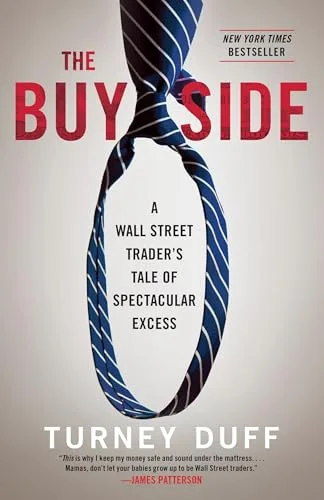
The Buy Side
A Wall Street Trader's Tale of Spectacular Excess
by Turney Duff
- Published
- 2013
- Pages
- 320 pages
- Publisher
- Crown Currency
- Readers
- 2 members have read this
A former Galleon Group trader's memoir of rising from a Morgan Stanley trainee to one of the Street's most powerful healthcare traders, and of the drug-fueled after-hours culture that came with it. It shows plainly how hedge funds' commission dollars buy information and favors from the sell side, and what that world cost the author personally.
Turney Duff started as a Morgan Stanley trainee, got his first seat as a trader at the Galleon Group, the hedge fund run by Raj Rajaratnam, who was later convicted of insider trading, and later became a prominent healthcare trader earning a seven-figure income. His memoir shows how the buy side works: funds that generate large commissions are courted by brokers eager to please, and the trader's job includes extracting as much information as possible from those relationships. Its second half is a story of addiction, collapse and the decision to walk away.
Bryan Burrough, reviewing it for The New York Times, compared it to Liar's Poker and Bright Lights, Big City, said it outdid both as spectacle and called Duff a fine wordsmith. Kirkus admired the author's honesty about his personal chaos but found the portrait of daily life inside a hedge fund the most absorbing part. Readers should know that Duff was a trader, not a portfolio manager, so the book says little about investment strategy.
For young people on trading desks or in sales, it is a frank picture of how commissions, entertainment and information flow between the sell side and the buy side, and of the personal risks of that culture.
- Commissions buy access. Hedge funds that generate large trading commissions receive information, favors and entertainment from brokers. Know what you are paying for in every trade.
- Information edges have limits. Galleon's culture of gathering tips shows how easily the hunt for an edge slides toward illegal territory, as the later insider-trading case proved.
- The buy side holds the power. Traders who direct order flow command the sell side's attention, and that imbalance shapes behavior on both sides.
- Burnout is a business risk. Long hours, pressure and an after-hours culture of excess damaged Duff's health and judgment. Firms ignore that at their peril.
- Money does not fill the gap. Duff's seven-figure pay did not prevent his collapse. The book is a reminder to decide what you want from a career before the career decides for you.
The memoir moves chronologically from Duff's arrival on Wall Street to his exit, with the professional and personal stories rising and falling together.
- Starting out. A small-town kid from Maine, Duff talks his way into a trainee job at Morgan Stanley and learns the pecking order of the trading floor, where buy-side clients are the alphas and sell-side brokers aim to please.
- Galleon. At Rajaratnam's Galleon Group from 1999, Duff finally trades on his own. He is encouraged to befriend brokers and gather every tip he can, while puzzling over how the firm made so much money so fast.
- The top of the game. At Argus Partners and then J.L. Berkowitz he becomes one of the Street's most powerful healthcare traders, with brokers competing for his commissions with dinners, parties and worse.
- The fall. His nightlife escalates into serious drug addiction, and the strain shows in his work, relationships and health.
- Walking away. Duff decides to leave a seven-figure income behind before the life destroys him, and looks back on the culture that rewarded his excesses.
Reader reviews
No reviews yet. Join to write the first one.