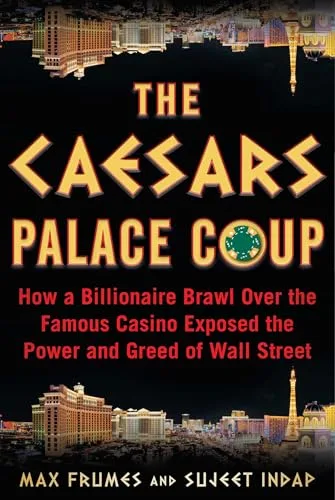
The Caesars Palace Coup
How a Billionaire Brawl Over the Famous Casino Exposed the Power and Greed of Wall Street
by Max Frumes and Sujeet Indap
- Published
- 2021
- Pages
- 352 pages
- Publisher
- Diversion Books
- Readers
- 5 members have read this
The inside story of the fight over Caesars Entertainment after Apollo and TPG's roughly $30 billion buyout went bad. The private equity owners used aggressive financial engineering to protect their stake, distressed-debt funds fought back in court, and the 2015 Chapter 11 case became one of the most contested restructurings of the era. It is a working education in how creditor fights are won and lost.
Max Frumes and Sujeet Indap tell how Apollo and TPG's debt-laden buyout of Caesars turned into a fight with hedge funds holding the operating company's bonds, which came to see Apollo's maneuvers as an attempt to strip assets from under them, and how that fight played out in bankruptcy court.
Indap is US editor of the Lex column at the Financial Times and a former investment banker. Frumes has covered leveraged finance and bankruptcy for The Deal, S&P's Leveraged Commentary & Data and a bankruptcy trade publication he helped found. Bloomberg's Matt Levine called the book the Barbarians at the Gate of distressed debt. The Wall Street Journal praised its behind-the-scenes portraits of the lawyers, bankers and fund managers who now dominate big bankruptcy cases.
Publishers Weekly found it thorough but dry, since most of the action happens in court filings and conference rooms rather than on the casino floor. That is also why it is useful. Few books explain intercreditor fights, guarantees and fraudulent-conveyance claims in this much practical detail.
It is essential for leveraged finance, restructuring and private equity professionals, and for law and business students who want a real case.
- Leverage magnifies cyclical risk. A heavily indebted buyout of a consumer-discretionary business has little room for error when a recession hits, however strong the brand.
- Read the documents. Covenants, guarantees and intercreditor terms decided who could move assets and who could sue. Many of the fights were won or lost on legal drafting done years earlier.
- Liability management has limits. Moving assets to affiliates can buy time, but it invites fraudulent-conveyance claims that can cost sponsors more than they saved.
- Distressed investing is a negotiation. The returns of hedge funds and creditor groups depended on forming coalitions, timing litigation and holding out, as much as on valuation.
- Judges and examiners change the odds. An independent examiner's report on the pre-bankruptcy transfers, and the court's rulings on the creditors' lawsuits, reshaped every party's bargaining position.
The book moves from the casino's founding to the buyout, the bankruptcy and the final settlement.
- The empire. Jay Sarno opens Caesars Palace in 1966. Decades later, Gary Loveman's data-driven Harrah's assembles the largest gaming company in the United States.
- The buyout. Apollo and TPG agree in 2006 to buy Harrah's in one of the largest leveraged buyouts of the boom, piling debt onto a cyclical business just before the financial crisis.
- Financial engineering. As revenue falls, the sponsors run a long series of exchanges, extensions and asset transfers to affiliated entities to buy time and protect their equity. Junior creditors come to see these moves as an effort to strip the operating company's best assets.
- War in court. The operating company files for Chapter 11 in 2015. Distressed-debt funds, first-lien and junior creditors, the examiner and the sponsors fight over fraudulent-transfer claims and parent guarantees in a contest of leverage and nerve.
- Settlement and aftermath. The sponsors agree to a costly deal, the company emerges in 2017 with its real estate spun into a REIT, and Caesars is sold to Eldorado Resorts in a deal agreed in 2019. The authors weigh who won and what the case changed in restructuring practice.
From the Vegas Strip to Wall Street boardrooms and Federal courts, modern corporate titans collide in this explosive true story of how private equity firm Apollo Global Management's thirty-billion-dollar buyout of Caesars Entertainment turned into unprecedented bankruptcy of the gaming empire. In the bestselling tradition of Michael Lewis's The Big Short and Ben Mezrich’s Bringing Down the House, journalists Max Frumes and Sujeet Indap deliver a page-turning account of the spectacular 2015 bankruptcy of America’s biggest gaming empire, Caesars Entertainment. Backdropping this thrilleresque narrative are the jokers, kings, and called bluffs at the center of the modern distressed-debt-investing world. Distressed-debt investing, dubbed vulture investing” in its infancy, is the buying of debt of struggling corporations, institutions, and even cities or countries—and making a windfall profit on a turnaround. In covering the extraordinary Caesars case, The Caesars Palace Coup presents a riches-to-rags adventure unlike any other as it appraises the battling billionaires who held the cards in 2008's leveraged buyout. This wild coup’s scope spans courtrooms, levels of government, academic halls, and ultimately involves an entire corrupt system of liar’s poker. Readers will discover just how rivetingly sophisticated—and underhanded—the high-stakes finance battleground has become. Authors Frumes and Indap, experienced business journalists, illuminate the major players and businesspeople at the tipping points of almost every major vulture’s turnaround in recent history. The Caesars Palace Coup reveals the cut-throat, multilevel competition enacted by powerful investors used to getting their own way. And goes one step further to consider the devastating, true impact of the upheaval wrought by their actions. It’s a treacherous game. Roll the dice.
Reader reviews
No reviews yet. Join to write the first one.