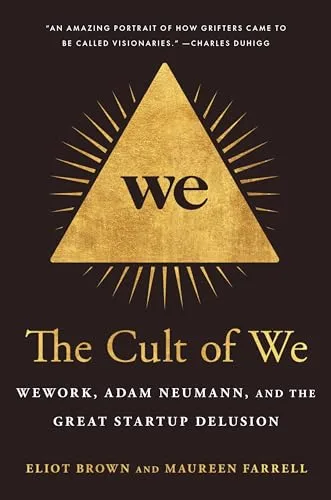
The Cult of We
WeWork, Adam Neumann, and the Great Startup Delusion
by Eliot Brown and Maureen Farrell
- Published
- 2021
- Pages
- 464 pages
- Publisher
- Crown
- Readers
- 2 members have read this
Two Wall Street Journal reporters who covered the company tell the full story of Adam Neumann's office-subletting company. It reached a $47 billion private valuation on SoftBank's money and lost most of it when its 2019 IPO filing went public. The book is a case study in what happens when cheap capital, founder control and a tech-company story meet real estate economics.
WeWork rented long-term office leases and sublet desks on short terms, which is a real estate business with thin margins and large fixed obligations. Adam Neumann persuaded investors it was a technology company that might one day be worth trillions. Eliot Brown and Maureen Farrell, who covered WeWork and its investors for the Wall Street Journal through the boom and the failed IPO, show how venture investors, bankers and above all Masayoshi Son of SoftBank kept raising the price. The book draws on that reporting and adds many details that had not been published before.
Publishers Weekly praised the pacing and the sharp prose, which keep the story from reading like a dry postmortem. Much of that appeal comes from the spectacle of private jets and parties, so readers who want a detailed analysis of flexible-office economics will find less of it. Reeves Wiedeman's Billion Dollar Loser (2020) covers similar ground. This book puts particular weight on the investors and bankers who financed Neumann.
It is for venture and growth investors, IPO bankers, and anyone who has to decide whether a high-growth company is really a tech business.
- Check the business model behind the label. Calling a company tech does not change its economics. WeWork's long leases and short-term customers made it a leveraged real estate operator, whatever its multiple.
- Private marks are not prices. Each round at a higher valuation was set by a small group of motivated buyers. The public market priced the company very differently within weeks of seeing its filing.
- One giant investor can distort a market. SoftBank's checks let WeWork outspend competitors and delay any test of its unit economics.
- Governance red flags are visible early. Super-voting shares, related-party leases and payments to the founder were all disclosed in the S-1 and should have weighed on the valuation.
- Banks chase fees and relationships. The book shows major banks courting Neumann for lending and IPO business, which bred optimism instead of scrutiny.
The book follows WeWork's arc from a single Manhattan floor to a failed IPO and SoftBank's rescue.
- Origins. Neumann leaves the Israeli Navy, moves to New York and tries to sell baby clothes. With Miguel McKelvey he starts Green Desk, a Brooklyn coworking business, then sells it and founds WeWork in 2010.
- The pitch. WeWork expands quickly, and Neumann recasts a subletting business as a community and technology platform. Blue-chip venture investors and banks, including JPMorgan, join in, and the valuation climbs from round to round.
- SoftBank's money. Masayoshi Son commits billions through SoftBank and its Vision Fund, starting with a $4.4 billion deal in 2017. That money funds WeGrow, a long run of acquisitions and side investments, and a valuation of $47 billion by early 2019, while losses reach about $2 billion a year.
- The S-1. The August 2019 IPO filing reveals the losses, the lease obligations, Neumann's voting control and his related-party deals, including a $5.9 million payment for the We trademark. Investors balk, the offering is pulled and Neumann resigns as CEO.
- Aftermath. SoftBank takes control in a package that pays Neumann close to $1.7 billion, staff are laid off, and the authors ask what the episode says about a financial system flush with cheap capital.
A juicy investigation into one of Silicon Valley’s most-hyped fallen unicorns.”—Time (Best Books of Summer 2021) The definitive inside story of WeWork, its audacious founder, and what its epic unraveling says about a financial system drunk on the elixir of Silicon Valley innovation—from the Wall Street Journal correspondents (recently featured in the WeWork Hulu documentary) whose scoop-filled reporting hastened the company’s downfall. WeWork would be worth $10 trillion, more than any other company in the world. It wasn’t just an office space provider. It was a tech company—an AI startup, even. Its WeGrow schools and WeLive residences would revolutionize education and housing. One day, mused founder Adam Neumann, a Middle East peace accord would be signed in a WeWork. The company might help colonize Mars. And Neumann would become the world’s first trillionaire. This was the vision of Neumann and his primary cheerleader, SoftBank’s Masayoshi Son. In hindsight, their ambition for the company, whose primary business was subletting desks in slickly designed offices, seems like madness. Why did so many intelligent people—from venture capitalists to Wall Street elite—fall for the hype? And how did WeWork go so wrong? In little more than a decade, Neumann transformed himself from a struggling baby clothes salesman into the charismatic, hard-partying CEO of a company worth $47 billion—on paper. With his long hair and feel-good mantras, the six-foot-five Israeli transplant looked the part of a messianic truth teller. Investors swooned, and billions poured in. Neumann dined with the CEOs of JPMorgan and Goldman Sachs, entertaining a parade of power brokers desperate to get a slice of what he was selling: the country’s most valuable startup, a once-in-a-lifetime opportunity and a generation-defining moment. Soon, however, WeWork was burning through cash faster than Neumann could bring it in. From his private jet, sometimes clouded with marijuana smoke, he scoured the globe for more capital. Then, as WeWork readied a Hail Mary IPO, it all fell apart. Nearly $40 billion of value vaporized in one of corporate America’s most spectacular meltdowns. Peppered with eye-popping, never-before-reported details, The Cult of We is the gripping story of careless and often absurd people—and the financial system they have made.
Reader reviews
No reviews yet. Join to write the first one.