
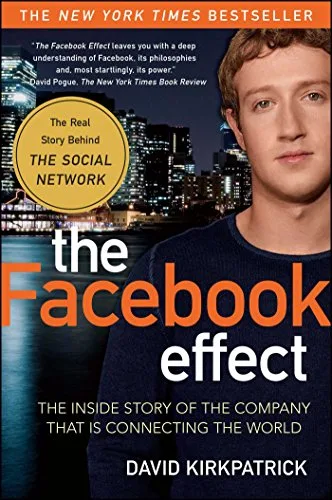
The Facebook Effect
The Inside Story of the Company That Is Connecting the World
- Published
- 2010
- Pages
- 384 pages
- Publisher
- Simon & Schuster
- Readers
- 0 members have read this
A Fortune technology editor with rare cooperation from Mark Zuckerberg tells Facebook's story from a Harvard dorm room to roughly 500 million users in 2010. It is the best early account of how the company grew, how it was financed, why Zuckerberg turned down buyers and how it learned to make money, though written by an admirer before the company went public.
David Kirkpatrick, then the senior editor for internet and technology at Fortune, had extensive access to Facebook and to Zuckerberg, and he uses it to write a detailed corporate history of the company's early years, ending when the site had about half a billion users.
For finance readers the most useful thread is how the company was funded and controlled. Kirkpatrick makes clear that Zuckerberg repeatedly chose growth over short-term profit and kept control while doing so, which explains a great deal about the company Facebook later became.
Publishers Weekly judged it more informative and credible than Ben Mezrich's The Accidental Billionaires, the basis for The Social Network. Kirkus called it comprehensive but one-sided and bland, faulting its admiration for Zuckerberg and noting that it promises more analysis of Facebook's social effects than it delivers; TechCrunch's Michael Arrington called it a wonderfully biased history. It was shortlisted for the FT and Goldman Sachs Business Book of the Year in 2010.
It ends years before the IPO, Cambridge Analytica and the rename to Meta, so read it as a record of the startup years, not a verdict on the company.
- Growth first, monetization later. Zuckerberg repeatedly put user growth ahead of revenue, a bet that looked reckless until advertising caught up with the audience.
- Control is a deal term. He took outside money while keeping the decision rights to refuse buyers, a structure every investor in founder-led tech has had to price since.
- Valuation can be strategic. The Microsoft investment set a headline price that reflected the bidding contest with Google as much as any cash flow model.
- Network effects create winner-take-most markets. Facebook overtook Friendster and MySpace by growing in dense communities, starting with college campuses, rather than chasing raw sign-ups.
- Privacy is a business risk. User revolts over features such as News Feed showed early that the company's core asset, personal data, was also its main liability.
After a prologue on what the author calls the Facebook effect, the book moves chronologically through the company's first six years, then steps back to assess its business and influence.
- Harvard and Palo Alto (2004). Zuckerberg launches TheFacebook from his dorm, spreads it to other colleges and moves to Palo Alto for the summer, with a chapter placing it in the history of social networking.
- Investors and becoming a company (2004-2005). Early backers arrive, the founders' roles are sorted out and the company builds a real organization through the fall of 2005.
- The CEO, privacy and 2006. Zuckerberg grows into the job, users revolt over the News Feed and privacy, and he turns down acquisition offers as the site opens beyond students.
- Platform and the $15 billion deal. Facebook opens its platform to outside developers and sells a stake to Microsoft at a valuation of $15 billion.
- Making money and the wider effects. The closing chapters cover the advertising model, Facebook's role in politics and activism around the world, its effect on institutions and the company's future.
In little more than half a decade, Facebook has gone from a dorm-room novelty to a company with 500 million users. It is one of the fastest growing companies in history, an essential part of the social life not only of teenagers but hundreds of millions of adults worldwide. As Facebook spreads around the globe, it creates surprising effects—even becoming instrumental in political protests from Colombia to Iran.
Veteran technology reporter David Kirkpatrick had the full cooperation of Facebook’s key executives in researching this fascinating history of the company and its impact on our lives. Kirkpatrick tells us how Facebook was created, why it has flourished, and where it is going next. He chronicles its successes and missteps, and gives readers the most complete assessment anywhere of founder and CEO Mark Zuckerberg, the central figure in the company’s remarkable ascent. This is the Facebook story that can be found nowhere else.
How did a nineteen-year-old Harvard student create a company that has transformed the Internet and how did he grow it to its current enormous size? Kirkpatrick shows how Zuckerberg steadfastly refused to compromise his vision, insistently focusing on growth over profits and preaching that Facebook must dominate (his word) communication on the Internet. In the process, he and a small group of key executives have created a company that has changed social life in the United States and elsewhere, a company that has become a ubiquitous presence in marketing, altering politics, business, and even our sense of our own identity. This is the Facebook Effect.
Reader reviews
No reviews yet. Join to write the first one.