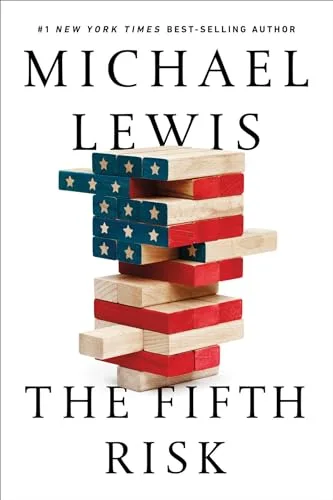
The Fifth Risk
- Published
- 2018
- Pages
- 221 pages
- Publisher
- W. W. Norton & Company
- Readers
- 3 members have read this
Michael Lewis looks at what the federal government actually manages, from the nuclear arsenal to weather data to farm loans, and what happened when the 2016 Trump transition ignored it. For anyone who prices risk, it is a lesson in how the dull, unglamorous risk of bad project management can matter more than the dramatic ones.
The book grew out of Lewis's Vanity Fair reporting on the handover from the Obama administration to the Trump administration, when career staff at the Departments of Energy, Agriculture and Commerce prepared detailed briefings that, in many offices, nobody came to hear. Lewis uses that silence to ask a basic question: what do these agencies do, and what is at risk when the people put in charge don't care to learn?
He answers through profiles of civil servants. The title comes from the five risks that most worried John MacWilliams, Energy's first chief risk officer; the fifth was project management, the slow failure that nobody sees until it is too late.
This is Lewis in a more political register than in Moneyball or The Big Short, and it is shorter and less narrative than either. In the Washington Post, Carlos Lozada found him at times too starry-eyed about federal workers, and the NPR reviewer felt the run of admiring profiles sometimes wanders. Kirkus named it one of the best books of 2018.
Finance readers will find two things worth having: a clear account of how much public data (weather, crop, census) private businesses depend on, and a working definition of operational risk that any risk manager will recognize.
- The fifth risk is the boring one. MacWilliams ranked project management alongside nuclear accidents and grid attacks. Slow, invisible failures in execution are often the risks that end up doing the most damage.
- Transitions are when institutions are weakest. Briefings that nobody reads, posts left empty and lost institutional memory are a failure of key-person risk that applies to companies as much as to governments.
- Much of the economy runs on public data. Weather forecasts, crop reports and census counts are free inputs that private firms build products on. When their quality falls, markets and businesses carry the cost.
- Agencies are often financial institutions. Agriculture's lending and insurance programs, and Energy's role as a long-horizon manager of liabilities, show how much credit and risk the federal government carries on its books.
- Willful ignorance is its own kind of risk. Lewis's charge is less about ideology than about leaders who decline to learn the business they are running, a warning that applies to any board or new management team.
The book opens on election night 2016 and then works through three departments, each through the eyes of the people who ran it.
- Lost in Transition. Chris Christie builds a transition plan for Trump, then Steve Bannon fires him and the work is thrown out. Agencies that have prepared briefings wait for visitors who come late, few in number, or not at all.
- Tail Risk. The Department of Energy is mostly a nuclear agency: it maintains the weapons stockpile, cleans up nuclear waste and guards against catastrophe. John MacWilliams explains his five risks, ending with the quiet danger of mismanaged long-term projects.
- People Risk. The Department of Agriculture turns out to be largely a lender, insurer and anti-hunger agency, running school lunches and food stamps and making rural loans. Lewis looks at what happens when political loyalists without relevant backgrounds are put in charge of those programs.
- All the President's Data. The Commerce Department collects much of the country's data, including the census and the National Weather Service. Lewis profiles Kathy Sullivan and D.J. Patil and examines the nomination of AccuWeather chief Barry Myers to lead NOAA, the agency whose free data his company repackages and sells.
The 2019 paperback, subtitled Undoing Democracy, adds new material, including a profile of Art Allen, for decades the lone oceanographer in the Coast Guard's search-and-rescue division.
New York Times Bestseller What are the consequences if the people given control over our government have no idea how it works? The election happened, remembers Elizabeth Sherwood-Randall, then deputy secretary of the Department of Energy. And then there was radio silence. Across all departments, similar stories were playing out: Trump appointees were few and far between; those that did show up were shockingly uninformed about the functions of their new workplace. Some even threw away the briefing books that had been prepared for them. Michael Lewis’s brilliant narrative takes us into the engine rooms of a government under attack by its own leaders. In Agriculture the funding of vital programs like food stamps and school lunches is being slashed. The Commerce Department may not have enough staff to conduct the 2020 Census properly. Over at Energy, where international nuclear risk is managed, it’s not clear there will be enough inspectors to track and locate black market uranium before terrorists do. Willful ignorance plays a role in these looming disasters. If your ambition is to maximize short-term gains without regard to the long-term cost, you are better off not knowing those costs. If you want to preserve your personal immunity to the hard problems, it’s better never to really understand those problems. There is upside to ignorance, and downside to knowledge. Knowledge makes life messier. It makes it a bit more difficult for a person who wishes to shrink the world to a worldview. If there are dangerous fools in this book, there are also heroes, unsung, of course. They are the linchpins of the system—those public servants whose knowledge, dedication, and proactivity keep the machinery running. Michael Lewis finds them, and he asks them what keeps them up at night.
Reader reviews
No reviews yet. Join to write the first one.