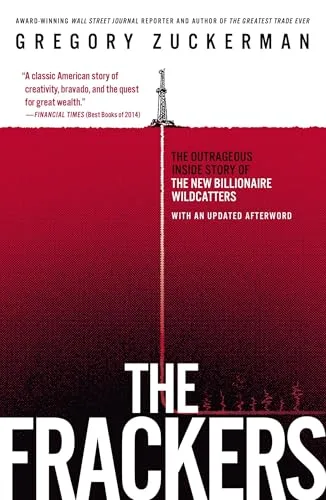
The Frackers
The Outrageous Inside Story of the New Billionaire Wildcatters
- Published
- 2013
- Pages
- 448 pages
- Publisher
- Portfolio
- Readers
- 2 members have read this
Wall Street Journal reporter Gregory Zuckerman tells how a handful of independent wildcatters, not Exxon or Chevron, cracked shale with fracking and horizontal drilling and turned American oil and gas output around. A character-driven account of boom, leverage and bust that energy investors and credit analysts will recognize.
Zuckerman, a longtime Wall Street Journal reporter and former Heard on the Street columnist who had written The Greatest Trade Ever about John Paulson, tells how a handful of independents revived American oil and gas when most experts considered domestic drilling a dead end. He follows wildcatters such as George Mitchell, Aubrey McClendon, Harold Hamm and Charif Souki, and had access to many of the principals.
He is as interested in the financing as the engineering. The book shows how leverage, land leases and Wall Street capital drove the boom, and how falling gas prices that the boom itself created wiped out several of the founders. Publishers Weekly noted that several became billionaires and most still lost the companies they founded.
The main caveat is environmental. The same review faulted the book for giving little space to fracking's environmental effects, which Zuckerman addresses mainly in an afterword. Readers looking for geology or the role of service companies will find it thin.
Read it for the people and the capital cycle behind the shale revolution, which still shapes energy markets.
- Innovation came from the fringe. Independents with little capital and high risk tolerance, not the majors, made shale work, which is a pattern worth remembering in any industry.
- Success can create its own bust. The surge in supply that made the wildcatters rich drove gas prices down and left heavily borrowed producers exposed.
- Leverage decides who keeps the prize. Several founders built enormous value and still lost their companies because they financed growth with debt and complex deals.
- Commodity investing is a capital cycle. High prices draw in capital and technology, output rises, prices fall, and the weakest balance sheets fail first.
- Policy and environmental risk are part of the trade. Water, seismic and disclosure concerns can change the economics of an energy play as much as geology does.
The book moves from obscure experiments to a national boom and its financial hangover.
- The doubters' consensus. Zuckerman sets the scene in a declining American oil patch where the majors had largely moved overseas and peak-oil predictions dominated.
- Mitchell's long bet. George Mitchell's company keeps experimenting on the Barnett Shale in Texas through the 1980s and 1990s until cheaper fracturing techniques make the gas flow economically.
- The land rush. McClendon and Ward turn Chesapeake into a leasing machine financed by debt and Wall Street, and the shale model spreads to new basins.
- Oil in North Dakota. Harold Hamm and others apply the techniques to oil in the Bakken, and production surges.
- Glut and reckoning. Gas prices collapse under the new supply, overextended companies stumble, founders lose control, and Charif Souki raises billions at Cheniere Energy to export the surplus as liquefied natural gas.
- Afterword. Zuckerman weighs the environmental risks and argues for disclosure of fracking fluids and stronger regulation.
A lively, exciting, and definitely thought-provoking book.” —Booklist Things looked grim for American energy in 2006, but a handful of wildcatters were determined to tap massive deposits of oil and gas that giants like Exxon and Chevron had ignored. They risked everything on a new process called fracking. Within a few years, they solved America’s dependence on imported energy, triggered a global environmental controversy, and made and lost astonishing fortunes. No one understands the frackers—their ambitions, personalities, and foibles—better than Wall Street Journal reporter Gregory Zuckerman. His exclusive access drives this dramatic narrative, which stretches from North Dakota to Texas to Wall Street.
Reader reviews
No reviews yet. Join to write the first one.